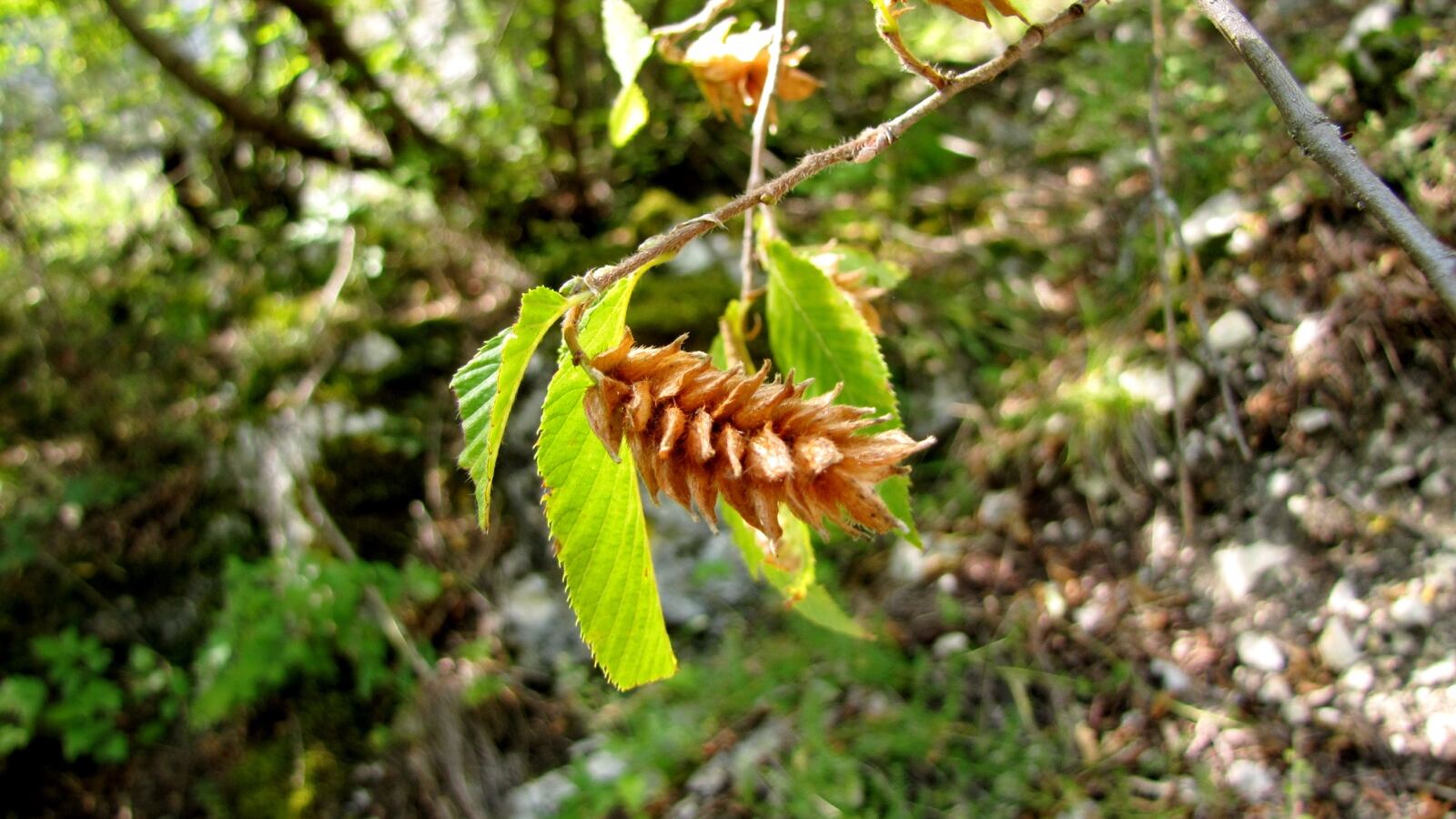
What it is
Ostrya, a small genus of the northern hemisphere — American hop-hornbeam, O. virginiana, and European hop-hornbeam, O. carpinifolia — in the birch family, and close to true hornbeam, Carpinus, which it strongly resembles.
Two features separate it from hornbeam. The fruit hangs in pale, papery, inflated clusters that look remarkably like the hops used in brewing — hence the name — where hornbeam's seeds sit on flat three-lobed bracts. And the bark is shreddy, breaking into narrow vertical strips, where hornbeam's is smooth and fluted.
A small understorey tree, rarely above 12 to 18 m, slow, and easily overlooked.
Ironwood
Hop-hornbeam is one of a long list of trees called ironwood, and it earns it: the timber is exceptionally hard, heavy, and dense — denser than water, so a piece sinks — and tough and shock-resistant.
That put it to the same uses as hornbeam and the shock-resistant ash and hickory: tool handles, mallet heads, wedges, sled runners, fence posts, and anything needing to survive punishment. It was a favoured wood for exactly these before metal replaced most of them, and it makes excellent, slow-burning firewood.
The name ironwood is worth a note, because it is attached to dozens of unrelated trees worldwide — hop-hornbeam, hornbeam, desert ironwood (Olneya, a nitrogen fixer), lignum vitae, and many tropical species — all sharing only extreme hardness. It is a use-name rather than a botanical one.
An overlooked understorey tree
Hop-hornbeam is shade-tolerant and grows as a small tree beneath the canopy of oak, beech, and maple forest, part of the sub-canopy layer that gives a woodland its structural diversity.
It is undemanding — tolerant of dry, poor, rocky, and alkaline soils, drought, and shade — which makes it a useful and tough small tree for difficult sites, and it is quietly recommended as an underused urban tree for exactly that resilience, in the same spirit as hackberry. See urban forestry.
The hop-like fruits feed finches, and the seeds and buds are taken by grouse and small mammals; it is a reasonable if unspectacular wildlife tree. See seed-dispersing birds.
Growing it
Full sun to fairly deep shade, and almost any well-drained soil including dry, thin, rocky, and limy ground. It dislikes only waterlogging and compaction.
Slow-growing and long-lived, with a neat rounded form and clear yellow autumn colour.
Grows from seed, which is doubly dormant and slow, often needing more than a year and a warm-then-cold sequence to germinate — one reason it is uncommon in nurseries despite its virtues. See propagation.
Few pests or diseases trouble it.
Hop-hornbeam is a connoisseur's small tree: not showy, but tough, shade-tolerant, wildlife-friendly, with beautiful hop-like fruit and iron-hard wood — a good sub-canopy component in a mixed woodland or a resilient small tree for a hard site.
See also
- Hornbeam the close relative it resembles, and how to tell them apart
- Hazel the other small tree of the birch family
- Structural Diversity the sub-canopy layer it occupies
- Ash the other shock-resistant handle timber
- Hackberry another tough, overlooked tree
- Urban Forestry resilient underused species
- Persian Ironwood
- Lignum Vitae
- Desert Ironwood