What they are
Schinus, the pepper trees — chiefly the Peruvian pepper tree (S. molle), with its graceful weeping foliage, and the Brazilian pepper (S. terebinthifolia), a denser shrubby tree — both South American, both bearing hanging clusters of small, rose-pink berries.
They are not true pepper (which comes from an unrelated vine); they belong to the cashew family, Anacardiaceae, alongside the mango, cashew, sumac, and quebracho — a kinship that matters both for the spice they yield and for the family's irritant chemistry.
Pink peppercorns
The pepper trees' most familiar product is the "pink peppercorn" of the spice rack and the smart restaurant plate. The dried rose-red berries of the pepper tree (mainly S. molle, and sometimes S. terebinthifolia) are sold as pink peppercorns — often mixed with true black, white, and green peppercorns in "rainbow" pepper blends — prized for their pretty colour and a mild, sweet, faintly resinous, peppery-fruity flavour quite unlike true pepper.
They are a genuine culinary spice, but with a caveat rooted in the tree's family: being an Anacardiaceae, the berries contain some of the family's irritant compounds, and people sensitive to cashew, mango, or poison ivy can occasionally react to pink peppercorns, and large amounts can irritate — so they are used in moderation, as a garnish and accent rather than a staple. The whole tree is aromatic; the crushed leaves and bark smell strongly of pepper and turpentine, and the tree has a long folk-medicinal use in South America.
The graceful ornamental
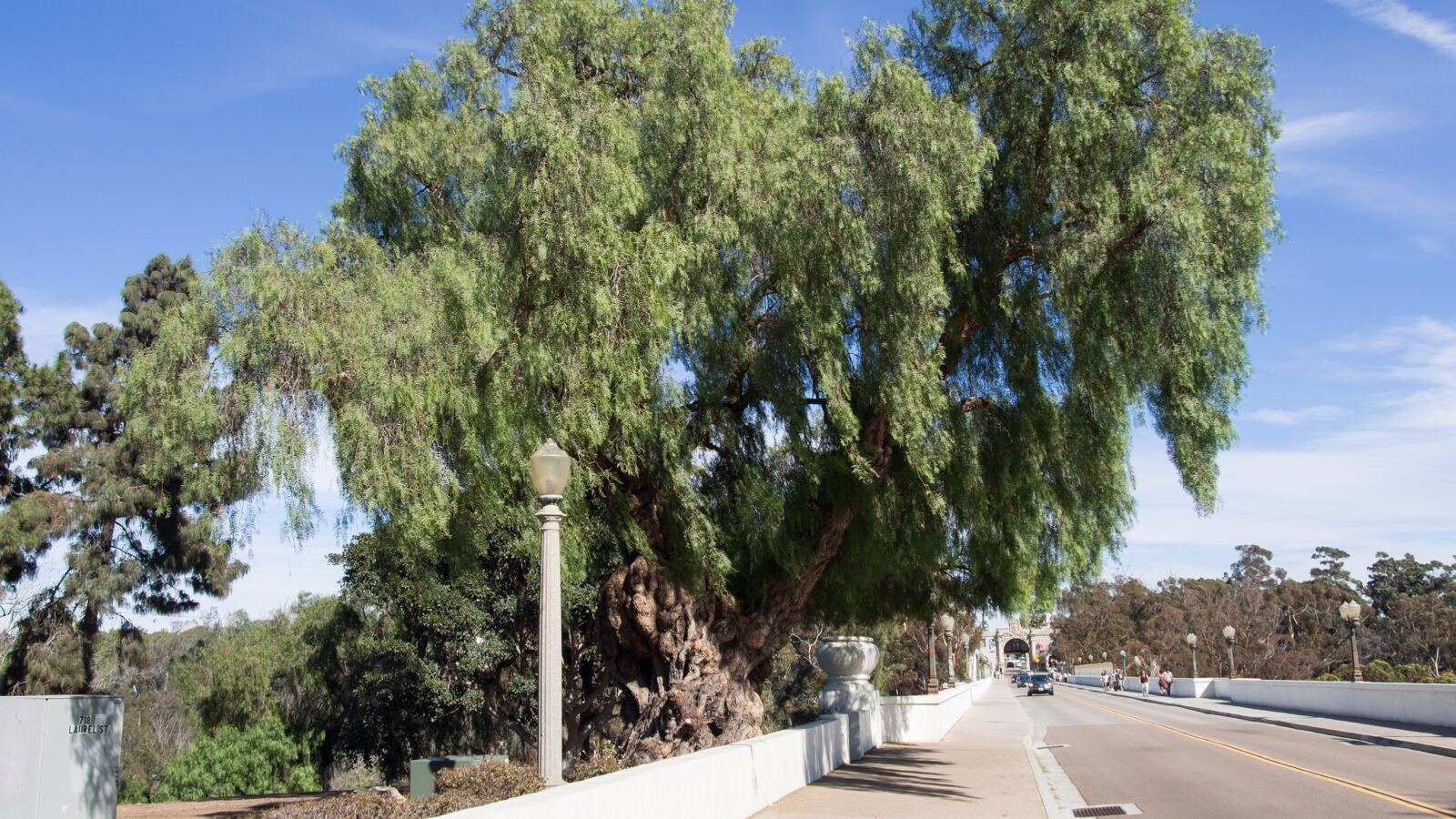
The Peruvian pepper tree is genuinely lovely — a graceful, drought-hardy, evergreen tree with a rounded crown of fine, weeping, fern-like foliage, aromatic when brushed, hung with those decorative pink berries, and casting a light, pleasant shade. It has been planted for centuries as a shade, street, and garden tree across the warm, dry world — the Mediterranean, California, Australia, South Africa, the Middle East — where its toughness, drought tolerance, and beauty made it a favourite; the "pepper tree" is an icon of old California and of dry-country towns worldwide. See urban forestry and drought-tolerant species.
The invasive shadow
And there is the now-familiar catch. The very toughness, drought tolerance, and heavy bird-sown seeding that made the pepper trees such successful ornamentals have made them serious invasive species, above all the Brazilian pepper.
Brazilian pepper is one of the worst invasive plants in Florida, where it has overrun huge areas of disturbed land, pine flatwoods, and the margins of the Everglades, forming dense thickets that shade out everything beneath — a menace on the scale of melaleuca and casuarina in the same state — and it is invasive in Hawaii, Texas, California, Australia, and South Africa too. The Peruvian pepper, similarly, has become weedy in parts of Australia, California, and South Africa. Both are now banned or targeted for control in many of the places that once planted them, and their allelopathic, bird-spread, drought-proof habit makes them hard to remove. The lesson is the recurring one: a tough, pretty, prolific, bird-sown tree is exactly the profile of an invader. So enjoy the pink peppercorns and the graceful shade where the trees are managed — and do not plant them where they run wild.
Growing them
Warm-temperate to subtropical, frost-tender to lightly frost-hardy, the pepper trees want full sun and are extremely tough — tolerant of drought, heat, poor soil, and salt, which is the source of both their ornamental value and their invasiveness. They are fast, evergreen, and long-lived, grown easily from seed (the problem) and cuttings.
Plant them only where they are not invasive, choosing well-behaved alternatives elsewhere; where appropriate, they remain among the loveliest and toughest of dry-climate shade trees, and a home source of pink peppercorns. See propagation.
See also
- Mango, Cashew, and Sumac and Smoke Tree its cashew-family relatives
- Quebracho another South American Anacardiaceae
- Invasive Species Brazilian pepper in Florida
- Melaleuca and Tea Tree and Casuarina fellow invaders of the same region
- Drought-Tolerant Species the pepper tree as a dry-climate ornamental
- Urban Forestry the pepper tree as a street and shade tree