What urbanisation does to a hydrograph
Rain on undeveloped ground mostly infiltrates. What runs off does so slowly, through vegetation and soil, arriving at the watercourse over hours or days.
Rain on a roof, a road, or a car park runs off almost entirely, immediately, and arrives in minutes.
Plotted as a hydrograph — flow against time — the natural catchment gives a low broad hump. The urbanised one gives a tall narrow spike arriving much sooner.
Two consequences follow:
Flooding, because the peak exceeds channel and drain capacity.
Low flows between storms, because the water that would have infiltrated and sustained base flow left instead. Urban streams flood more and run dry more.
Typical figures: undeveloped ground might shed 10 percent of rainfall as runoff; a dense urban catchment 60 to 90 percent.
The traditional engineering answer was to move water away faster — bigger pipes, straighter channels, concrete banks. That solves the local problem and moves it downstream, where all the fast-arriving water from everywhere upstream now coincides.
Slow, store, infiltrate
The modern approach reverses it: keep water where it lands, slow it, and let it soak in.
Known variously as SuDS in Britain, LID in North America, WSUD in Australia, and green infrastructure generally — the principles are the same and they are the same principles as swales and earthworks applied to hard surfaces.
Source control. Deal with runoff where it falls, before it concentrates. This is by far the most effective stage and the cheapest.
Treatment train. A sequence of small interventions, each doing part of the job, rather than one large end-of-pipe structure. Water passes from roof to butt to soakaway to swale to basin, being slowed, cleaned, and reduced at each step.
Manage the small storms locally, and design overflow routes for the large ones. Most rainfall arrives in small events, and handling those on site removes most of the annual volume.
The components
Green roofs. Retain 40 to 80 percent of annual rainfall, and delay and flatten what does run off. Also insulation and habitat.
Water butts and tanks. Simple, and effective only if emptied between storms — a full butt attenuates nothing. See rainwater harvesting basics and tank sizing.
Permeable paving. Porous surfacing over a granular sub-base that stores water and releases it slowly or infiltrates it. See permeable surfaces.
Rain gardens and bioretention. Shallow planted depressions that receive runoff, pond briefly, and infiltrate through an engineered soil. Excellent at removing hydrocarbons, metals, and sediment. See rain gardens.
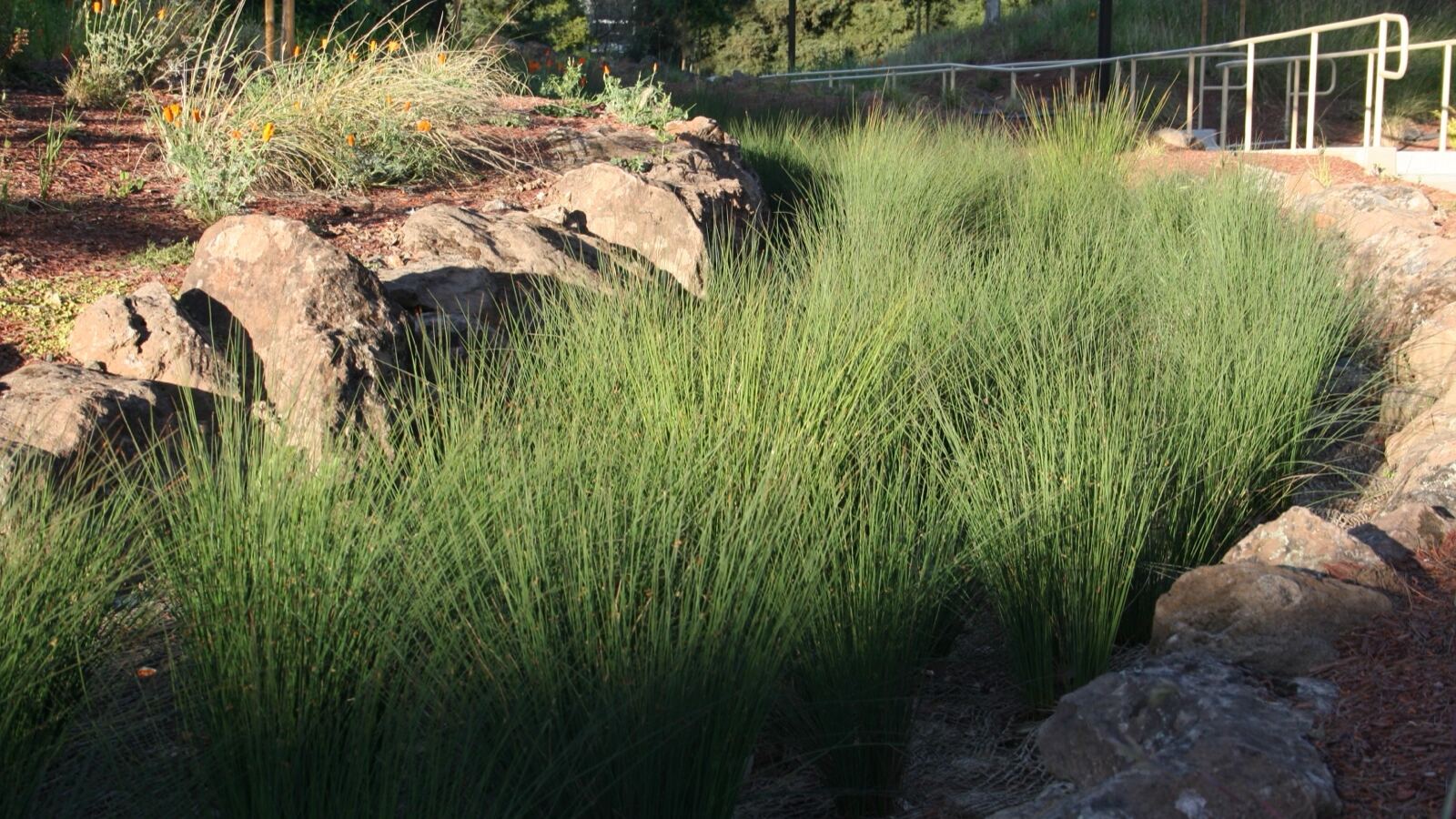
Swales. Vegetated channels conveying water slowly while infiltrating and filtering — the roadside version of the contour swale. See swales and finding contour.
Detention and retention basins. Larger storage, dry between storms or permanently wet. Wet basins double as habitat.
Constructed wetlands for treatment plus attenuation. See constructed wetlands.
Soakaways and infiltration trenches, where soil and groundwater conditions allow. See aquifer recharge.
Trees. Canopy interception, transpiration, and root channels that open soil. A mature street tree intercepts thousands of litres a year, and tree pits designed to receive road runoff do double duty. See urban forestry.
Runoff is polluted
Easily forgotten because the water looks clean.
Road and roof runoff carries hydrocarbons, tyre and brake wear particles, heavy metals — zinc, copper, lead — sediment, nutrients, road salt, and microplastics.
The first flush is the worst of it: the initial runoff carries the accumulated deposition of the whole dry period. See first-flush diverter.
Which is why infiltration without treatment is a bad idea in the wrong places — sending road runoff straight into an aquifer is a contamination route, and it is the caution in aquifer recharge and water quality testing.
Vegetated systems handle this well. Sediment settles, hydrocarbons are broken down by soil microbes, and metals are bound to organic matter and clay. A rain garden is a treatment device as well as a storage one.
Natural flood management
The same logic applied at catchment scale, upstream of towns rather than within them.
Leaky dams — woody debris placed across small watercourses to slow flow and spill water onto floodplains.
Floodplain reconnection, by removing embankments and letting rivers spread.
Riparian and catchment woodland, increasing infiltration and roughness. See riparian buffers.
Soil management across farmland, since compacted arable soil sheds water like tarmac. Restoring infiltration across a catchment is a large-volume intervention that nobody sees. See decompaction and soil water storage.
Peatland restoration, where drained peat sheds water fast and rewetted peat holds it. See peatland restoration.
Beavers, which do the whole job continuously and maintain the structures for free. Studies of beaver-modified catchments consistently show attenuated storm peaks. See beavers.
The evidence for natural flood management is strongest for small and moderate events and weaker for extreme ones — it is a complement to hard defences rather than a replacement, and overselling it has damaged its credibility in places.
Doing it on one property
The principles scale down completely.
Disconnect the downpipe from the drain and route it to a butt, a soakaway, or a planted bed. This single change removes a roof from the sewer network.
Replace impermeable paving with gravel, permeable block, or planting. Paving over a front garden is a small decision repeated across a street until the street floods.
Make a rain garden in a low corner to receive the overflow.
Build soil organic matter, which raises infiltration measurably. See organic matter building.
Plant trees and keep the ground covered. See soil cover.
Each is trivial alone. The reason urban flooding got worse is that the opposite decisions were also trivial, and taken everywhere.
See also
- Permeable Surfaces letting rain soak in where it falls
- Rain Gardens storage and treatment in one
- Constructed Wetlands treatment at the end of the train
- Urban Forestry canopy interception in cities
- Beavers natural flood management that maintains itself
- Swales the same principle on a rural slope