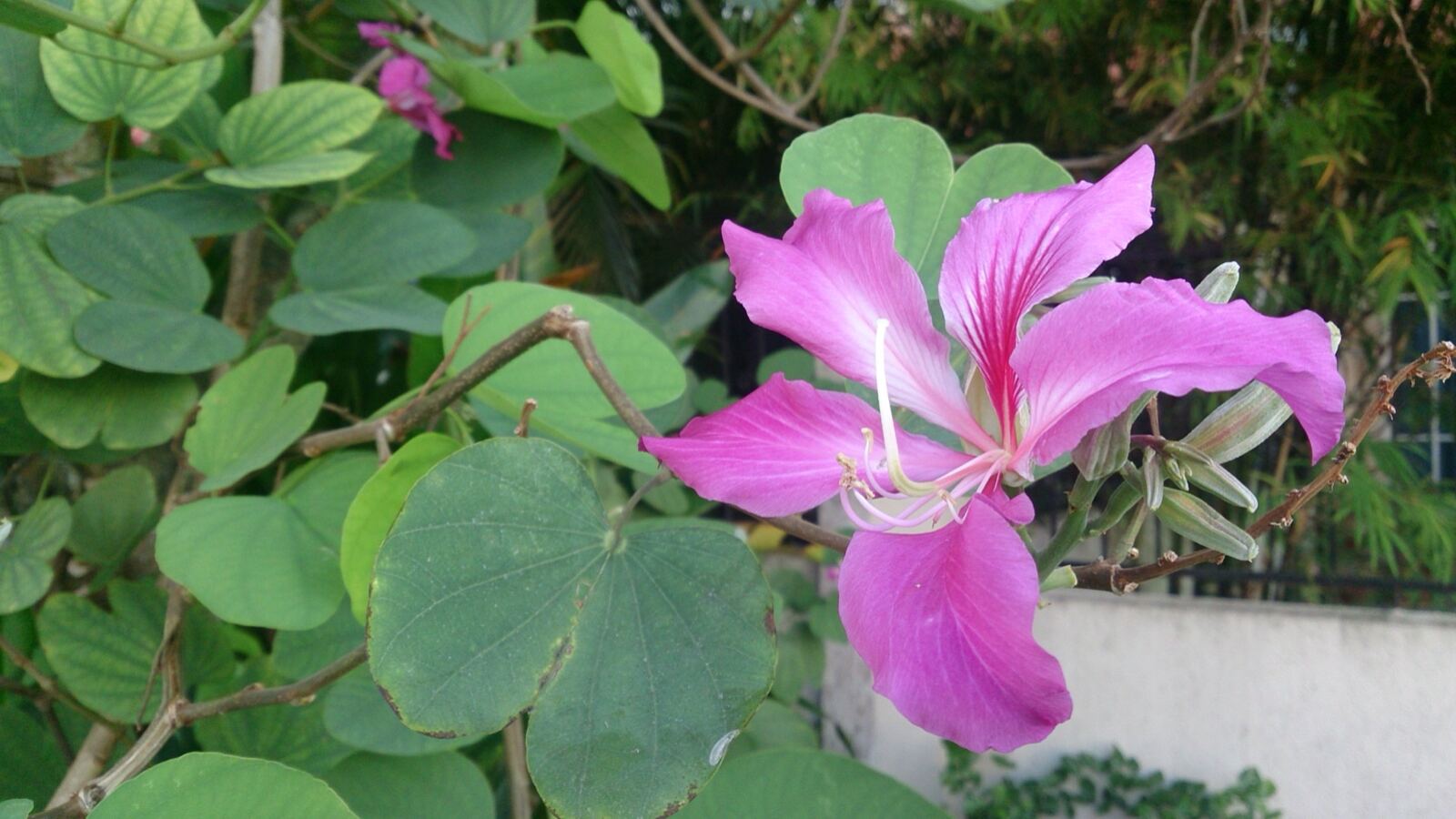
What it is
Bauhinia, the orchid trees — a large genus of tropical and subtropical flowering trees, shrubs, and climbers in the legume family, kin to the silk tree, redbud, and the other pea-flowered trees, and grown throughout the warm world for their spectacular blooms.
They are called orchid trees because their large, showy, five-petalled flowers — in pink, purple, white, or red — genuinely resemble orchids, and a bauhinia in full flower is one of the loveliest sights of the tropical and subtropical garden.
The butterfly leaf
The bauhinia's other signature is its leaf, which is unmistakable once known. Each leaf is deeply cleft into two rounded lobes, so that it looks like a butterfly's wings, or a camel's or ox's footprint — and this twin-lobed leaf gives the tree several of its common names (camel's foot tree, butterfly tree) and is the surest way to identify a bauhinia even out of flower.
The two lobes are actually the two halves of what is really a single compound leaf fused together — and in some related plants the halves fold together at night, a small daily movement. The genus was named by Linnaeus for the Bauhin brothers, two sixteenth-century botanists, the paired lobes of the leaf standing for the pair of siblings — one of the more charming pieces of botanical name-lore.
The emblem of Hong Kong
One bauhinia has a special fame. Bauhinia × blakeana, the Hong Kong orchid tree, is a naturally-occurring sterile hybrid, discovered around 1880 near Hong Kong, bearing large, deep reddish-purple, richly-scented flowers over a long season.
Because it is sterile it sets no seed, so — like the Cavendish banana or a grafted fruit variety — every Hong Kong orchid tree in the world is a clone, propagated by cuttings and grafting from that single original hybrid, all genetically one plant. It was so admired that it became the floral emblem of Hong Kong, and a stylised version of its flower appears on the Hong Kong flag and coinage — a striking case of a single, sterile, clonal tree becoming a civic and national symbol. Its long, showy flowering also makes it, and other bauhinias, a very popular street and park tree across the subtropics. See urban forestry.
Flowers, pods, and a caution
Being legumes, the seed-bearing bauhinias follow their flowers with flat pods that split, often explosively, to fling out the seeds — the same ballistic dispersal as gorse and other pod-bearers. The flowers are rich in nectar and are worked by bees, butterflies, sunbirds, and — for some species — bats, making bauhinias good pollinator trees; several species are important nectar sources.
The usual caution attaches to a tough, free-seeding tropical tree: some seed-bearing bauhinias (the orchid tree Bauhinia variegata especially) have become invasive in parts of Florida, Australia, and other warm regions, where they self-sow into bushland — so the sterile Hong Kong hybrid, which sets no seed, is in this respect the better-behaved choice. As legumes, bauhinias fix some nitrogen and enrich the soil, adding to their value in agroforestry, and several species' young leaves, flowers, and pods are eaten as vegetables in South and Southeast Asia.
Growing them
Tropical to warm-subtropical, mostly frost-tender (some take light frost), wanting full sun and well-drained soil; they are tough, fast-growing, and drought-tolerant once established, which suits them to warm-climate streets and gardens.
They flower prolifically, often over a long season and sometimes on bare branches, and are grown from seed (the fertile species), and — for the sterile Hong Kong orchid tree and named forms — from cuttings and grafting. They respond to pruning and are easily kept to a manageable size. For a frost-free garden, few small trees give such a long and orchid-like display. See propagation and grafting.
See also
- Silk Tree the ferny-leaved legume relative
- Redbud and Sassafras the redbud, a temperate legume flowering tree
- Jacaranda and Flame Tree other subtropical flowering street trees
- Banana and Plantain another famous sterile clone
- Invasive Species the seed-bearing orchid trees abroad
- Urban Forestry bauhinia as a flowering street tree