What it is
Aesculus hippocastanum, in the soapberry family — and not related to the sweet chestnut at all, which is Castanea in the beech family. See chestnut for the edible one.
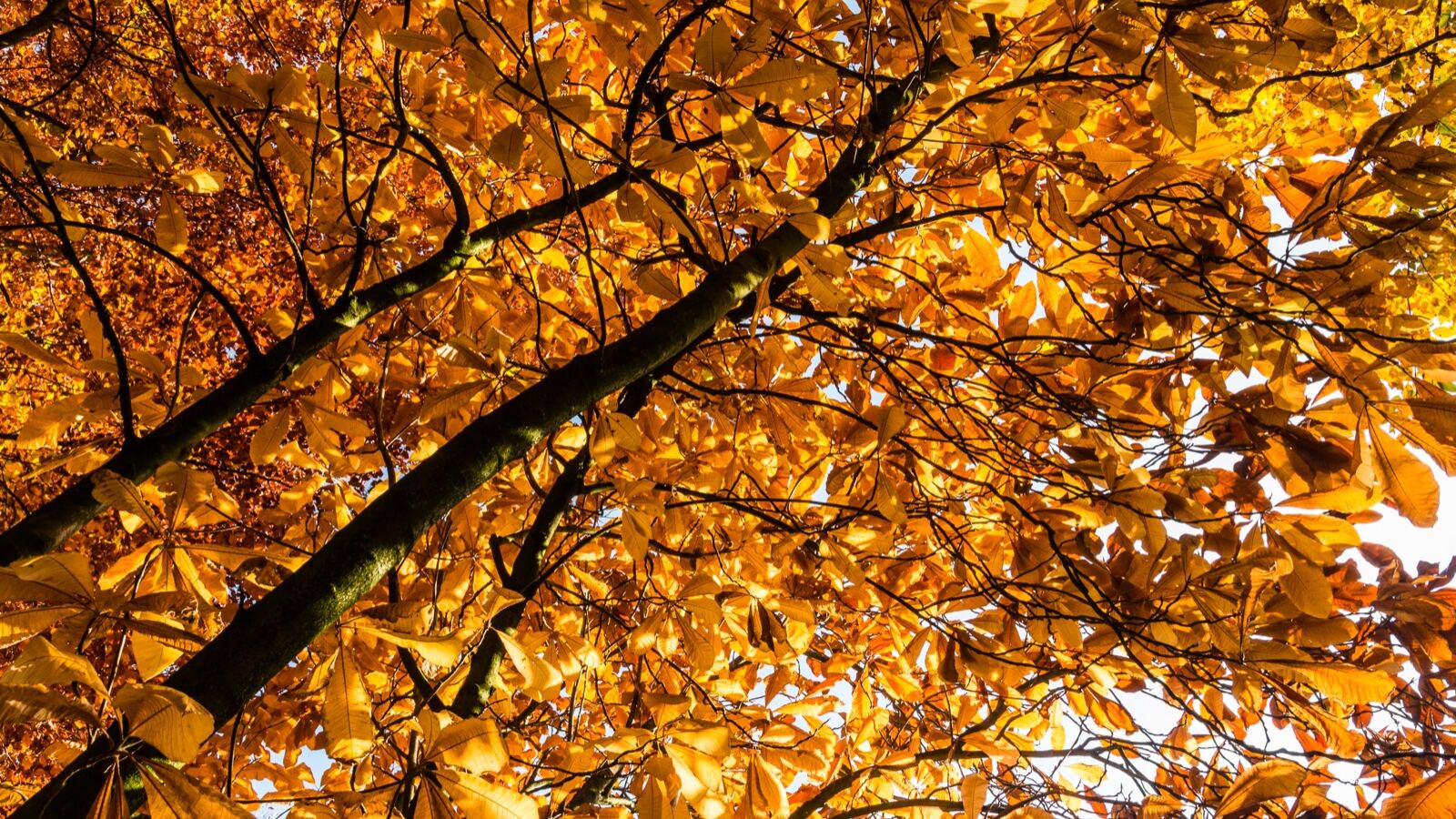
Distinctive at every season: large palmate leaves with five to seven leaflets radiating from a single point, upright white flower panicles like candles in late spring, spiny green cases, and sticky brown buds in winter.
The conker inside those cases is not edible — it contains aesculin and saponins, and is mildly toxic to humans, though deer and wild boar eat them.
The name probably comes from the horseshoe-shaped leaf scar left on the twig after leaf fall, complete with marks resembling nails, or from a historical use treating horses for coughs.
Endangered at home, everywhere else
One of the odder facts about a tree most Europeans see daily.
The natural range of horse chestnut is tiny: a scatter of mountain valleys in the Balkans — Greece, Albania, North Macedonia, Bulgaria. In the wild it is assessed as Vulnerable, with small, fragmented, poorly regenerating populations.
Introduced to western Europe in the sixteenth century, it became one of the most widely planted amenity trees on the continent — avenues, parks, village greens, and school grounds — and is now vastly more abundant in cultivation than in the wild.
A species can be simultaneously ubiquitous and endangered, and the planted population does nothing for the wild one, since almost all of it derives from a narrow founder stock. It is a practical illustration of the difference between abundance and genetic conservation argued in minimum viable populations and seed banking.
Conkers
The game is a British and Irish tradition dating to the mid-nineteenth century: a conker on a string, struck against an opponent's until one breaks.
The conker itself is a large seed with a substantial food reserve and no dormancy requirement to speak of — it germinates readily and quickly, which makes it one of the easiest trees to grow from seed and a reliable classroom exercise. Collect in autumn, plant immediately, and keep from drying out.
The persistent folk belief that conkers repel spiders has no supporting evidence.
The saponins in the seed do work as a soap, and horse chestnut extract has genuine pharmacological use in treating chronic venous insufficiency.
Two diseases at once
Horse chestnut across Europe is now in visible decline, and the cause is a combination.
Horse chestnut leaf miner, Cameraria ohridella. A tiny moth whose larvae mine between the leaf surfaces, producing blotches that turn brown and coalesce until whole trees look autumnal by midsummer.
It appeared in Macedonia in 1984 and spread across Europe within two decades. Interestingly it was found in the same region as the tree's native range, and its origin remains debated.
The damage looks catastrophic and is mostly cosmetic. It reduces growth and seed size but rarely kills. The practical control is to collect and destroy fallen leaves in autumn, since the pupae overwinter in leaf litter — a genuinely effective measure at the scale of a garden or a park, and the rare case where clearing leaf litter is the right call rather than the wrong one. Compare dead wood habitat, where the opposite advice applies.
Bleeding canker, caused by the bacterium Pseudomonas syringae pv. aesculi. This one is serious. Rusty or black sticky ooze runs from lesions on the trunk and branches; the lesions girdle and the crown dies back. It has affected a large proportion of British horse chestnuts and kills mature trees.
The combination — a defoliating pest plus a lethal canker — is why so many avenues are now being felled. See tree diseases.
There is no treatment for the canker. Some trees resist or recover, and as with ash, those survivors matter and should not be felled pre-emptively.
Wildlife
Modest, and worth being honest about. As a non-native in most of Europe it supports relatively few specialist invertebrates compared with oak or willow.
The flowers are genuinely valuable to bees, producing abundant nectar and pollen in late spring, and the flowers change colour from yellow to red at the base once pollinated — a signal to pollinators to stop visiting, which is neat and easy to observe. See native bees.
Mature and veteran horse chestnuts develop rot holes and cavities readily, which makes them useful for hole-nesting birds and bats despite the limited invertebrate fauna. See bats.
The other Aesculus
Red horse chestnut, A. × carnea, a hybrid with the American red buckeye, is smaller, pink-flowered, and notably more resistant to leaf miner — a common replacement choice.
Buckeyes, the American Aesculus species, fill similar roles in North America. Ohio buckeye and yellow buckeye are the main ones.
Indian horse chestnut, A. indica, flowers later and is also less affected by leaf miner.
Growing it
Undemanding, fast, and large — 25 to 35 m with a broad spreading crown, so it needs real space and is a poor choice for a small garden.
Tolerates most soils, prefers deep moist fertile ground, dislikes drought and compaction, and suffers in hot dry city conditions.
Easy from seed, as above. Transplants well when young.
Given the disease situation, think carefully before planting one where a long-lived specimen is the goal. Where the point is a large flowering amenity tree, the hybrid or Indian species are more sensible choices; where the point is wildlife value, a native oak, lime, or wild cherry will do considerably more.
See urban forestry on species diversity in street and park planting, which is exactly the lesson this tree teaches.
See also
- Chestnut the unrelated edible one
- Tree Diseases bleeding canker in context
- Urban Forestry why monoculture avenues fail
- Minimum Viable Populations common in cultivation, endangered in the wild
- Native Bees the flowers and their colour signal
- Lime and Linden a better large amenity tree for wildlife
- Monkey Puzzle
- Lychee and Longan
- American Buckeyes