What it is
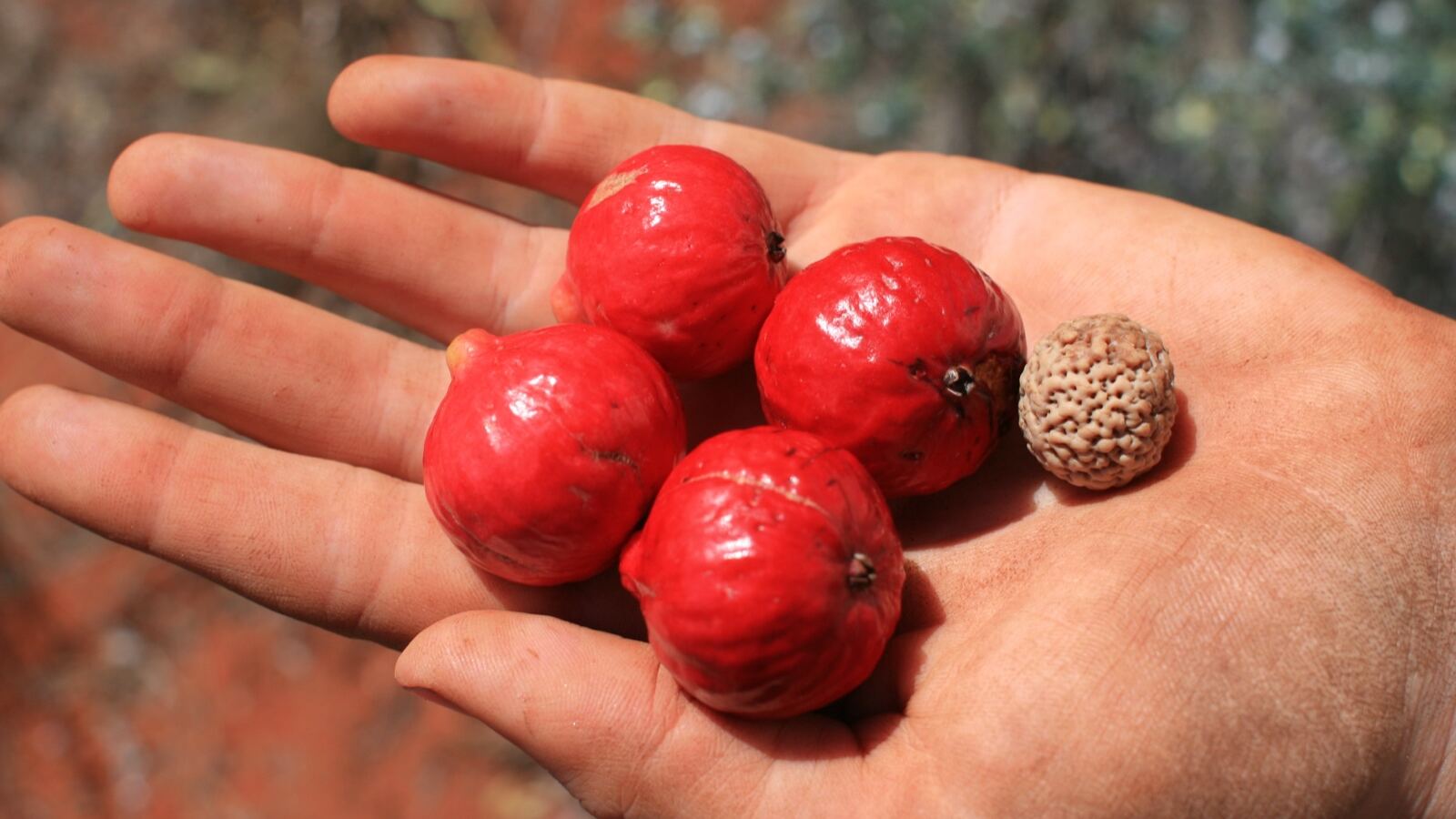
Santalum acuminatum, the quandong or desert peach — a small, hardy tree or shrub of the dry inland of Australia, bearing bright red, round fruit that were one of the most important wild foods of the outback and are now a valued native "bush food."
Remarkably, the quandong belongs to the genus Santalum — the sandalwood genus — which means this desert fruit tree is a close relative of the fragrant sandalwood of temple and perfume, and, like it, it has an unusual way of making a living.
A tree that taps its neighbours
Like the sandalwood, the quandong is a hemiparasite. It has green leaves and photosynthesises like any plant, but it cannot thrive alone: it grows special root structures (haustoria) that tap into the roots of neighbouring plants, drawing water and nutrients from them — so a quandong lives partly at the expense of the grasses, shrubs, and (usefully) nitrogen-fixing plants growing around it.
This root-parasitism is the central fact of growing a quandong: it must be planted with host plants, and it does best with nitrogen-fixing hosts (native acacias and others) whose roots it can tap, exactly as sandalwood must be grown with its hosts. A quandong grown in isolation, with nothing to parasitise, struggles or fails — an unusual and important requirement that long made the tree difficult to cultivate, and a fascinating piece of botany. See rosewood and sandalwood for its fragrant, host-tapping cousin.
The desert peach
The quandong's fruit is its treasure. The bright red, round fruit has a tart, tangy, peach-and-rhubarb-like flesh — refreshing and pleasantly sour — that is very high in vitamin C (like so many of the tough dry-country fruits), and it was a staple food of Aboriginal peoples across arid Australia, eaten fresh and dried for storage (dried quandong keeps for years and rehydrates, a vital feature in the desert). Inside the fruit is a hard, pitted stone containing an edible, oily kernel, also eaten and pressed for oil.
Today the quandong is one of the best-known bush foods, made into jams, pies, sauces, chutneys, and desserts (the "quandong pie" is an outback classic), and grown commercially as a native fruit crop, its tartness and colour prized; the kernel oil is used in cosmetics. It is a genuine success story of an Indigenous desert fruit finding a modern market, in the way the finger lime and kakadu plum have. See restoration economics and food forest design.
Growing it
A tree of hot, dry, inland Australia, the quandong is superbly drought-hardy, wanting full sun, sharp drainage, and poor, dry, sandy, or alkaline soil — the harsh conditions of the outback — and it resents wet, humid, or rich conditions; it is frost-tender to moderately hardy. But its defining requirement is the one above: it must have host plants to tap, ideally nitrogen-fixing ones, from an early stage.
It is grown from seed (the hard stone, which is slow and needs care to germinate), planted among suitable hosts, and it is slow to establish but tough and long-lived once away. As a drought-proof, vitamin-rich, host-tapping desert fruit tree — a sandalwood relative that feeds the outback — the quandong is one of the most distinctive and rewarding of Australian bush foods. See propagation and drought-tolerant species.
See also
- Rosewood and Sandalwood its sandalwood cousin, the other great root-tapping Santalum
- Finger Lime, Kakadu Plum, and Davidson Plum other Australian bush foods
- Nitrogen Fixers the host plants the quandong taps
- Drought-Tolerant Species the quandong for hot, dry country
- Food Forest Design growing a quandong with its hosts
- Restoration Economics a desert fruit turned bush-food crop