What it is
The bottlebrushes — Callistemon (now often merged into Melaleuca) — are Australian shrubs and small trees in the myrtle family, Myrtaceae, close kin to the paperbarks and tea trees, the eucalyptus, and the fellow Australians the banksias.
They are among the most popular and instantly recognisable of all Australian native plants, grown as garden and street shrubs around the warm-temperate and subtropical world for their extraordinary flower spikes.
The brush
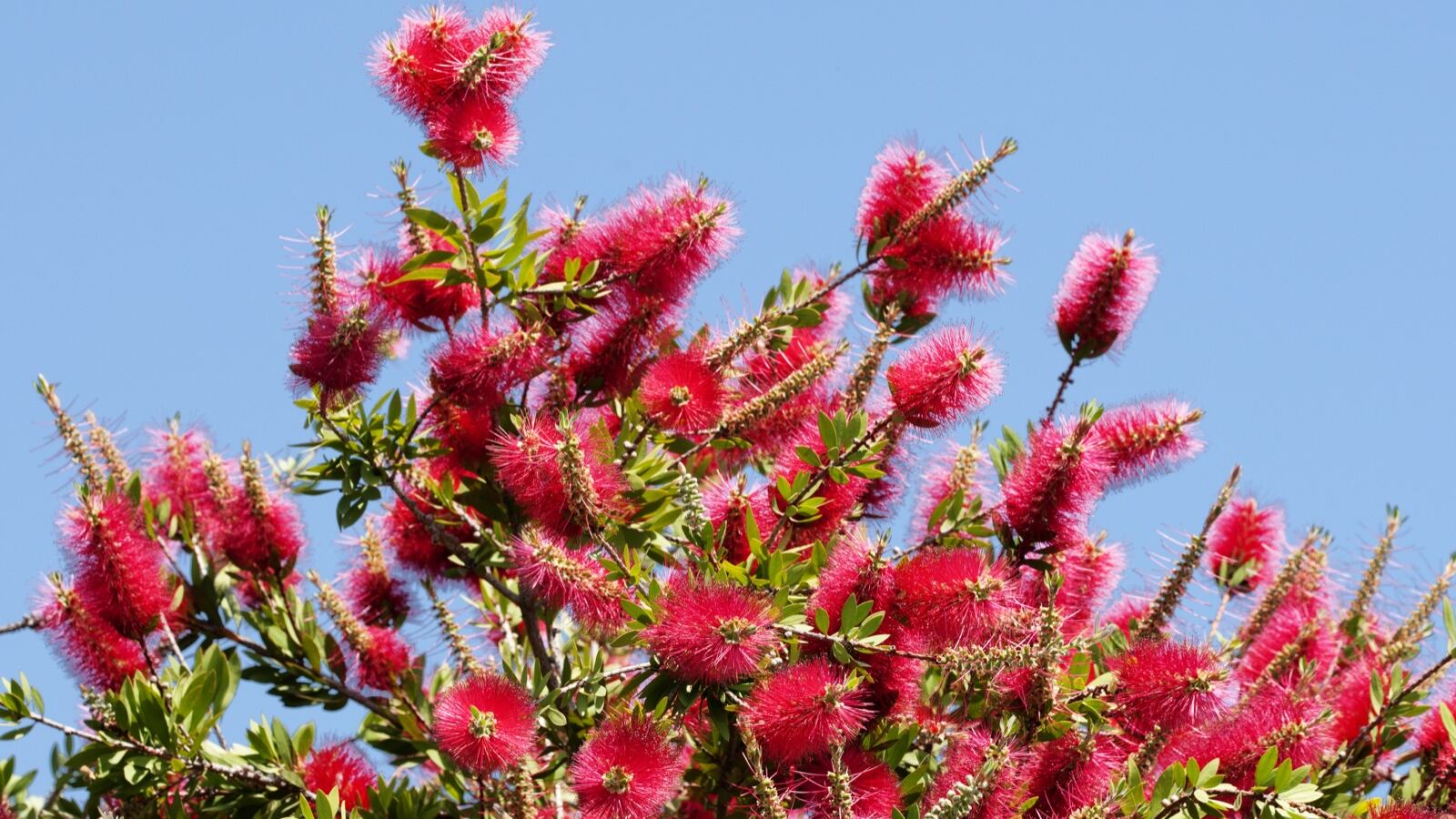
The bottlebrush's flower is one of nature's most literal resemblances: a dense cylindrical spike of flowers bristling all around a stem, exactly like the brush used to clean a bottle. Usually brilliant red (though pink, mauve, cream, yellow, and green kinds exist), the spike sits partway along a branch — and, distinctively, the branch keeps growing on out the far end of the flower spike, leaving the old brush behind on the stem.
The reason the flower looks like a brush is that its show comes not from petals — which are tiny and drop away — but from a dense mass of long, colourful stamens, the filaments tipped with pollen making the bristles of the brush. This is a flower built as a bird-landing-and-feeding platform, exactly like the brush flowers of the banksias and the melaleucas.
Nectar for birds
Bottlebrushes are classic bird-pollinated plants and superb wildlife shrubs. The brush spikes are rich in nectar, and in Australia they are worked constantly by nectar-feeding birds — honeyeaters and lorikeets — as well as by bees, butterflies, and other insects; where they are grown abroad, they draw in whatever nectar-feeders are local (hummingbirds in the Americas, sunbirds in Africa and Asia). A flowering bottlebrush is one of the best plants for bringing birds and pollinators into a warm-climate garden, and it flowers over a long season, often more than once a year. See pollinator habitat and native bees.
Woody seeds and fire
Like its Myrtaceae relatives, the bottlebrush is a plant of a fire-prone land, and it stores its seed in a fire-adapted way. After flowering, the spike develops a cluster of small, hard, woody seed capsules that stay clamped tightly to the woody stem — often for years — holding the seed safely in a "canopy seed bank."
Many bottlebrushes are serotinous: the capsules stay shut until they are triggered to open — classically by the heat of a fire, or by the death of the branch — whereupon they release their fine seed onto the cleared, ash-fertilised ground at the moment most favourable for germination. This is the same fire-cued seed release seen in the banksias, melaleucas, and much of the Australian flora, and it means fire is woven into the bottlebrush's life cycle. See fire management and seed banking.
Growing it
Warm-temperate to subtropical, and among the hardier of the popular Australian plants — several bottlebrushes take a few degrees of frost, which lets them be grown well beyond the tropics — wanting full sun and reasonable drainage, and otherwise tough and adaptable: they tolerate poor soil, drought once established, wind, and coastal salt, and some (the weeping and stiff bottlebrushes) even tolerate wet ground, unusual in the family.
They are easy, fast, long-flowering shrubs and small trees, kept in shape by pruning after flowering (cut behind the old brushes), and are grown from seed (shaken from heated capsules) and cuttings. Unlike their protea-family neighbours the banksias, bottlebrushes are not fussy about phosphorus and tolerate ordinary feeding, which makes them much easier garden plants. For a sunny warm-climate garden, few shrubs give more colour or more birds for less trouble. See propagation.
See also
- Melaleuca and Tea Tree the close paperbark relatives
- Eucalyptus the great Myrtaceae tree
- Banksia and Grevillea the other great Australian bird-nectar plants
- Fire Management the serotiny that ties bottlebrush to fire
- Pollinator Habitat bottlebrush as a bird-and-bee plant
- Seed Banking the woody canopy seed store