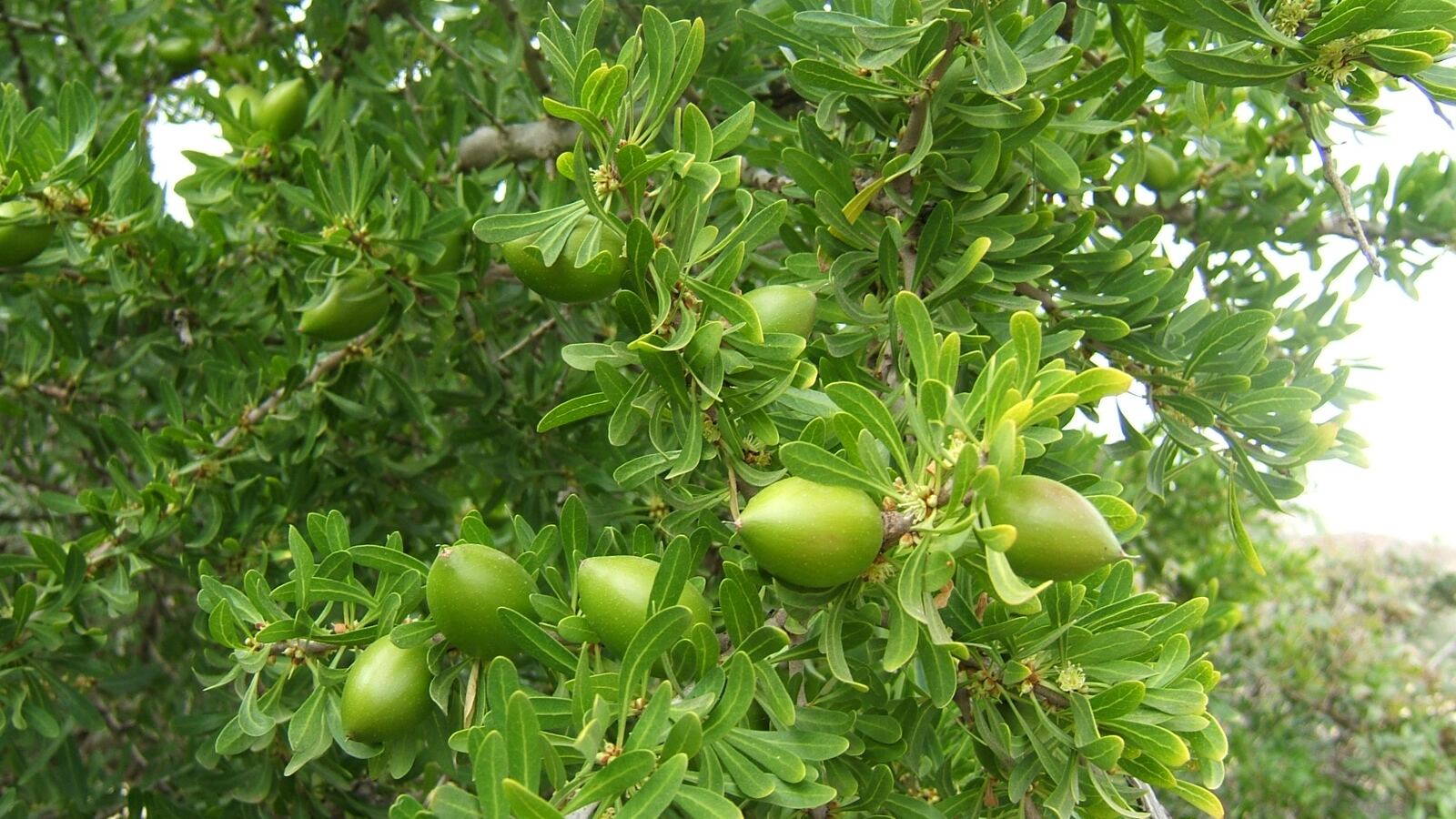
Two dryland oil trees
Both are slow-growing trees of dry Africa whose seeds yield valuable oils, both are managed as scattered trees within farmed landscapes rather than in plantations, and both are economically dominated by women's labour and income — which shapes everything about how they are used and conserved.
Shea, Vitellaria paradoxa, of the Sahelian and Sudanian belt across West and Central Africa.
Argan, Argania spinosa, of southwestern Morocco and a sliver of Algeria — the only place on earth it grows.
Shea
Shea trees are a defining feature of the agroforestry parkland of West Africa: scattered mature trees deliberately retained in cultivated fields, providing shade, soil improvement, and a crop, while millet and sorghum grow beneath them.
That parkland system is a form of silvopasture and farmer-managed tree retention, closely related to the FMNR approach — the trees are protected and encouraged rather than planted, because a shea takes 15 to 20 years to fruit and decades to reach full production, and nobody plants a tree that a grandchild will harvest without good reason.
The butter. The nut is processed — a laborious hand operation of boiling, drying, pounding, and kneading — into shea butter, which is a solid fat used across the region for cooking, soap, medicine, and skin care, and exported in large quantities for the cosmetics and, as an illipe substitute, the chocolate industry.
Women's crop. Shea processing and the income from it are, across the region, overwhelmingly controlled by women, and shea is one of the few significant sources of independent female income in rural West Africa. That makes the tree's conservation a livelihoods and gender question as much as an ecological one, and it connects directly to community engagement and restoration economics.
The trees are threatened by clearance for mechanised agriculture, by charcoal cutting, and by the slow regeneration that makes losses hard to reverse. Protecting the parklands means protecting the trees that are already there.
Argan
Argan grows only in a defined region of southwestern Morocco, where it forms open woodland — the arganeraie — that is designated a UNESCO biosphere reserve.
It is a spiny, gnarled, extraordinarily drought-hard tree, deep-rooted, tolerant of heat, poor soil, and the encroaching desert, and it is the keystone of its landscape: without argan the arganeraie would be desert, and the tree is credited with holding back the Sahara along that front. See dryland restoration and erosion control.
The goats in the trees. Argan is famous for the goats that climb into its branches to eat the fruit — a genuine sight, though now partly staged for tourists. Traditionally the goats ate the fleathery fruit pulp and passed or regurgitated the hard nuts, which were then collected, though modern production mostly harvests fallen fruit directly to avoid contamination.
Argan oil. The nut is cracked by hand — the shell is famously hard, and cracking it between stones is the rate-limiting step of the whole industry — and the kernels are pressed for argan oil, used for food and, increasingly and lucratively, for cosmetics.
Women's cooperatives. Argan oil production is organised largely through women's cooperatives, which has been promoted as a model of combining conservation with rural female income and literacy — though the reality is more mixed than the marketing, with much of the value captured downstream. The pattern echoes shea: a slow dryland tree whose oil sustains both households and an export economy, worked mostly by women.
The conservation lesson
Both trees make the same point, and it is worth drawing out because it recurs across dryland agroforestry.
These are not plantation crops. They are slow-growing wild or semi-wild trees whose value depends on the standing tree, so the conservation strategy is protection and regeneration of existing trees, not planting new ones — the same logic as the Brazil nut and the extractive-economy argument in restoration economics.
And in both cases the tree's survival is bound up with the livelihoods, and specifically the incomes of women, that depend on it. A conservation plan that ignores who harvests the tree and who keeps the money will not hold — the point made generally in stakeholder mapping and community engagement.
Argan regeneration in particular is failing under grazing pressure and drought, the same regeneration gap seen in juniper and scots pine: mature trees standing over ground where no young ones survive. See minimum viable populations.
Growing them
Both are strictly trees of hot, dry, frost-tolerant climates and are essentially impossible to cultivate outside them — argan is barely grown even elsewhere in Morocco, being tied to its specific coastal-influenced arid climate.
Where they grow, they are undemanding once established, drought- and heat-hard, and long-lived — argan lives 150 to 250 years — but very slow, which is the whole reason they are conserved rather than planted.
They are of interest to a temperate reader less as garden plants than as examples: of the parkland agroforestry model, of trees whose economic value is the strongest argument for keeping them, and of the tight link between dryland trees and the people — often women — who depend on them.
See also
- Dryland Restoration parkland and FMNR systems
- Silvopasture trees retained within farmland
- Macadamia, Cashew and Brazil Nut the wild-harvested crop parallel
- Restoration Economics value that keeps trees standing
- Community Engagement conservation as a livelihoods question
- Moringa another multi-purpose dryland tree