What it is
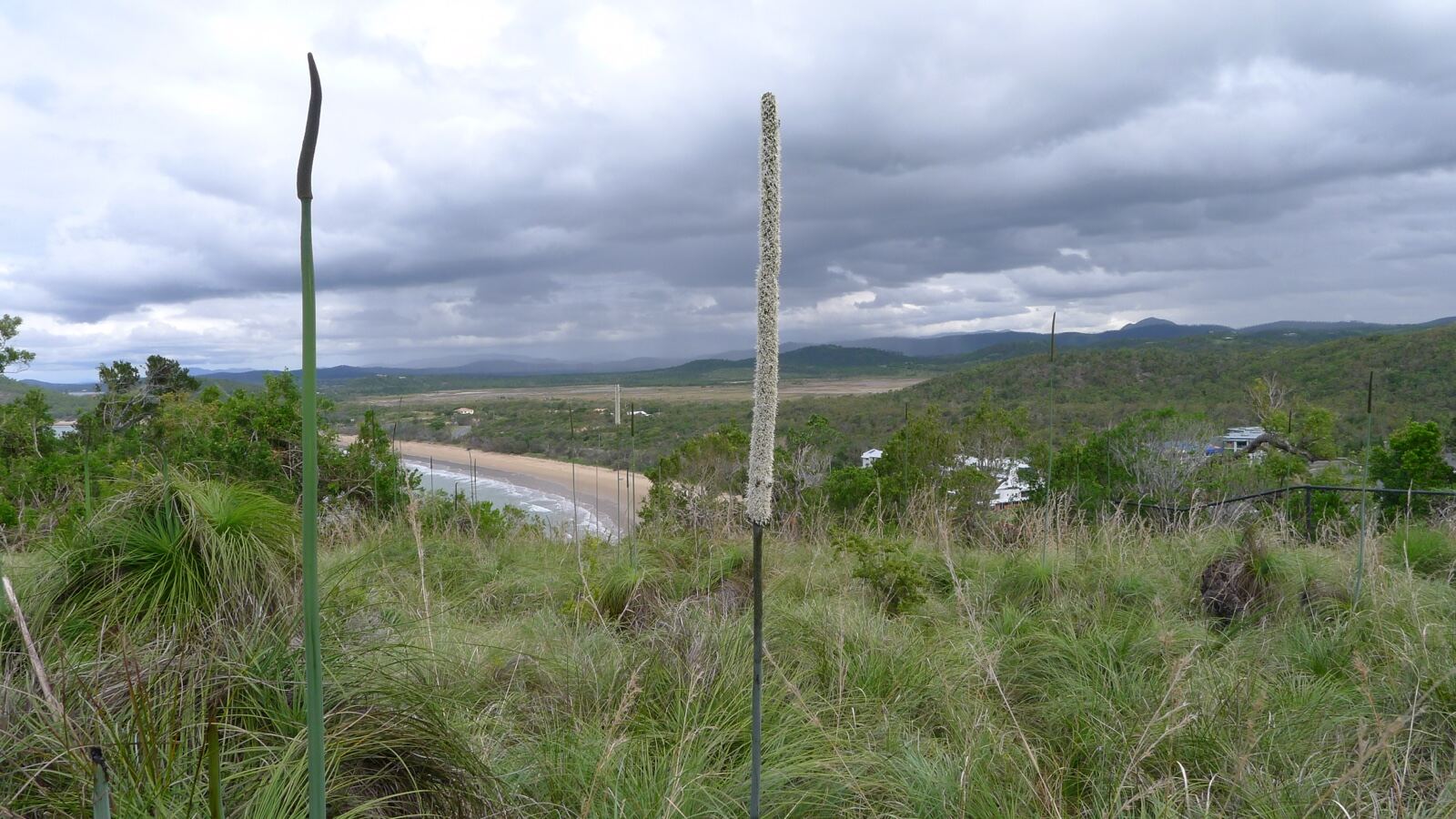
Xanthorrhoea, the grass tree — one of the most distinctive and iconic plants of the Australian bush: a stout, blackened trunk topped with a dense, fountaining skirt of long, wiry, grass-like leaves, from the centre of which rises a tall spear-like flower spike.
Despite the name and the grassy crown, it is not a grass and not really a "tree" in the ordinary sense — it is a monocot, related to the lilies and, distantly, to its fellow tree-form monocots the palms, yuccas, and dragon tree. Like them it has no true wood: its "trunk" is a column of tightly-packed old leaf bases, cemented together with resin, with a single growing point at the top.
Impossibly slow, surprisingly old
The grass tree grows at an almost unbelievable pace: about one to two centimetres of trunk a year, and often less. A grass tree with a trunk a metre or two tall is therefore not a young plant but an ancient one — often several hundred years old, some estimated at 600 years or more.
This extreme slowness, and the great age it implies, is central to the grass tree's conservation: a mature grass tree represents centuries of growth that cannot be quickly replaced, so digging up wild grass trees for gardens (once a common and destructive trade) removes plants that took lifetimes to grow, and transplanting them frequently kills them because of their sensitive roots. They should only ever be bought from salvaged or nursery-grown, certified stock. Their slow growth also makes them, like tree rings, a record of the past — the trunk laying down a band each year that scientists have read for fire and climate history.
Fire and the flower spike
The grass tree is one of the most fire-adapted plants in a fire-adapted land, and fire is woven through its life.
Its trunk is insulated by the dense mass of old leaf bases and coated in flammable resin, so a bushfire burns the skirt of leaves and blackens the trunk — giving the plant its charred appearance and its old colonial name — but the protected growing point survives, and the plant reshoots green from the top within weeks. More striking still, fire triggers flowering: a grass tree is far more likely to send up its tall flower spike in the season after a fire, the heat, smoke, and cleared ground signalling the plant to bloom. So a hillside of grass trees will burst into a forest of flower spikes after a bushfire — one of the memorable sights of the recovering Australian bush, and the same fire-cued flowering seen in the banksias and much of the flora. See fire management.
The flower spike itself is a magnificent thing — a dense cylinder of thousands of small nectar-rich cream flowers on a spear up to several metres tall — and it is a major nectar source, feeding a huge range of birds, insects, and small mammals, making the grass tree a keystone pollinator plant of the bush. Aboriginal people used every part: the nectar for a sweet drink, the flower spike as a spear shaft and fishing spear, the resin as a valuable adhesive (for hafting tools and mending) and waterproofing, and the soft leaf bases and grubs within as food.
Growing it
Grass trees want full sun and extremely sharp drainage on poor, sandy, acidic soil, and — being adapted to a lean, dry, fire-swept land — they resent rich soil, wet ground, humidity, and root disturbance, which is why transplanted wild specimens so often die. Given the right lean, dry, sunny conditions they are tough and long-lived; given kindness and water, they rot.
They are extremely slow, so a garden grass tree is a long-term or salvaged plant. They are grown from seed — slow but the ethical way — and buying nursery-grown or legitimately-salvaged plants (never wild-dug) is essential given how long they take to grow and how easily they die when moved. A grass tree is a plant to respect: an ancient, fire-forged monocot that has watched centuries pass. See propagation and native plant selection.
See also
- Palms fellow tree-form monocots without true wood
- Joshua Tree and Yuccas and Dragon Tree more monocot "trees"
- Banksia and Grevillea the fire-cued Australian flora
- Fire Management the fire ecology the grass tree embodies
- Pollinator Habitat the grass tree's great nectar spike
- Bristlecone Pine another very slow, very old plant
- Ombú