What it is
Bertholletia excelsa, the brazil nut, one of the largest trees of the Amazon rainforest — a canopy emergent rising 50 m and more above the forest, with a huge trunk, living for centuries, and among the most majestic trees of South America.
Its nuts are familiar worldwide, but the way they are produced is not: the brazil nut is one of the very few globally-traded foods that is still gathered almost entirely from wild trees in intact forest, not from plantations. And the reason why is one of the best stories in all of ecology.
The nut that resists the plantation
Every attempt to grow brazil nuts as an ordinary plantation crop has essentially failed, because the tree depends on a web of other forest species to reproduce — remove the forest, and the tree, even if it grows, will not fruit.
Pollination. Brazil nut flowers are large and have a coiled hood that only a strong insect can pry open. They are pollinated almost exclusively by large-bodied orchid bees (and a few other big native bees). The male orchid bees, in turn, need the scent of specific forest orchids to attract mates — so the bee needs the orchid, and the tree needs the bee. In a cleared plantation the orchids are gone, so the orchid bees are gone, so the flowers are not pollinated, and no nuts form. The tree's fertility is chained to the intact forest around it. See pollinator habitat and native bees.
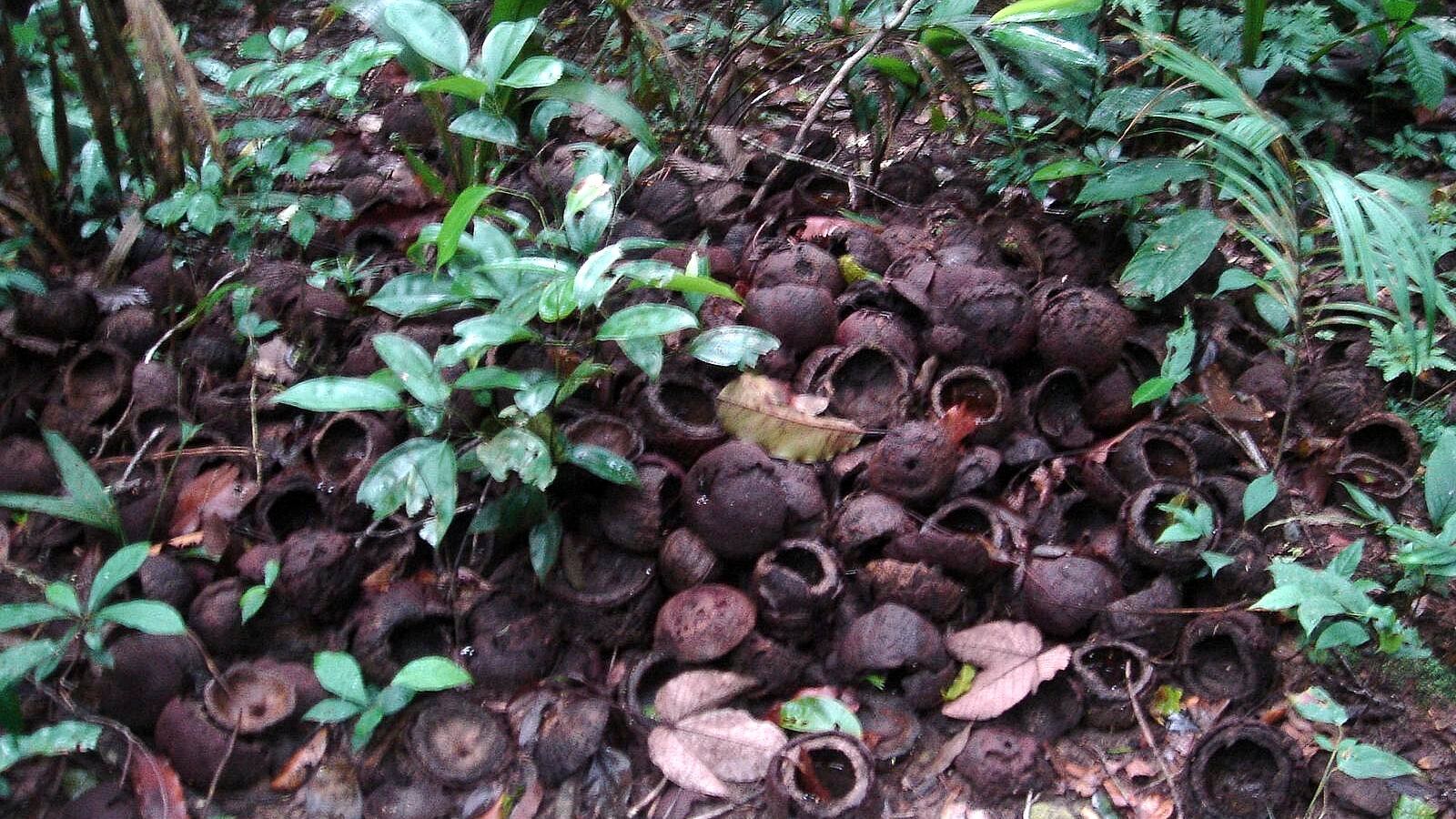
Dispersal. The nuts are sealed inside a hard, heavy, woody pod ("cannonball") the size of a grapefruit, which falls to the forest floor and does not open on its own. Almost the only animal that can gnaw it open is the agouti, a large forest rodent with teeth strong enough to breach the pod. The agouti eats some of the nuts and, squirrel-like, buries others in scattered caches across the forest — and the ones it forgets germinate into new trees. No agouti, no planting. See seed-dispersing birds for the wider role of animal dispersal.
So the brazil nut needs the orchid, the orchid bee, and the agouti — a whole functioning rainforest — to complete its life cycle. This makes it the classic living argument that a standing forest can be worth more than a felled one: brazil-nut harvesting gives local communities a sustainable income from the intact forest, and the trees are legally protected from felling in several countries. Where the forest around them is cleared, the isolated brazil-nut trees left standing in pastures slowly stop fruiting, because their partners are gone — a silent demonstration of why the pieces matter. See restoration economics and structural diversity.
Gathering the harvest
The harvest is genuine forest work. Gatherers (castanheiros) walk the forest collecting the fallen pods — carefully, because a pod weighing a kilo or more dropping from 40 m is a lethal hazard, and gatherers wear protection and avoid the trees in high winds. The pods are broken open to extract the nuts (arranged inside like the segments of an orange), which are then dried and shelled.
The nuts are exceptionally nutritious and famously the richest known dietary source of selenium — so rich that a couple of nuts supply a full day's requirement, and eating many at once can actually give a mild selenium excess. They are also high in fat and protein, a valuable forest food and export.
A note on the mycorrhizal link
Like most rainforest trees, brazil nut also depends on mycorrhizal fungi in the soil for its nutrients, another of the hidden partnerships that a plantation on cleared, sterilised ground disrupts — one more reason the tree does best embedded in the living forest. It stands with the macadamia and other tropical nuts as a tree crop, but unlike them it has resisted domestication precisely because of these dependencies.
Growing it
Tropical, frost-free, wanting deep rich moist rainforest soil, high rainfall, and warmth; it is a huge, slow, long-lived tree unsuited to small spaces.
It can be grown from seed (slow and erratic to germinate, needing the hard shell scarified — the agouti's job) and is planted in enrichment and agroforestry systems within or beside forest, where its pollinators and the surrounding diversity give it a chance to fruit, rather than in cleared monoculture. Grafting can bring earlier, lower fruiting. The lesson of the brazil nut is that some trees cannot be separated from their forest — and are all the more valuable for it. See reforestation techniques and propagation.
See also
- Macadamia and Tropical Nuts tree nuts that did domesticate
- Pollinator Habitat the orchid-bee link the brazil nut needs
- Native Bees the large bees that pollinate it
- Restoration Economics a standing forest worth more than a felled one
- Structural Diversity why the whole forest web matters
- Mycorrhizal Fungi the hidden soil partnership
- Marula
- Cannonball Tree
- Rattan
- Cupuaçu
- Seed Dispersal