Three species
Morus, in the fig family — which explains the fruit structure and the milky sap.
Black mulberry, M. nigra, from western Asia. The best fruit by a wide margin: intensely flavoured, dark, sharp-sweet. Slow, gnarled, long-lived, and hardy to about minus 20 C.
White mulberry, M. alba, from China. Grown for leaves, not fruit — this is the silkworm tree. Fast, tolerant of drought, heat and poor soil, and much less interesting to eat, with insipid white to pink fruit.
Red mulberry, M. rubra, from eastern North America. Good fruit, and now threatened by hybridisation with introduced white mulberry, which is displacing it genetically.
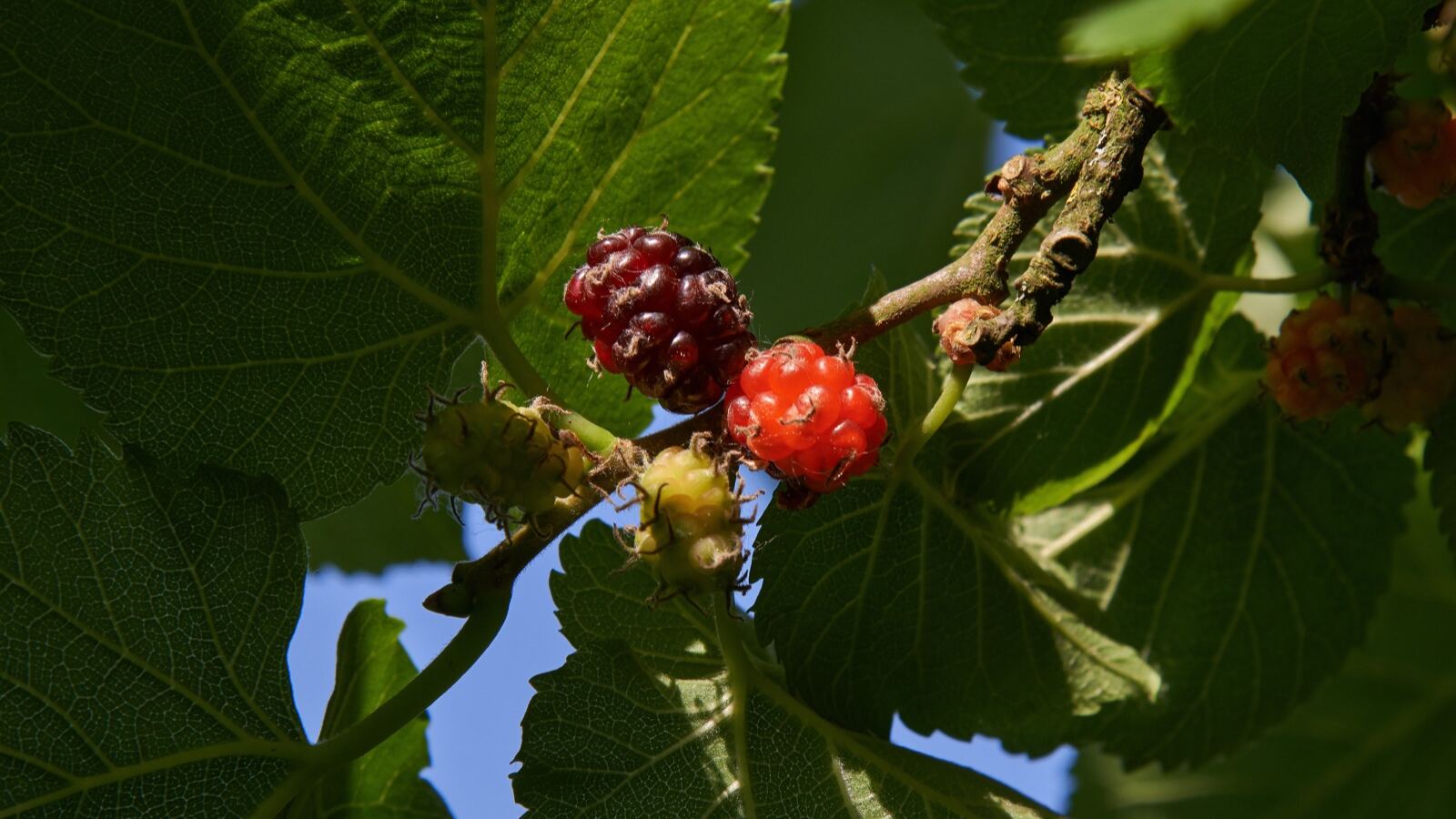
The fruit is not a berry but a multiple fruit — an aggregate of many small drupelets, each from a separate flower, fused together. The same structure as a fig turned inside out.
The silk tree
White mulberry leaves are the sole food of Bombyx mori, the domesticated silkworm, and the entire history of silk runs through this tree.
Sericulture began in China around 4,000 years ago and the technique was guarded for millennia. Its spread west along the Silk Road eventually carried the trees with it, and mulberry plantations followed silk production into Persia, Byzantium, Italy, and France.
The trees are grown as pollarded or coppiced stools and stripped of leaves several times a season — a cut-and-regrow system closely comparable to coppice rotation, managed for foliage rather than poles.
James I attempted to found an English silk industry in the early 1600s and had thousands of mulberries planted. It failed, and the traditional explanation is that black mulberries were planted instead of white — the wrong species for silkworms. The story is probably too neat, since England's climate was the larger problem, but many of the ancient mulberries in English gardens date from that push.
A fruit that cannot be sold
Mulberries are almost never in shops, and the reason is purely physical.
The fruit is extremely soft, has no protective skin worth the name, and begins to break down within hours of picking. It cannot be transported, cannot be stacked, and stains everything it touches with a dye that does not wash out easily.
So it is a fruit you can only really have by growing it or knowing someone who does — which is the whole argument for planting one.
Ripe fruit falls. The traditional harvest is a sheet spread under the tree and a gentle shake, taking the fruit that is ready and leaving the rest. Picking by hand crushes them.
Ripeness is judged by colour going almost black and by the fruit detaching at a touch. Underripe mulberries are sharp and disappointing.
Use fresh, or freeze immediately, or turn into jam, cordial, wine, or vinegar. See harvest and storage.
Plant it away from paving, paths, parking, and washing lines. Everything below a fruiting mulberry gets stained, along with the birds, and the birds then stain everything else.
Growing it
Black mulberry wants a warm, sheltered, sunny position and free-draining fertile soil. It is slow — genuinely slow, taking 8 to 15 years to fruit well from a young tree — and then productive for centuries. Many English mulberries are 300 years old and still cropping.
Buy the largest plant you can afford, since the wait is the main cost.
White mulberry is fast, tough, drought-tolerant, and much more adaptable, and it is grown in agroforestry systems across Asia for leaf fodder as well as silk.
Both root very readily from hardwood cuttings and from truncheons — large cuttings pushed straight into the ground, in the manner of willow. This makes propagation cheap. See propagation.
Prune only in winter, fully dormant. Mulberries bleed profusely from cuts made in spring or summer, and the bleeding weakens them. Keep pruning to a minimum in any case — mulberries need very little and resent heavy cutting.
The wood is brittle and old trees frequently split and lean, often propped in old gardens. A leaning mulberry that has layered itself where a branch touched the ground is a common and rather charming sight.
Beyond fruit and silk
Fodder. Mulberry leaf is high in protein and digestibility and is a significant livestock fodder across Asia and Africa, cut from pollarded trees. It is a strong candidate in silvopasture and dryland agroforestry, particularly white mulberry.
Wildlife. The fruit is taken enthusiastically by birds and mammals, and a mulberry is one of the more effective bird-feeding trees available. Some growers plant one as a decoy near an orchard to draw birds off cherries. See seed-dispersing birds.
Paper. The bark of paper mulberry, Broussonetia papyrifera, a related genus, is the traditional fibre for Japanese washi and Pacific tapa cloth.
Timber. Yellow, hard, durable, and attractive, used for furniture, fencing, and sports goods, though rarely available.
Note that paper mulberry is a serious invasive in parts of Africa, Asia, and the Americas, and white mulberry is invasive in parts of North America where it hybridises with the native red. Check local status before planting either. See invasive species.
See also
- Fig Species the family relative and comparable fruit structure
- Coppice Rotation the cut-and-regrow leaf harvest
- Silvopasture mulberry as a fodder tree
- Propagation rooting truncheons and hardwood cuttings
- Harvest and Storage dealing with a fruit that will not keep
- Invasive Species white and paper mulberry outside their range
- Pawpaw and Persimmon
- Osage Orange
- Breadfruit and Jackfruit
- Iroko