The original experiment
The term comes from Robert Paine's work on the rocky shores of Washington State in the 1960s.
He removed the starfish Pisaster ochraceus from experimental plots and left adjacent plots alone.
In the plots with starfish, roughly 15 species coexisted. In the plots without, mussels — freed from their main predator — outcompeted everything and the community collapsed to a near-monoculture within a couple of years.
The starfish was not abundant and not large in biomass terms. Its influence was disproportionate to its abundance, which is the definition. Paine took the name from the keystone of an arch: not the largest stone, but the one whose removal brings the structure down.
The types
The concept has broadened, usefully, into several distinct mechanisms.
Keystone predators suppress a dominant competitor and thereby maintain diversity, as Paine's starfish did. Wolves, sea otters, and starfish are the standard examples.
Ecosystem engineers physically create or modify habitat that other species depend on. Beavers are the clearest case — dams create ponds, wet woodland, deadwood, and structural complexity that a very large number of species use. Elephants, prairie dogs, and earthworms qualify. See earthworms.
Keystone mutualists provide a service that many species require. Fig species are the textbook example: figs fruit asynchronously through the year, so they feed frugivores during periods when nothing else is fruiting, and losing them removes a food source at exactly the point it is most needed.
Keystone resources are habitat features rather than species — a single water source in a dry landscape, or the deadwood in dead wood habitat.
Trophic cascades
The mechanism by which a keystone predator's effect propagates.
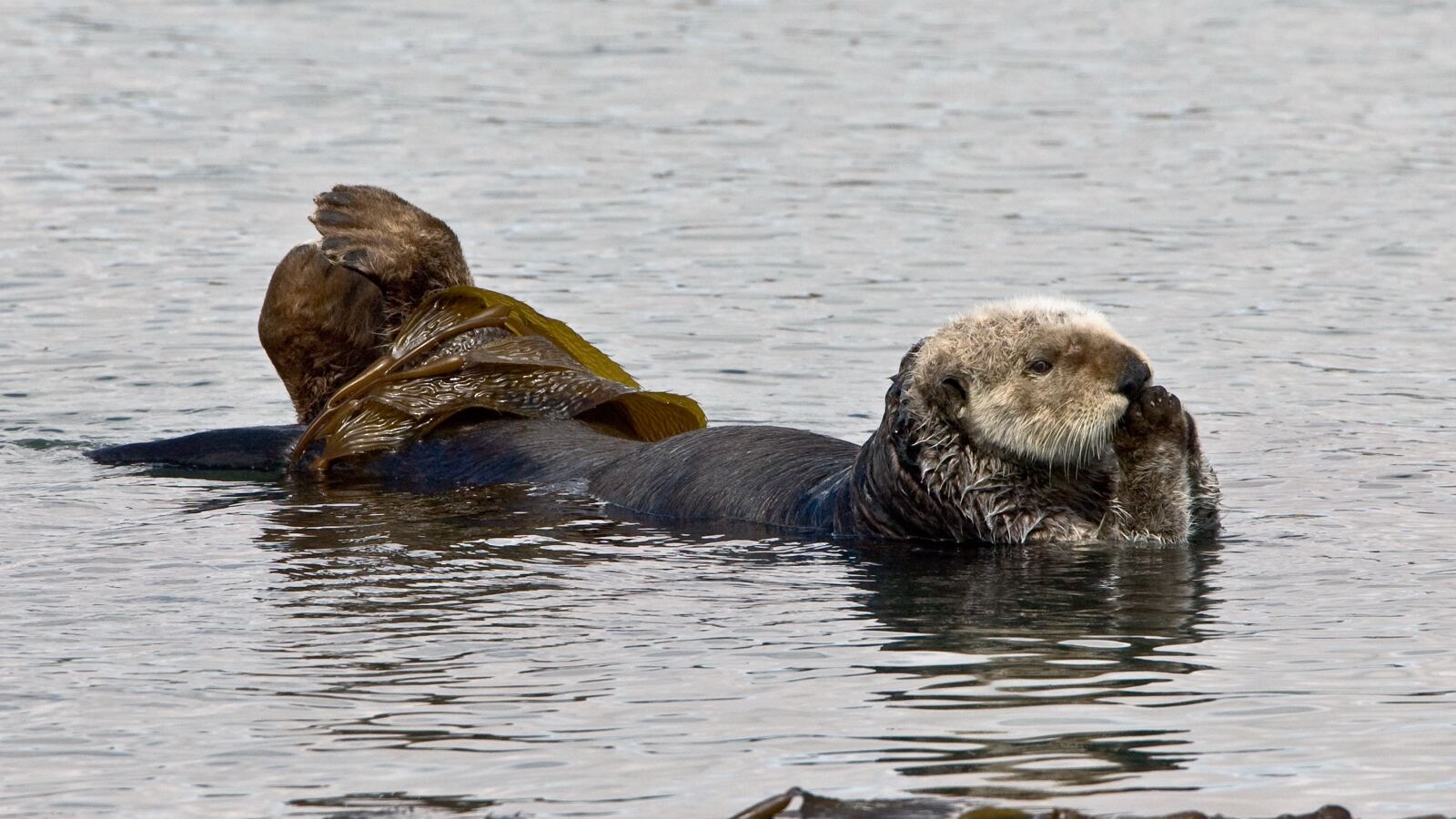
Sea otters, urchins, and kelp is the cleanest documented example. Otters eat sea urchins; urchins graze kelp. Where otters were hunted out, urchin populations exploded and grazed kelp forests down to barren rock. Where otters returned, kelp returned with them, along with the fish and invertebrates it houses.
Wolves in Yellowstone is the famous one, and it deserves a more careful treatment than it usually gets — see below.
Deer without predators is the version most readers can observe directly. High deer densities remove tree regeneration, shrub layers, and ground flora, and the woodland becomes a canopy over bare ground with no successors. It is a cascade running in the damaging direction, and it is visible across much of Europe and North America. See deer and rabbits and site protection.
Where the story gets overstated
Worth being straight about, because the concept is frequently oversold and that damages its credibility.
The Yellowstone wolf story — wolves changed elk behaviour, willows recovered, beavers returned, rivers changed course — is widely repeated as established fact. The reality is contested.
The willow and aspen recovery is real but patchy and better explained in many places by changes in elk numbers, hydrology, beaver activity, and climate than by wolf-induced behavioural change alone. The specific claim that wolves changed the courses of rivers is not well supported. Several ecologists who work on the system have published careful critiques of the popular version.
The underlying point — that removing a top predator has large consequences — holds. The tidy narrative does not.
More generally:
Keystone status is context-dependent. A species can be keystone in one system and unremarkable in another.
It is hard to identify in advance. Paine identified his by removing it. That experiment is rarely available, and predicting which species will turn out to be keystone is genuinely difficult.
Not everything charismatic is keystone, and the label is sometimes applied as advocacy rather than as ecology.
Redundancy exists. Some systems absorb the loss of a species because others perform the same function, which is the argument in structural diversity for maintaining functional variety rather than any particular species.
Why it matters practically
Two conclusions follow, and they are the useful ones.
Restoring a process may need a species. If a habitat depends on disturbance, grazing, damming, or predation, restoring the vegetation without restoring the agent produces something that needs permanent management. Beaver reintroduction versus building and maintaining leaky dams is the cleanest example — one maintains itself and adapts, the other is a capital project with an ongoing cost. See stormwater management and restoration economics.
Losses can be non-linear. A system can absorb species losses with little visible change and then shift abruptly when a keystone goes. That is the case for precaution when the function of a species is unknown, and it is Aldo Leopold's point about keeping every cog and wheel. See Aldo Leopold and minimum viable populations.
In a garden or a smallholding
The concept scales down further than people expect.
Predators that suppress a dominant pest — the guild in beneficial predators and ladybirds.
Engineers — earthworms restructuring soil, mycorrhizal fungi connecting roots.
Mutualists — pollinators, and the nitrogen-fixing bacteria in nitrogen-fixing bacteria.
Resources — a pond, a log pile, a flowering hedge providing the one thing that is otherwise absent.
The practical version of the idea: when something is going wrong, ask what is missing rather than what is present in excess. A slug problem is frequently a predator absence. See predator-prey balance.
See also
- Beavers the ecosystem engineer in detail
- Predator-Prey Balance the mechanism at garden scale
- Structural Diversity redundancy and functional variety
- Minimum Viable Populations losing a species gradually
- Fig Species a keystone mutualist
- Aldo Leopold keeping every cog and wheel
- Macadamia, Cashew and Brazil Nut
- Hemlock
- Banyan and Strangler Figs
- Dipterocarps
- Longleaf Pine
- Desert Ironwood
- Trophic Cascades
- Food Webs
- Mistletoe