What it is
Calocedrus decurrens, the incense cedar — a tall, fragrant evergreen conifer of the mountains of California, Oregon, and the American West, named for the sweet, spicy scent released by its crushed foliage and its wood.
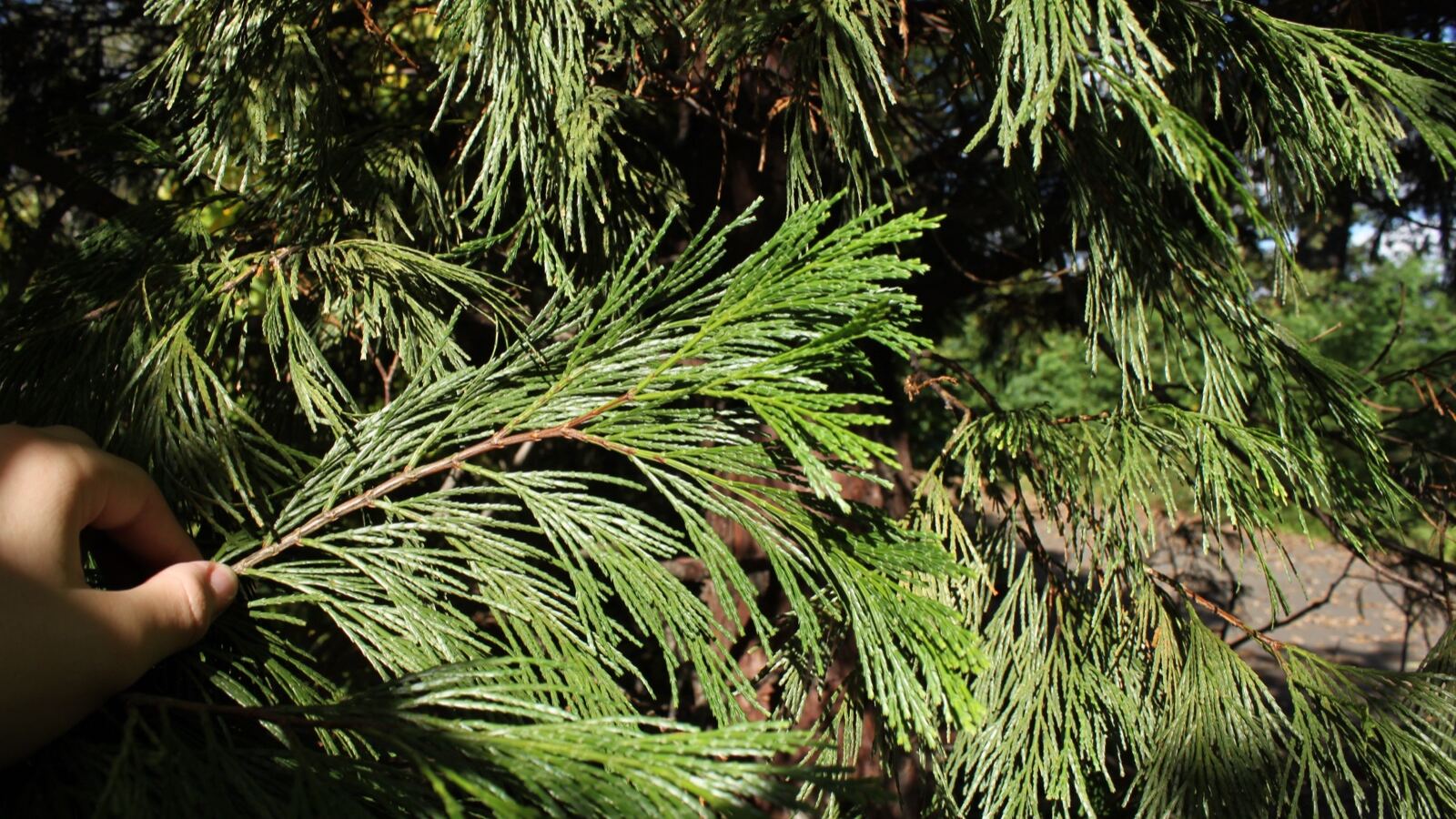
Despite the name it is not a true cedar (the cedars are pines-family conifers); incense cedar belongs to the cypress family, Cupressaceae, a relative of the cypresses, thujas, and junipers. It has flattened sprays of scale-like foliage, fibrous reddish-brown bark, and a narrow, columnar, aromatic presence — a handsome forest and ornamental tree. But its fame rests on one very specific, very everyday use.
The wood in every pencil
The incense cedar is, above all others, the pencil tree — the wood from which the great majority of the world's wooden pencils are made.
A pencil wood has exacting requirements: it must be soft and even enough to sharpen easily, in any direction, to a clean point without splintering or chipping; straight-grained and stable so it does not warp; and pleasant to hold and smell. Incense cedar meets all of these superbly — it is soft, light, uniform, straight-grained, and fragrant, and it sharpens to a clean point with a knife or a pencil sharpener without shattering the graphite core — so it became the standard pencil wood, and California incense cedar supplies pencil factories around the world. That faintly sweet, resinous "pencil smell" of a freshly-sharpened pencil is the scent of incense cedar.
It shares this pencil-making role historically with the eastern redcedar — which is actually a juniper (Juniperus virginiana), not a cedar — the original American pencil wood, prized for exactly the same qualities until it grew scarce and incense cedar largely took its place. So "the pencil tree" is really two aromatic Cupressaceae, one a false cedar and one a juniper, chosen for the same knife-friendly, straight, fragrant wood. See restoration economics.
Beyond pencils
The incense cedar's aromatic, soft, and — importantly — highly rot- and insect-resistant wood suits it to more than pencils. Like the true cedars and the western redcedar it is used for shingles, fence posts, siding, boxes, chests, and outdoor work, where its durability and scent (which repels moths and insects, like Spanish cedar and true cedar) are valued. It is a significant forest tree of the western mountains, a component of the mixed conifer forests with the pines, firs, and Douglas fir, and it is planted as a narrow, drought-tolerant, aromatic ornamental and screening conifer.
Growing it
The incense cedar is tough and drought-tolerant — a real virtue among ornamental conifers — wanting full sun and well-drained soil, and tolerant of heat, drought, poor soil, and a range of conditions once established, though it dislikes waterlogging and hard exposure when young. It is hardy, slow-to-moderate growing, and long-lived, forming a distinctive narrow, dense, columnar spire that makes it a good specimen and screening tree for dry-summer climates.
It is grown from seed, and the columnar forms are prized for their neat, formal, aromatic presence. As a drought-hardy, fragrant, rot-resistant conifer — and the source of the wood in nearly every pencil you have ever sharpened — it is a tree with a quietly enormous reach into everyday life. See propagation and drought-tolerant species.
See also
- Cypresses and Thujas its cypress-family relatives, including western redcedar
- Juniper whose eastern redcedar was the original pencil wood
- Cedars the true cedars it is named for but unrelated to
- Spanish Cedar another fragrant, insect-repelling "cedar" that is not one
- Pines and Firs its companions in the western mixed-conifer forest
- Drought-Tolerant Species a tough conifer for dry climates