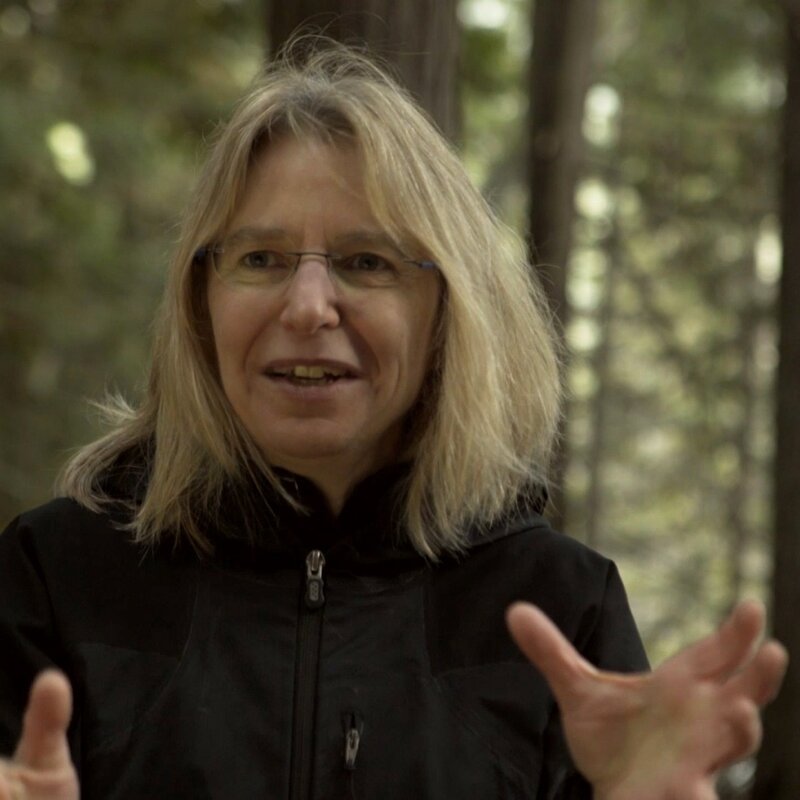
A Logging Family
Suzanne Simard was born in 1960 in British Columbia, into a family that had logged the inland rainforests of the Monashee Mountains for generations.
Her grandfather practised horse logging, selective and slow, taking individual trees and leaving the forest structure intact. She grew up in those woods, and the difference between how her family had worked and what came later shaped everything she did afterwards.
She trained in forestry and went to work for the British Columbia Forest Service in the 1980s, at the height of industrial clearcutting.
The Question Nobody Was Asking
Forestry doctrine at the time was built on competition. Trees competed for light, water, and nutrients, so the way to grow timber was to remove the competition: clearcut, plant a single commercially valuable species in rows, and spray or cut everything else.
Simard noticed that it was not working. Plantations of conifers established after clearcutting, with birch and alder removed as competitors, were frequently less healthy than naturally regenerated stands where those species remained.
The seedlings that were supposedly freed from competition were doing worse. Something in the doctrine was wrong.
The Isotope Experiment
Her answer came from a set of experiments in the 1990s that have become genuinely famous.
Simard grew paper birch, Douglas fir, and western red cedar together in the field. She covered pairs of seedlings with plastic bags and fed them carbon dioxide containing different carbon isotopes: one labelled with carbon-14, the other with carbon-13.
Then she measured where the labelled carbon ended up.
It moved. Carbon fixed by birch appeared in Douglas fir, and carbon from fir appeared in birch. The cedar, which forms a different type of mycorrhizal association, received almost none, which ruled out simple leakage through the soil and pointed directly to the fungal network as the pathway.
More striking was the direction. The net flow ran toward whichever seedling was more shaded and more in need. Birch, in full sun, subsidised fir in the shade during summer. In autumn, as birch dropped its leaves and fir kept photosynthesising, the flow reversed.
The paper was published in Nature in 1997. The journal put it on the cover under the phrase that stuck: the wood wide web.
What Followed
Simard and others went on to map the structure of these networks. They found that forests are connected below ground in patterns resembling other natural networks: a small number of large, old, highly connected trees linked to many smaller ones.
She called these hub trees, or mother trees. Older trees with extensive root and fungal connections, linked to dozens of neighbours, including their own offspring, which showed measurable preferential connection.
Further work indicated that dying trees transfer carbon and defence signals to neighbours, and that seedlings connected into an established network survive better than isolated ones.
The management implication is direct and was Simard's main practical argument: clearcutting removes the hubs. Taking out the oldest, most connected trees dismantles the below-ground infrastructure that the next generation would have plugged into. Retaining mature trees and mixed species is not sentimentality; it preserves the network.
That case is now reflected in retention forestry practice in several countries, and it is one of the strongest arguments in woodland management for continuous cover over clearfell.
The Scientific Argument
Simard's work is genuinely contested, and the disagreement is worth stating honestly because it is a live scientific debate rather than a manufactured one.
Critics, including a prominent 2023 review, have argued that the evidence for common mycorrhizal networks functioning as deliberate resource-sharing systems in mature forests is weaker than popular accounts suggest. The specific challenges are that carbon transfer has mostly been demonstrated in seedlings and controlled conditions, that the quantities moving may be ecologically minor, that fungi may be acting in their own interest rather than distributing resources altruistically, and that the mother tree framing imports intention into a system that need not have any.
Simard has defended the work and continues to publish. What is not disputed is that mycorrhizal fungi connect plants below ground, that transfer of carbon, nutrients, and signalling compounds between plants through fungi occurs, and that mycorrhizal networks are fundamental to forest function.
What remains genuinely open is how much moves, in what direction, under what conditions, and who benefits.
That is an ordinary scientific dispute about magnitude and mechanism, not a refutation. The underlying ecology is covered in mycorrhizal fungi and soil food web.
The Wider Effect
Simard became Professor of Forest Ecology at the University of British Columbia and founded the Mother Tree Project, a long-term field experiment testing retention harvesting across a range of climates in British Columbia.
Her 2021 memoir Finding the Mother Tree reached a very large general audience, and her ideas influenced Richard Powers's novel The Overstory and, through it, a much wider public conversation about forests.
The lasting contribution is a shift in default assumption. Forestry inherited a model of trees as individuals competing in a shared space. Simard's work moved the default toward forests as connected systems in which cooperation and exchange are at least as important as competition.
For anyone planting or managing woodland, the practical conclusions hold regardless of how the scientific dispute settles: keep the old trees, keep the species mixture, keep the soil biology intact, and be sceptical of any system that treats a forest as a collection of separate stems.
See also
- Mycorrhizal Fungi the underground networks
- Soil Food Web the wider soil biology
- Woodland Management retention over clearfell
- Structural Diversity why mixture matters
- Soil Inoculation restoring missing fungal partners