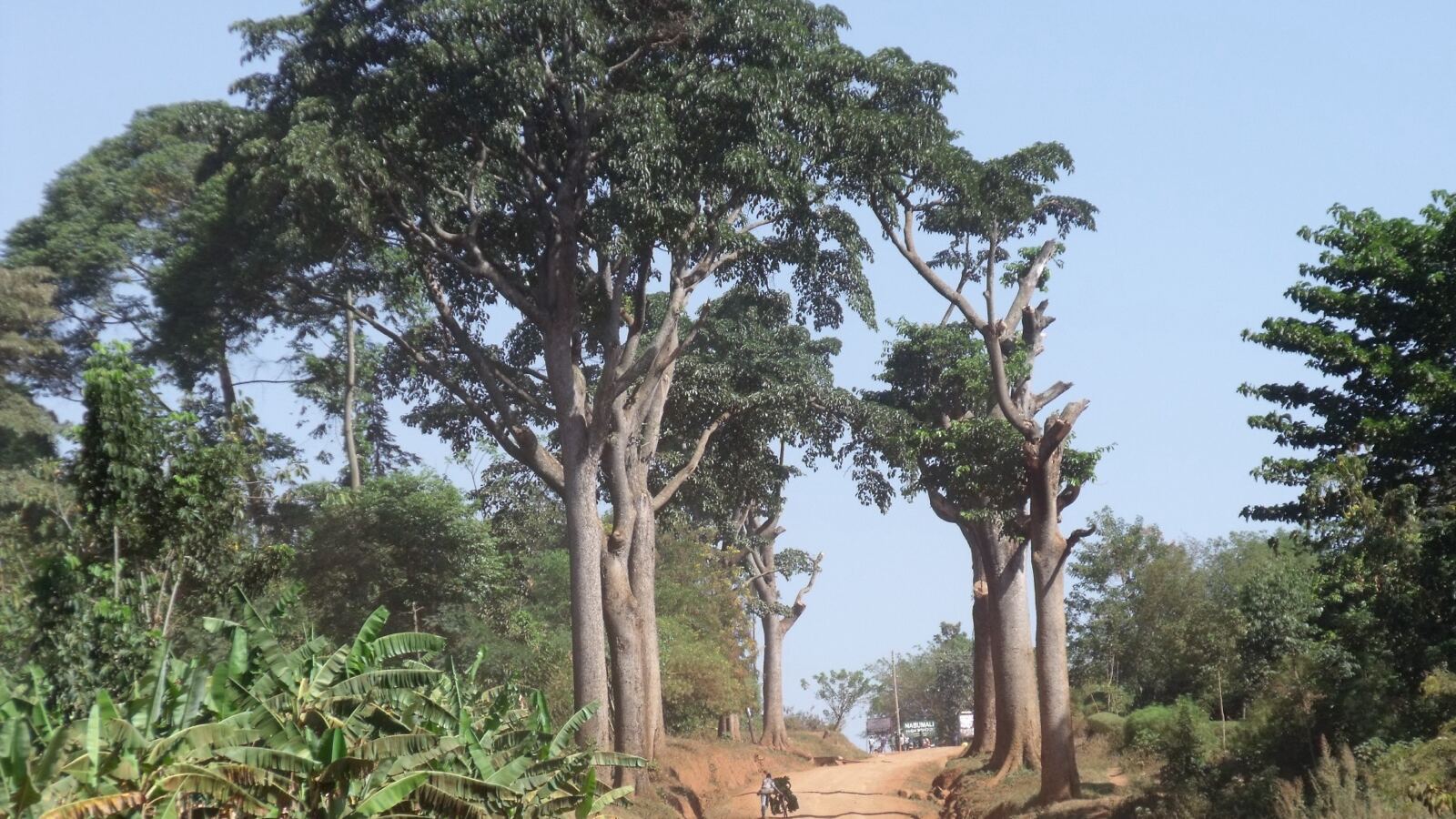
What it is
Milicia excelsa (and M. regia), the iroko — a large hardwood tree of tropical Africa, and one of the continent's most important timber trees, widely sold as "African teak" for its resemblance to the real teak.
Surprisingly, iroko is a member of the fig and mulberry family, Moraceae — a relative of the fig, mulberry, breadfruit, and banyan — and, like them, it exudes a milky latex when cut. It grows into a tall, straight-boled forest giant, and it is both a commercial timber of the first rank and, in West African belief, one of the most spiritually powerful trees in the forest.
The timber
Iroko's wood is the reason it is logged across Africa. It is a hard, heavy, golden-brown to dark-brown timber that is very durable and rot-resistant — resistant to insects, fungi, and weather without treatment — and dimensionally stable, so it is used, exactly as teak is, for outdoor and marine work: boat-building, decking, docks, garden furniture, cladding, flooring, and joinery, as well as heavy construction. It is often chosen as a cheaper substitute for teak, which it closely resembles once weathered, and it is one of West and Central Africa's principal export timbers. Like the other great tropical hardwoods, its value has driven heavy and sometimes unsustainable logging, and it is now a species of conservation concern, best bought certified and legal. See restoration economics and woodland management.
The stones in the wood
Iroko has one notorious peculiarity that every sawyer who has worked it knows: it grows stones inside its own wood. The tree deposits lumps of calcium carbonate (limestone) in its timber, hard mineral concretions traditionally called "stone" or rowe.
These hidden stones are hard enough to blunt or shatter saw blades and cutting tools, so milling iroko is hazardous and expensive, and the concretions are a real defect that downgrades the timber. It is an unusual and striking case of a tree literally mineralising part of its own trunk — the mechanism is thought to help the tree manage excess calcium — and it gives iroko a fearsome reputation in the sawmill quite separate from its reputation in the forest.
The tree of spirits
In much of West Africa, and especially in Yoruba belief, the iroko is far more than a timber tree: it is a sacred and feared tree, believed to be inhabited by a powerful spirit (the "Iroko-man" or ìrókò).
The tree is surrounded by taboo and ritual: it is said that spirits dwell in the great iroko, that the tree can be heard at night, and that anyone who cuts one down without the proper rites, or fells it carelessly, invites misfortune, madness, or death upon themselves and their family. Woodcutters traditionally make offerings and prayers before felling an iroko, and many old iroko trees are protected precisely because people fear the consequences of harming them. This spiritual status has, in effect, conserved countless great trees that would otherwise have been cut — religion and taboo doing the work of conservation, exactly as the sacredness of the banyan and bodhi fig, the baobab, and the dragon tree has protected them elsewhere. The iroko appears throughout West African and diaspora folklore, art, and religion. See historical ecology.
Growing it
Tropical, frost-tender, wanting the warm, humid conditions of the West and Central African forest zone and deep, well-drained soil; it is a large, long-lived forest tree, and a light-demander that regenerates in gaps and on forest edges.
It is grown from seed in restoration, enrichment planting, and (increasingly) plantation and agroforestry, both to relieve the pressure on wild trees and for its valuable timber — though its slow growth and a gall-forming psyllid pest that attacks young trees have made plantation establishment difficult. As a large shade and avenue tree it is also planted in African towns. The responsible use of iroko, as with all the great tropical hardwoods, means certified and legal sourcing. See propagation and reforestation techniques.
See also
- Teak the timber iroko imitates and substitutes for
- Banyan and Strangler Figs its sacred, latex-bearing fig-family relatives
- Fig Species and Mulberry more of the Moraceae family
- Baobab another sacred, taboo-protected African tree
- Restoration Economics the value driving iroko logging
- Historical Ecology belief and taboo as conservation