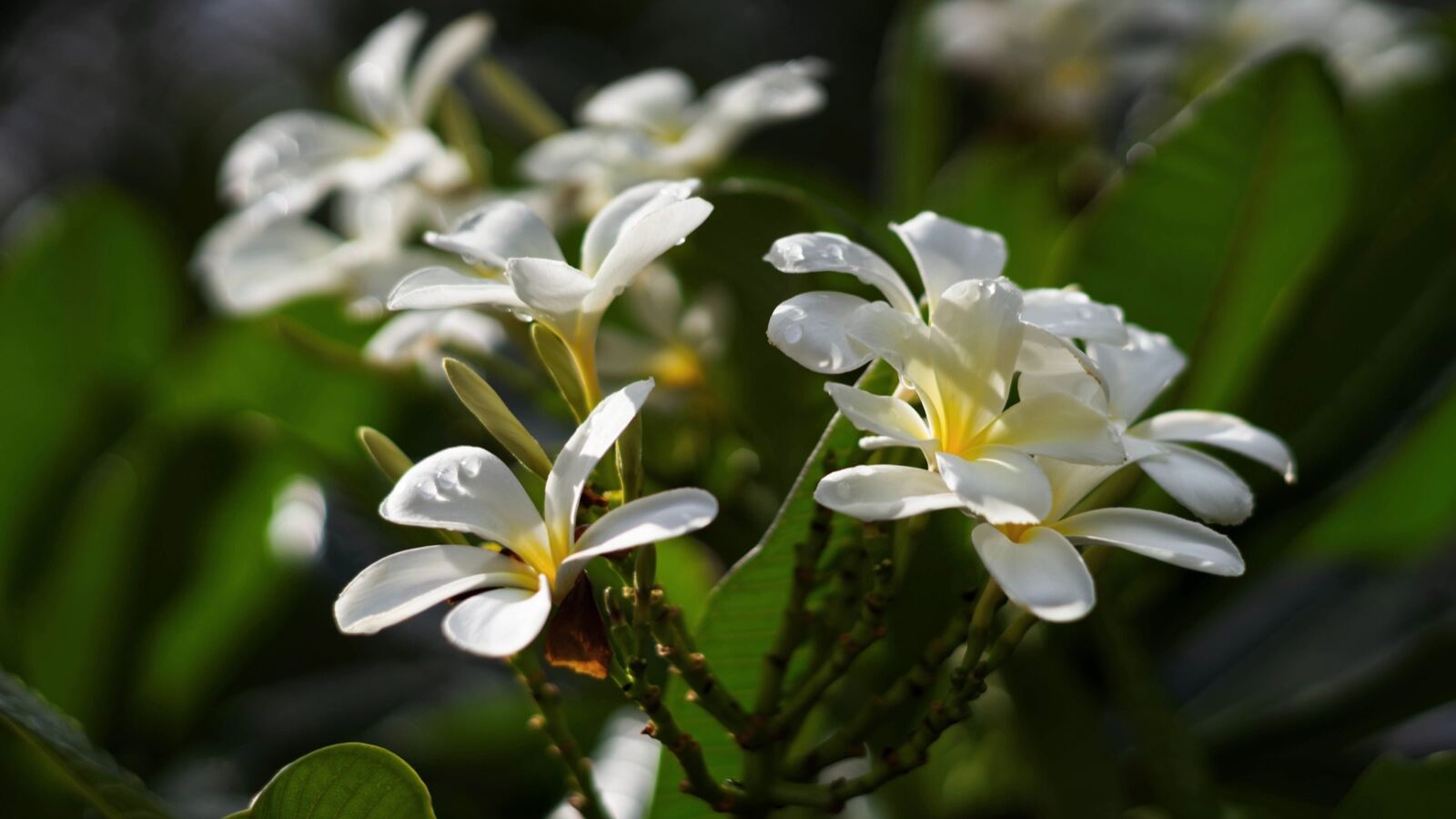
What it is
Plumeria, the frangipani — small tropical American trees, now grown and beloved across the warm world, famous above all for their intensely fragrant, waxy, five-petalled flowers in white, yellow, pink, and red, and for the thick, blunt, sparsely-branched form that makes an old frangipani look like a piece of living sculpture.
It belongs to the dogbane family, Apocynaceae — kin to oleander and, distantly, the milkweeds — and, like most of that family, it exudes a milky, toxic latex when cut, so the beautiful tree is also a mildly poisonous one, its sap an irritant not to be eaten.
The temple tree and the lei
Frangipani carries deep cultural meaning wherever it is grown. Across South and Southeast Asia it is the temple tree — planted in the grounds of Buddhist and Hindu temples and in cemeteries, its flowers offered at shrines, its association with the afterlife and the sacred so strong that in some cultures it is a tree of graveyards and spirits. In the Pacific, its flowers are the classic material of the Hawaiian and Polynesian lei and are worn behind the ear (on the left for taken, the right for available, by tradition). Its scent — sweet, rich, and heady — is one of the defining smells of the tropics.
Perfume as a lie
The frangipani's fragrance holds a beautiful piece of natural deception, and it is the tree's most fascinating secret.
The flowers pour out their strongest scent at night, and the fragrance is designed to attract night-flying hawk moths (sphinx moths), which the moth follows in the dark expecting the reward that a strongly-scented, pale, tubular night flower normally offers: nectar. But the frangipani flower produces no nectar at all. It is a deceit: the moth is lured in by the promise of a meal, probes the flower, finds nothing, and flies on to the next frangipani — and in the fruitless visiting it carries pollen from flower to flower, pollinating the tree for free. The frangipani, in effect, advertises a product it does not sell, exploiting the moth's instincts to get itself pollinated at no cost in nectar. It is one of the clearest and most elegant examples of pollination by deception, a strategy also used by many orchids. See pollinator habitat. (In cultivation far from its native moths, frangipani often sets little seed and is simply grown from cuttings — see below.)
Growing it
Tropical to warm-subtropical and frost-tender, the frangipani is one of the easiest of all tropical trees to grow, which is a large part of its popularity.
Soil and site. It wants full sun, heat, and — above all — very sharp drainage; it is highly drought-tolerant, storing water in its thick, fleshy, blunt branches, and it rots in wet, heavy, or cold ground, so overwatering is the main way it is killed. In cool climates it is grown in a pot and kept dry and frost-free over winter, when it obligingly drops its leaves and rests.
Propagation. Famously simple from cuttings: a thick branch cut off, left to callus for a week or two, and pushed into gritty soil will root and grow into a new tree — so frangipanis are passed from garden to garden as bare sticks, and named colour forms are all grown this way. See propagation and container growing.
Care. Little needed beyond sun, warmth, and restraint with water; the main pest is frangipani rust, an orange leaf fungus, and the sap should be kept off skin and out of mouths. It flowers over a long warm season, often on the bare branch tips, and fills the evening with scent.
For a frost-free garden or a sunny patio pot, the frangipani gives more fragrance and beauty for less effort than almost any tree — a piece of the temple and the tropics from a stick in the ground.
See also
- Pollinator Habitat the moth-deceiving trick behind its scent
- Jacaranda and Flame Tree other spectacular tropical flowering trees
- Silk-Floss Tree another water-storing flowering tropical tree
- Container Growing keeping a frangipani in a pot in cool climates
- Propagation growing frangipani from a cut stick
- Tropical Fruit Trees the wider warm-climate tree palette
- Ylang-Ylang
- Champak