What they are
The banyans and strangler figs are members of Ficus, the enormous fig genus that also gives the edible fig — over 800 species of trees, shrubs, and climbers, mostly tropical, and among the most ecologically important plants on Earth. They share the fig's milky latex and its unique "fruit," and a set of extraordinary growth habits found almost nowhere else.
The most famous are the strangler figs and the banyans (especially Ficus benghalensis) — figs that grow, quite literally, in the wrong direction, and that reach enormous size and age.
Growing downward: the strangler habit
A strangler fig begins life not in the ground but high in the canopy. A bird or bat eats a fig and deposits the tiny seed in a fork or crevice of another tree, where it germinates as an epiphyte, taking root in the debris caught among the branches.
From there it grows downward as well as up: it sends long aerial roots down the trunk of its host toward the soil, while spreading leaves above. When the roots reach the ground and root in, the fig begins to grow explosively — its roots thicken, fuse, and form a lattice that envelops and constricts the host tree, while its crown overtops and shades the host's own leaves. In time the host tree is strangled and shaded to death and rots away, leaving the fig standing as a hollow lattice-trunked tree in the shape of the tree it killed. It is one of the most dramatic growth strategies in the plant kingdom — a tree that uses another tree as a ladder to the light and then destroys it, sidestepping the slow, dangerous years of growing up through the shaded forest floor.
Banyans: a forest that is one tree
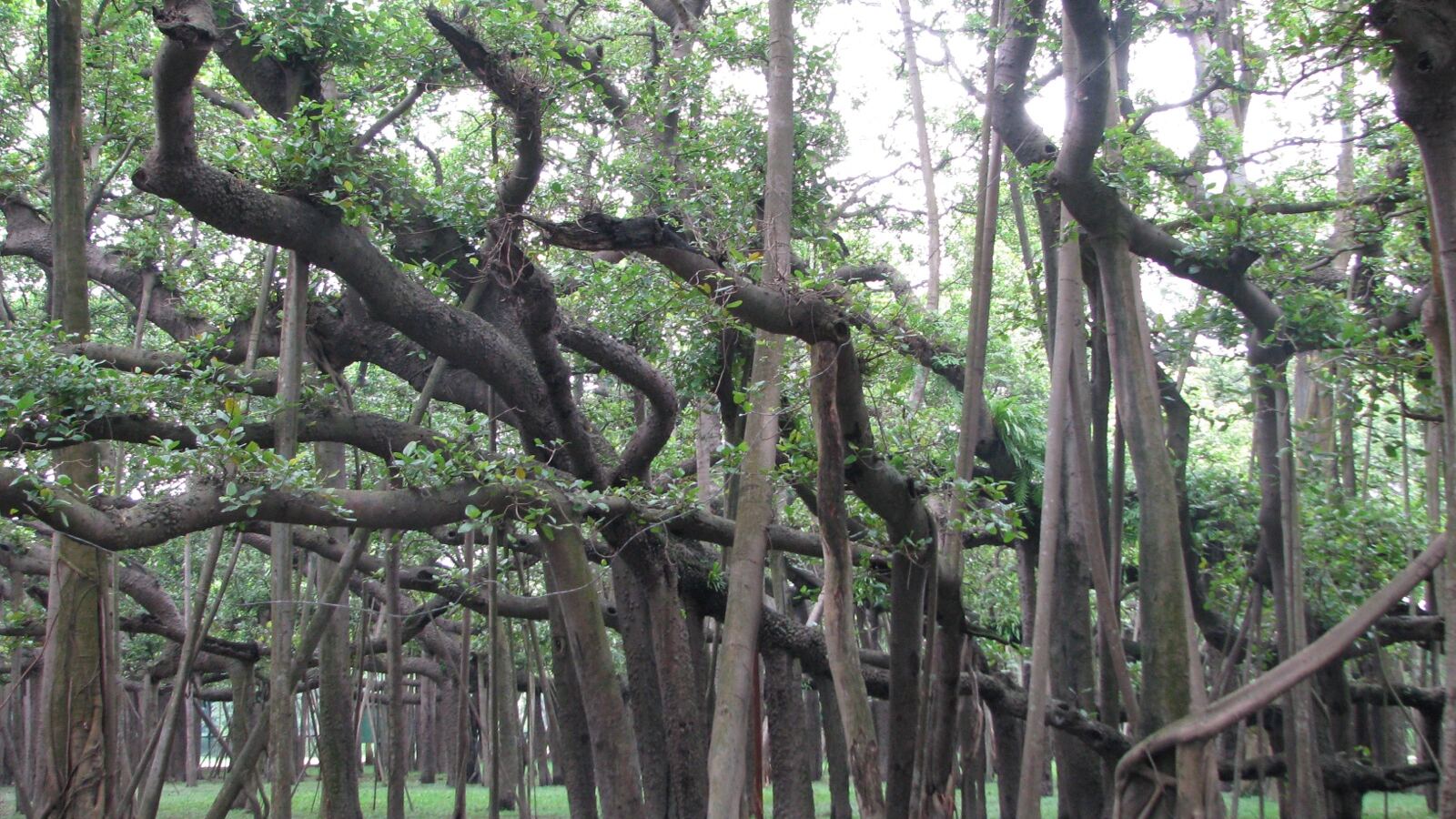
The banyans take another fig trick to its extreme. From their spreading horizontal branches they drop aerial prop roots that reach the ground, thicken into new "trunks," and support the branch so it can keep extending outward.
Repeated over centuries, this lets a single banyan spread laterally almost without limit, until one tree becomes a whole grove — a maze of pillar-like roots and interlinked crowns covering an area that looks like a small forest but is genetically one individual. The largest banyans (the Great Banyan near Kolkata, and the Thimmamma Marrimanu) cover several acres each and have thousands of prop-root "trunks," ranking among the largest trees in the world by canopy area. This is why the banyan is a symbol of longevity, shelter, and the interconnectedness of life across South Asia, and why villages grew up around them — a single banyan can shade a marketplace.
Sacred trees
Figs hold a religious place matched by few other trees. The sacred fig or bodhi tree (Ficus religiosa, the peepal) is the tree under which the Buddha is said to have attained enlightenment, and it is holy to Buddhists, Hindus, and Jains alike; descendants of the original Bodhi Tree are venerated and tended, and cuttings carried across Asia. The banyan is likewise sacred in Hinduism and is the national tree of India. This deep sacredness has, incidentally, protected many great figs from felling — religion doing the work of conservation, as it has for the dragon tree and baobab.
The fig and its wasp
Underlying all of this is one of the most famous partnerships in biology: figs and fig wasps are locked in an obligate mutualism as tight as the yucca and its moth.
A fig is not really a fruit but a hollow, fleshy chamber (a syconium) lined on the inside with hundreds of tiny flowers. The only way to pollinate them is from within, and this is done by minute fig wasps — each fig species pollinated by its own specific wasp species. A female wasp, carrying pollen, crawls in through a tiny pore (losing her wings in the squeeze), pollinates the flowers, lays her eggs, and dies inside; her offspring hatch, mate, and the new pollen-laden females fly off — often living only a day or two — to find another fig of exactly the right species at exactly the right stage. Neither fig nor wasp can reproduce without the other, and the coordination of the fig's flowering with the wasp's brief life is one of the wonders of coevolution. See pollinator habitat.
Keystones of the forest
Because different figs fruit at different times, a fig population produces fruit year-round, including in the lean seasons when almost nothing else is fruiting — and that fruit is eaten by an astonishing range of animals: monkeys, apes, bats, hornbills, pigeons, and countless others. This makes figs keystone species of tropical forests: in the hungry gaps, the figs are what keep the fruit-eating fauna alive, so a great fig tree supports far more of the forest's animal life than its numbers suggest, and losing figs can collapse whole communities. The birds and mammals repay the fig by dispersing its seeds — including up into the canopy forks where the next strangler begins. See seed-dispersing birds and structural diversity.
Growing them
Tropical and subtropical, frost-tender; figs want warmth and moisture and are otherwise tough, fast, and adaptable, tolerant of poor soil and pruning. Many banyans and strangler figs (the weeping fig, the rubber plant, and others) are among the most popular of all houseplants and indoor trees, precisely because they are so vigorous and forgiving.
Outdoors in the tropics they make magnificent shade and specimen trees — but their aggressive roots lift pavements, invade drains, and can damage buildings (a strangler will happily strangle a wall), so they need space and care in siting. Grown very easily from cuttings and, where their wasp is present, from seed. See propagation.
See also
- Fig Species the edible fig and the wider genus
- Keystone Species figs as year-round feeders of the forest
- Joshua Tree and Yuccas the parallel one-insect pollination partnership
- Pollinator Habitat the fig-wasp mutualism
- Breadfruit and Jackfruit the other giant Moraceae trees
- Baobab another sacred, protected forest giant
- Iroko
- Cannonball Tree
- Bael
- Chinese Parasol Tree
- Kadamba
- Coevolution