What it is
Ceiba speciosa (long known as Chorisia speciosa), the silk-floss tree — a striking flowering tree of the subtropical forests of South America, in the mallow family, Malvaceae, and a close relative of the great kapok, the baobab, and the Australian bottle trees.
It combines, in one tree, three memorable features — a spiny, bulging, green trunk; a spectacular display of large pink flowers; and pods full of silky floss — which makes it one of the most popular flowering street and park trees of the warm-temperate and subtropical world.
The green, spiny, bottle trunk
The silk-floss tree's trunk is unmistakable. When young it is bright green (and photosynthetic, like the palo verde), it often swells into a bottle shape as the tree stores water in it — the family water-storing trait of the baobab and kurrajong — and it is armed with stout, sharp, conical spines (really enlarged prickles) studding the bark like the studs on a mace.
Those spines are a defence — against climbing, browsing animals — and they make an old silk-floss trunk a genuinely formidable object, so the tree is sited away from where people brush against it. The swollen, spiny, green trunk is as much a reason to plant the tree as the flowers.
Pink flowers and silky floss
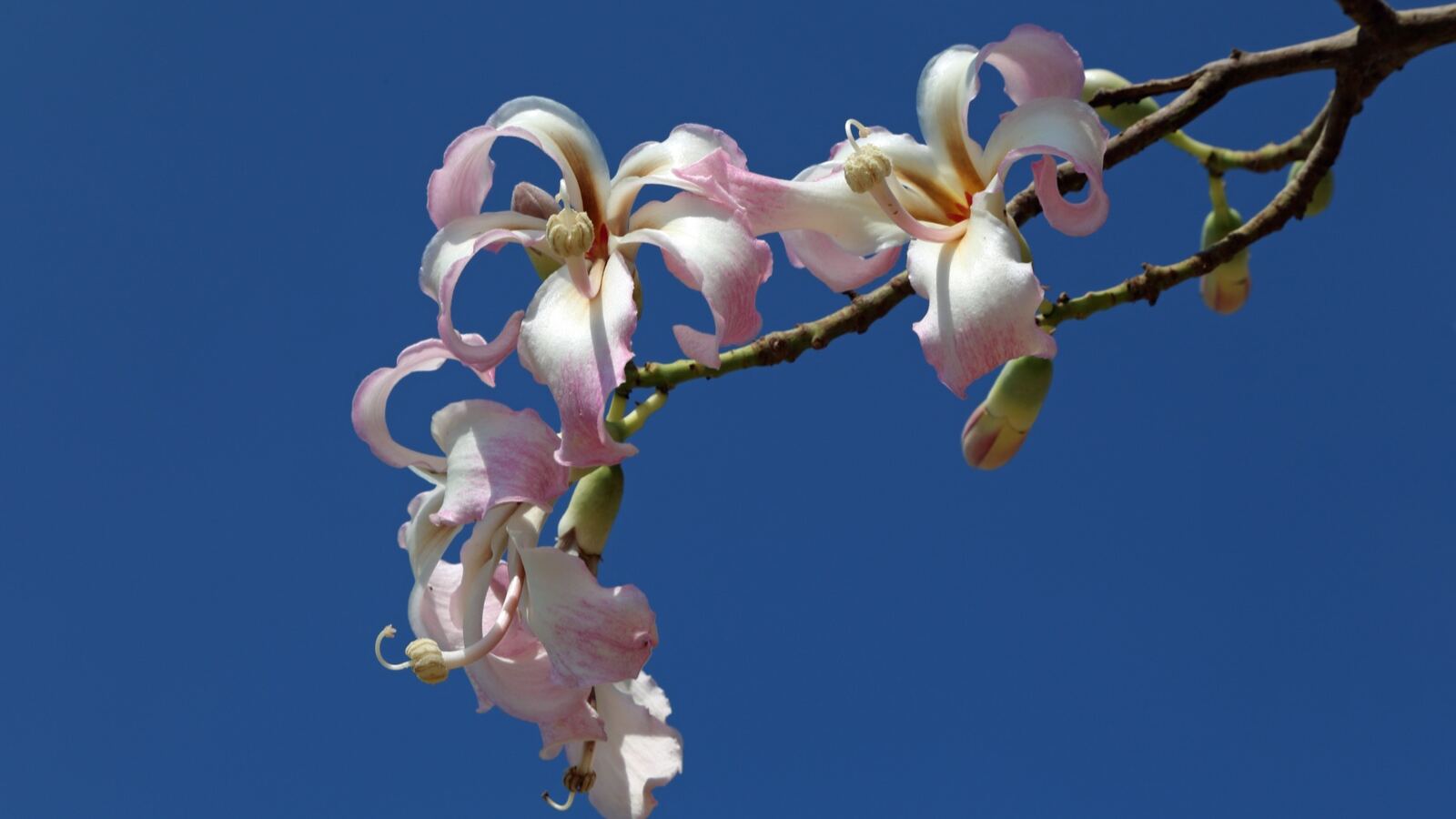
In late summer and autumn, often as the leaves fall, the silk-floss tree covers itself in large, showy, five-petalled flowers — usually deep pink to rose with a creamy-white or yellow throat, hibiscus-like (they are, after all, in the hibiscus family) — a spectacular display that rivals the flame tree and jacaranda it is often planted with. The nectar-rich flowers are worked by bees, butterflies, and, in their native range, hummingbirds, making it a good pollinator tree.
The flowers give way to woody pods that split to release seeds embedded in a mass of fluffy, silky, cream-coloured fibre — the "silk floss" of the name — which is essentially the same buoyant kapok-type fibre as its cousin produces, used in the same way as a stuffing for pillows, cushions, and life-preservers, and carrying the seeds on the wind. So the tree is, in effect, an ornamental cousin of the kapok, grown for beauty rather than fibre but making the same floss.
Growing it
Subtropical to warm-temperate, and moderately frost-tolerant once established (mature trees take several degrees of frost, which lets it be grown well beyond the tropics — it is a common street tree in California, the Mediterranean, and Australia), the silk-floss tree wants full sun and well-drained soil.
It is fast-growing and drought-tolerant once its water-storing trunk is established, tolerant of poor soil, heat, and urban conditions, which — with its long autumn flowering — makes it a favourite warm-climate ornamental and street tree; it needs room for its spreading crown and should be placed where its spiny trunk is no hazard. Grown easily from seed (which is quick) and cuttings. For a frost-light warm garden, it offers a bottle trunk, a mace of spines, a blaze of pink flowers, and a puff of silk all in one tree. See propagation and urban forestry.
See also
- Kapok and Balsa its close relative, grown for the same silky floss
- Baobab the family's great water-storing giant
- Kurrajong and Bottle Trees more swollen-trunked mallow-family trees
- Jacaranda and Flame Tree the flowering trees it is planted among
- Palo Verde another tree with a green, photosynthetic trunk
- Pollinator Habitat the nectar of its pink flowers
- Chinese Parasol Tree
- Bombax