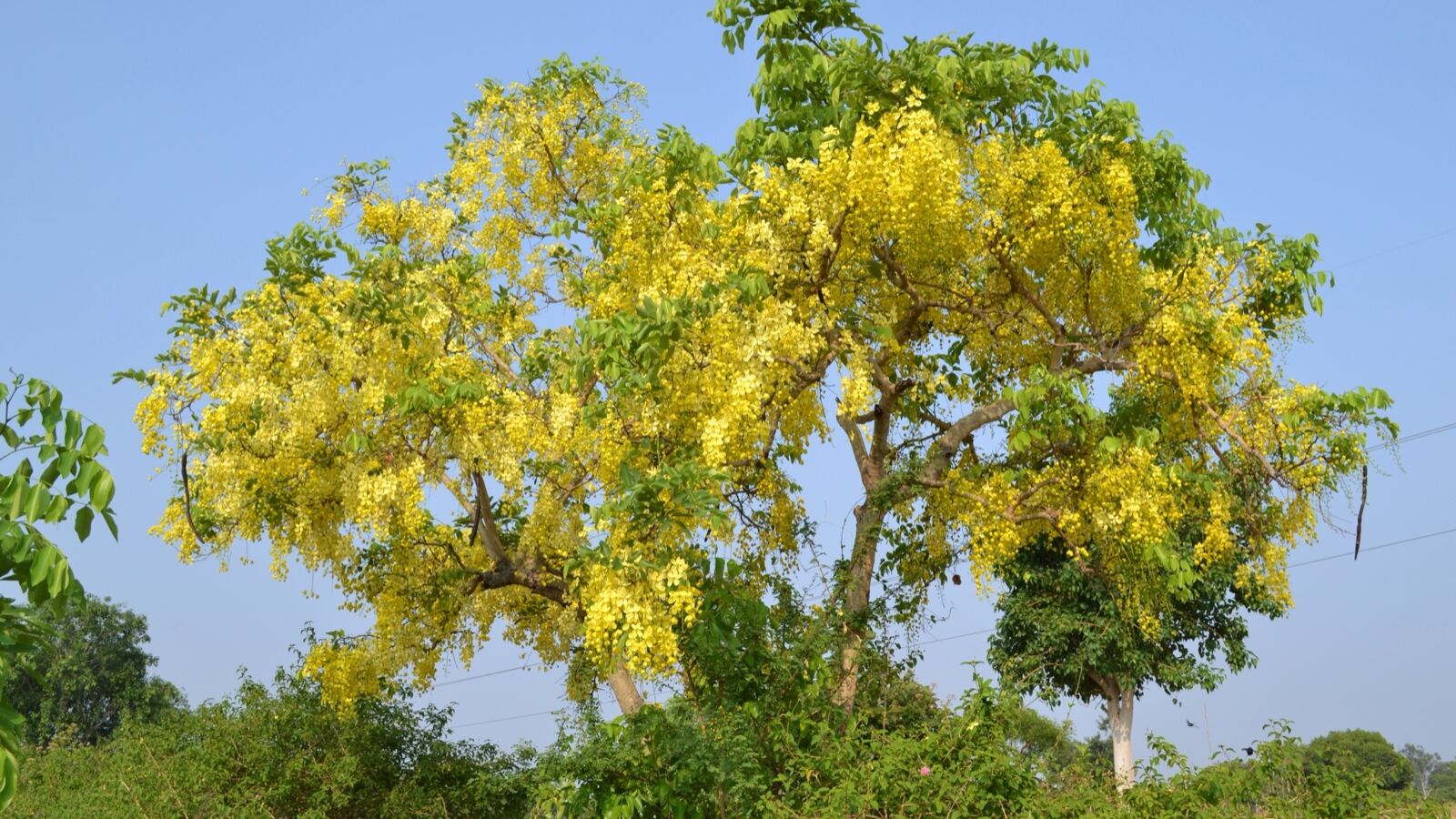
What it is
Cassia fistula, the golden shower tree — a flowering tree of South Asia, in the legume family, kin to the silk tree, tamarind, and the other pea-flowered trees — grown throughout the tropics for one of the most beautiful of all floral displays.
It is the national tree and national flower of Thailand, where it is called ratchaphruek and its golden colour is associated with royalty and Buddhism, and it is the state flower of Kerala in India, central to the Vishu festival — a tree woven into the culture of the regions it graces.
A shower of gold
The golden shower tree flowers in late spring and early summer, and when it does, it lives up to its name completely: the tree hangs itself with long, pendulous, cascading chains of pure bright-yellow flowers, dozens of blooms to a chain, dripping from every branch so that the whole crown becomes a shimmering cascade of gold — often before the new leaves are fully out, so the colour is unbroken.
It is one of the most spectacular flowering trees of the tropics, the yellow counterpart to the scarlet flame tree and the blue jacaranda, and it is planted everywhere in the warm world for avenues, parks, and gardens for those few glorious weeks of bloom. The chains of flowers recall the pea-flower chains of the temperate laburnum — indeed "golden shower" and laburnum's "golden chain" are close cousins in name and effect, though from different genera. The nectar-rich flowers are worked by large carpenter bees, the tree's main pollinators. See pollinator habitat.
The pudding-pipe pods
After the flowers come the fruit, and they are as distinctive as the blooms: long, cylindrical, dark-brown-to-black pods, up to 60 cm, that hang down like rods and give the tree its other old names — the "pudding-pipe tree" and "Indian laburnum." The pods rattle their seeds in the wind and hang on for months.
Inside, the seeds are separated by a sticky, sweetish, dark pulp, and that pulp — cassia pulp — has a long and important use in medicine: it is a gentle, safe laxative, valued in Ayurvedic, Unani, and Western herbal medicine for centuries and still used, milder than the drastic purges of many plants. So the golden shower tree, like several others in this encyclopedia, is at once a spectacular ornamental and a medicinal plant, its beauty and its pharmacy hanging on the same branches. (The related Cassia and Senna species give the stronger laxative senna.)
Growing it
Tropical to warm-subtropical and frost-tender, the golden shower tree wants heat, full sun, and well-drained soil, and it is drought-tolerant once established — indeed it flowers best where there is a distinct hot dry season, which triggers the spectacular bloom, so it thrives in seasonally-dry tropical climates.
It is a medium-sized, moderately fast-growing, fairly short-lived tree that flowers young, and it is grown very easily from seed (which is hard-coated and benefits from scarification, and comes reasonably true). As a legume it fixes a little nitrogen and tolerates poor soil, adding to its value as a tough, low-care ornamental and street tree. Give it sun, heat, and a dry season, and it will pay it back in gold. See propagation and urban forestry.
See also
- Laburnum the temperate "golden chain" tree it echoes
- Jacaranda and Flame Tree the scarlet and blue flowering trees it joins
- Silk Tree and Tamarind and Carob legume-tree relatives
- Pollinator Habitat the carpenter bees that pollinate it
- Urban Forestry the golden shower tree as an avenue tree
- Rain Tree another great legume shade-and-flower tree of the tropics
- Flame of the Forest