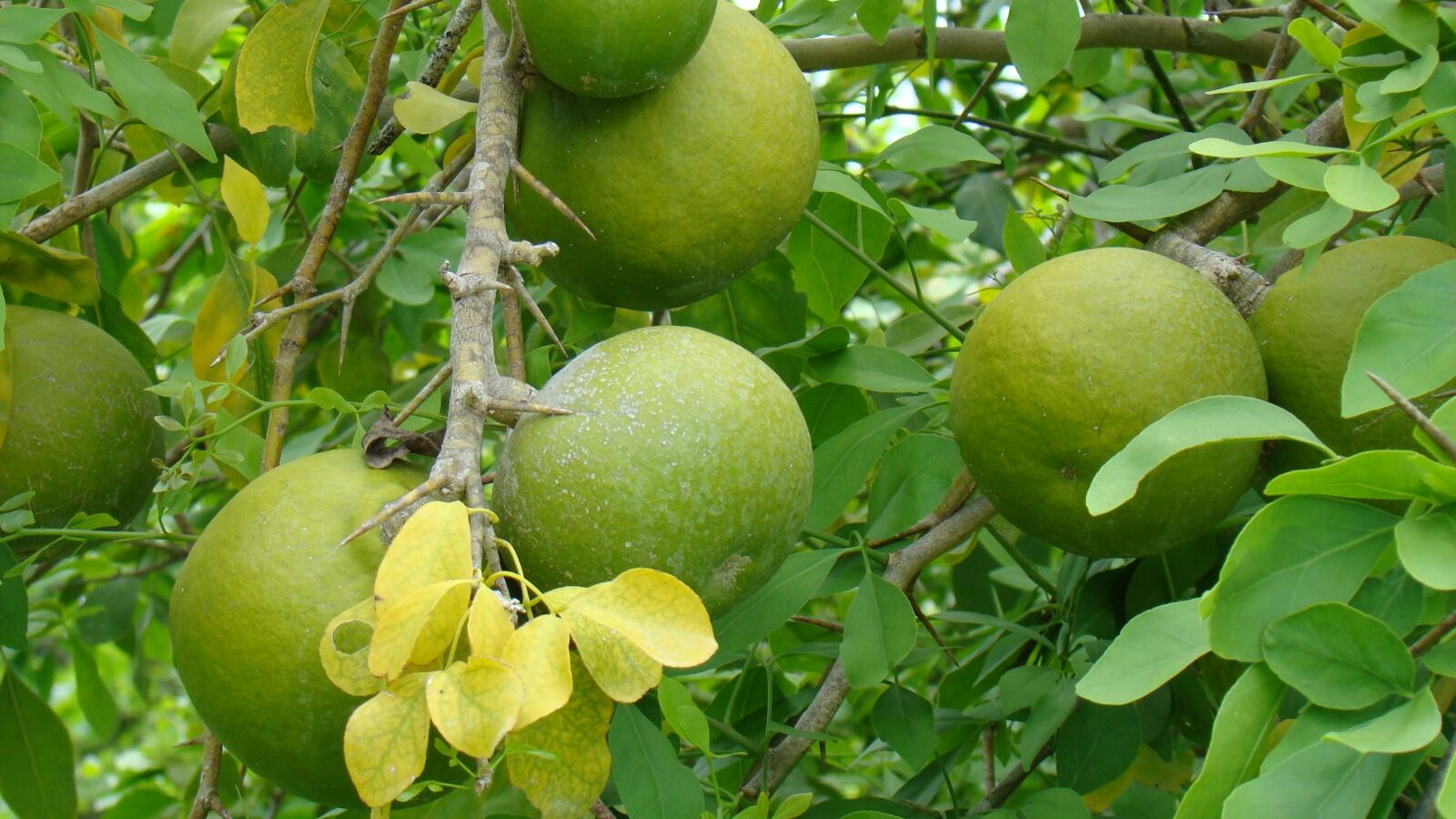
What it is
Aegle marmelos, the bael, bel, or stone/wood apple — a thorny, medium-sized deciduous tree of the Indian subcontinent and Southeast Asia, bearing round fruit with a smooth, hard, woody shell enclosing an aromatic orange pulp.
It belongs to the citrus family, Rutaceae — a relative of the citrus and the curry tree — and, like them, its leaves are aromatic when crushed. It is one of the most sacred and useful trees of India, revered in Hinduism and valued across South Asian medicine and cooking.
Sacred to Shiva
The bael is, above all, the tree of the god Shiva, and this shapes its whole cultural place. Its distinctive trifoliate leaves — each leaf divided into three leaflets — are seen to represent Shiva's trident, or the three eyes or three aspects of the god, and bael (bilva) leaves are the essential offering in the worship of Shiva, laid on the Shiva lingam in temples and home shrines across India.
The tree is planted at temples, considered holy to touch, and woven through Hindu ritual and mythology, so that — like the banyan and peepal — its sacredness has helped protect and propagate it for millennia. It appears throughout Indian religious life, and its cultivation is inseparable from its worship. See historical ecology.
The fruit and the drink
The bael fruit is unusual and unmistakable: a hard, woody, smooth shell (sometimes needing to be cracked open with a hammer) enclosing a fragrant, sweet, mucilaginous orange pulp full of seeds. The pulp is aromatic and pleasant, and its most famous use is as a cooling drink: the pulp is mixed with water, sugar, and sometimes milk to make bael sharbat, a refreshing summer beverage valued across India as a cooler and a digestive, especially in the fierce pre-monsoon heat.
Medicinally, the bael is one of the more important Ayurvedic and folk remedies, the unripe fruit in particular long used as a treatment for dysentery, diarrhoea, and digestive complaints (a use with some scientific support), and the leaves, bark, and root all having a place in traditional medicine. Ripe and unripe, the fruit is also made into preserves, murabba, and dried "bael candy."
Growing it
Tropical to subtropical, and notably tough and hardy: the bael tolerates a wide range of conditions — heat, drought, poor and alkaline and even somewhat saline soils, and periodic waterlogging — as well as some cold, which lets it grow across much of India from the plains into the foothills. It wants full sun and a distinct dry season, and it is deep-rooted, drought-hardy, and undemanding once established, making it a good tree for difficult, dry sites. See drought-tolerant species.
It is thorny and slow-to-moderate growing, long-lived, and grown from seed (variable) and by grafting and root cuttings for named fruiting types. The fragrant greenish-white flowers feed bees, and the tree is a natural, sacred, and useful component of a subtropical food forest and dryland planting. See propagation and tropical fruit trees.
See also
- Citrus the aromatic family the bael belongs to
- Curry Tree another useful Rutaceae of the subcontinent
- Amla a fellow sacred, medicinal Indian fruit tree
- Banyan and Strangler Figs the sacred peepal and banyan
- Historical Ecology sacredness as a force protecting trees
- Drought-Tolerant Species the bael for hot, dry sites
- Hardy Orange
- Myrobalan
- Sichuan Pepper