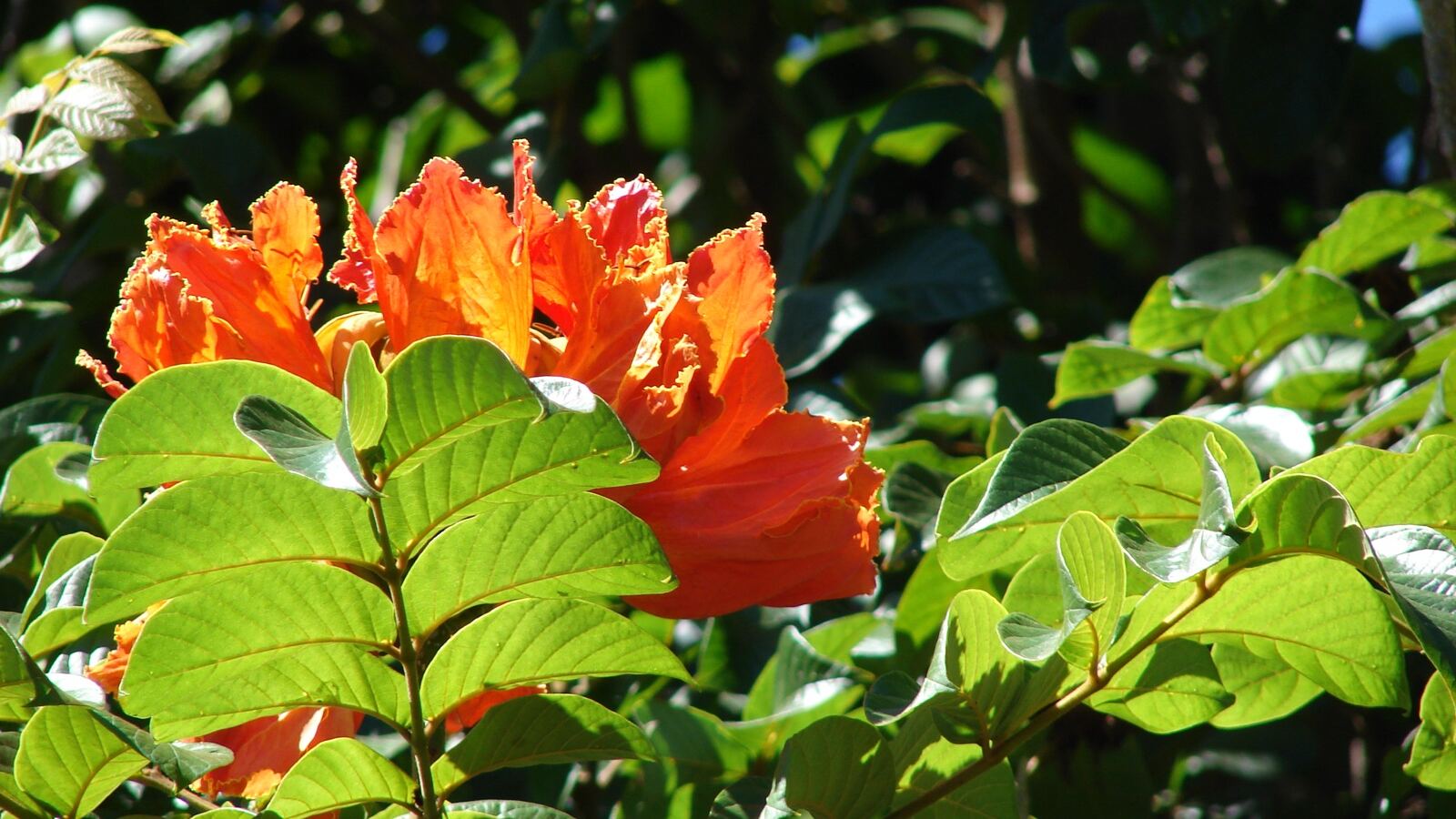
What it is
Spathodea campanulata, the African tulip tree — a large, fast-growing tropical tree of West and Central Africa, in the trumpet-vine family, Bignoniaceae, alongside the jacaranda, catalpa, sausage tree, and ipê.
It is grown throughout the tropics for its spectacular flowering, which earns it the names "flame of the forest" and "fountain tree": at the top of the crown it carries dense clusters of large, cupped, ruffled, scarlet-and-orange flowers that blaze against the dark foliage, one of the showiest of all tropical flowering trees.
The water in the bud
The African tulip tree has a delightful quirk that children across the tropics know well. The unopened flower buds are filled with water — a watery sap held inside the closed, boat-shaped bud (the spatha of its scientific name) — and when squeezed, the bud squirts that water out in a jet.
So the buds are used as natural squirt-toys, and the tree is sometimes called the "fountain tree" or "squirt tree" for this reason. The water-filled buds also serve the plant: they are visited by birds and insects that drink from them, and the arrangement of the flowers — opening in a ring around the outside of the cluster, each a cup of nectar — makes the African tulip tree a heavy nectar source, worked by sunbirds and other birds in its native Africa. See native bees.
One of the world's worst invaders
The African tulip tree's beauty carried it around the tropical world as an ornamental — and there it revealed a darker side, becoming one of the most damaging invasive trees on the planet, listed among the world's 100 worst invasive species.
It is fast, tough, and prolific: it produces enormous quantities of light, winged, wind-blown seed, resprouts and suckers vigorously when cut, and shoots up quickly in any gap, so across the Pacific islands (Fiji, Hawaii, and many others), the Caribbean, and other warm regions it has invaded on a huge scale, forming dense stands that smother and replace native forest. In some island ecosystems it is thought to actively harm native bees — its nectar or pollen appearing to be toxic to some stingless bees — compounding its ecological damage. It is a textbook case of a gorgeous ornamental turned catastrophe, the same story as so many other beautiful, prolific, bird- and wind-sown trees, and it is now banned or targeted for control in many of the places that once planted it. See invasive species. Where it is not invasive, its soft, light wood is of little value and the tree is grown purely for the flowers.
Growing it
Tropical to warm-subtropical and frost-tender, the African tulip tree wants heat, full sun, and moist, well-drained soil, and is otherwise easy, fast, and undemanding — indeed too easy, which is the root of its invasiveness.
It grows quickly into a large, spreading tree with a dense crown and brittle, soft wood (so it drops limbs and is not for planting over targets), and it flowers young and long. It is grown from seed (part of the problem) and from cuttings and suckers. Because of its serious invasiveness, it should be planted only where it is not a threat — and in much of the tropical island world the responsible choice is not to plant it at all, choosing a well-behaved flowering tree instead. See propagation and urban forestry.
See also
- Jacaranda and Flame Tree other blazing tropical flowering trees
- Ipê and Pau d'Arco and Catalpa trumpet-family relatives
- Sausage Tree the African Bignoniaceae with the giant fruit
- Invasive Species the African tulip tree in the Pacific
- Pollinator Habitat its nectar — and its harm to some native bees
- Frangipani another widely-planted tropical flowering tree