Not cereals at all
A pseudocereal is a broadleaf plant whose seed is used like grain. They are not grasses, and they are not related to each other beyond that shared use.
Buckwheat, Fagopyrum esculentum, is in the knotweed family — a relative of dock, sorrel, and rhubarb.
Quinoa, Chenopodium quinoa, and amaranth, Amaranthus species, are in the amaranth family, alongside beetroot and chard and spinach.
None contains gluten, so none makes risen bread, and all three are safe for coeliacs.
Buckwheat: 30 days to flower
Buckwheat's defining quality is speed.
It goes from sowing to flowering in about four to six weeks, and to seed in 10 to 12. Nothing else useful is that fast.
That makes it the outstanding short-window cover crop. Sow it into a gap between crops in midsummer, and within six weeks it has:
Smothered weeds with dense broad leaves and rapid canopy closure.
Flowered abundantly, feeding bees, hoverflies, and parasitoid wasps at a point in the season when nectar is often scarce. Buckwheat is one of the best insectary plants available and is grown deliberately for it. See pollinator habitat and beneficial predators.
Scavenged phosphorus. Buckwheat is unusually good at accessing soil phosphorus that other crops cannot reach, apparently through root exudates, and it releases it on decomposition. This is the best-supported of the dynamic accumulator claims.
Produced easy biomass, soft and quick to break down, unlike cereal straw.
Terminate by cutting or hoeing before seed sets — buckwheat self-seeds readily and becomes a weed if allowed. It is frost-tender, so a late sowing winter-kills conveniently.
Buckwheat honey is dark, strong, and distinctive.
The groats are used as kasha in eastern Europe, as soba noodles in Japan, and as galettes in Brittany. Note that soba is frequently cut with wheat flour, since pure buckwheat noodles are difficult to make and fragile.
Quinoa and saponins
Quinoa was a staple of the Andes for thousands of years, cultivated at 3,000 to 4,000 m alongside potatoes.
The seed coat contains saponins — bitter, soapy compounds that deter birds and insects. They must be removed before eating, traditionally by repeated washing and rubbing, industrially by mechanical abrasion.
Most quinoa sold is already de-saponified, though rinsing before cooking is still worth doing. Saponin-free varieties exist and are more vulnerable to bird damage, which is exactly why the saponins evolved.
Nutritionally quinoa is genuinely unusual among plant staples: a complete protein containing all essential amino acids in useful proportions, including lysine, which cereals are low in. That is real, and it is the basis of its reputation.
The boom is worth being honest about. Quinoa prices rose sharply from around 2006 as demand grew in wealthy countries. The widely repeated claim that this priced Bolivian and Peruvian growers out of their own staple is more complicated than the headlines: studies found that producing households' welfare improved substantially, and that consumption in growing regions fell somewhat but incomes rose more.
The more durable concerns are agronomic: intensification of quinoa monoculture on the Bolivian altiplano displaced llama grazing and fallow periods, causing soil degradation and erosion in a fragile dryland system. That is the same pattern described in dryland restoration and grassland restoration.
Amaranth
Grown for both grain and leaf, and important on both counts.
As a grain it was a staple of the Aztecs, used in ritual foods — which is why Spanish colonial authorities suppressed its cultivation, though the extent of the ban is often overstated.
The seed is tiny, high in protein and lysine like quinoa, and pops like miniature popcorn when heated, which is the traditional preparation.
As a leaf vegetable it is far more widely eaten than as grain — callaloo in the Caribbean, and a staple green across West Africa, India, and Southeast Asia. It is heat-tolerant and productive in conditions where spinach bolts immediately, which makes it one of the better summer greens in hot climates. See salad leaves.
Amaranth is a C4 plant, like sweetcorn and sorghum, giving it high photosynthetic efficiency in heat and drought.
Several Amaranthus species are also serious agricultural weeds — Palmer amaranth in particular, which has evolved glyphosate resistance and is a major problem in American cotton and soya. Same genus, different species, very different reputation.
Growing them
All three are undemanding and none needs rich soil.
Buckwheat. Sow after frost, broadcast at 6 to 10 g per square metre. Tolerates poor and acid soil, dislikes drought and heat at flowering. Harvest is awkward because seed ripens unevenly and shatters — cut when most seeds are brown, and finish drying under cover.
Quinoa. Sow in spring, thin to 25 to 40 cm. Prefers cool conditions and dislikes hot humid weather, which causes the seed to sprout in the head. It grows well in cool temperate climates and is a viable garden crop in northern Europe. Harvest when the leaves have dropped and the seed rubs free.
Amaranth. Sow after frost, warm soil. Very drought and heat tolerant. For leaf, cut repeatedly. For grain, harvest when seed shatters easily on rubbing.
All three shatter readily, which is the main harvest difficulty. Cut into a container, or bend heads into a bucket and rub.
Threshing and winnowing as for wheat, though the seed is much finer and needs a light touch on the winnowing.
Why they are worth space
Grain generally is a poor use of garden space, as set out in wheat. Pseudocereals are the partial exception:
Buckwheat earns its place as a cover crop and insectary plant regardless of whether you harvest any seed.
Amaranth earns it as a heat-tolerant leaf crop.
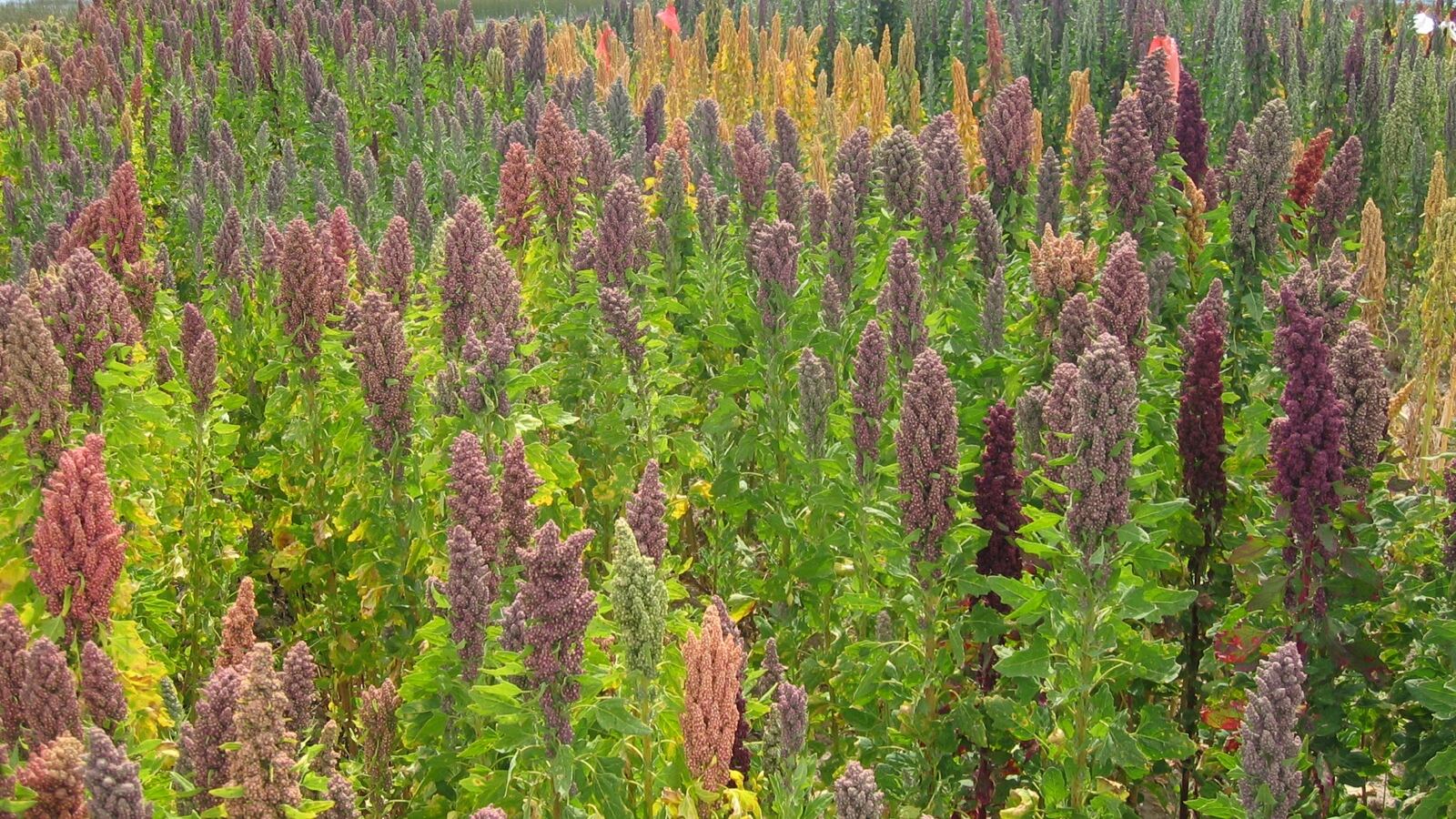
Quinoa is the most ornamental of the three — the seed heads are spectacular in red, gold, and purple — and is a genuine novelty grain that will ripen in a cool climate.
All three are also useful for genetic and dietary diversity, which is the broader argument in seed banking: a food system resting on three grasses is a narrow one.
See also
- Cover Cropping buckwheat in a short window
- Wheat the grain-scale arithmetic
- Salad Leaves amaranth as a summer green
- Pollinator Habitat buckwheat as an insectary crop
- Beetroot and Chard the family relatives
- Seed Banking diversity beyond the three big grasses