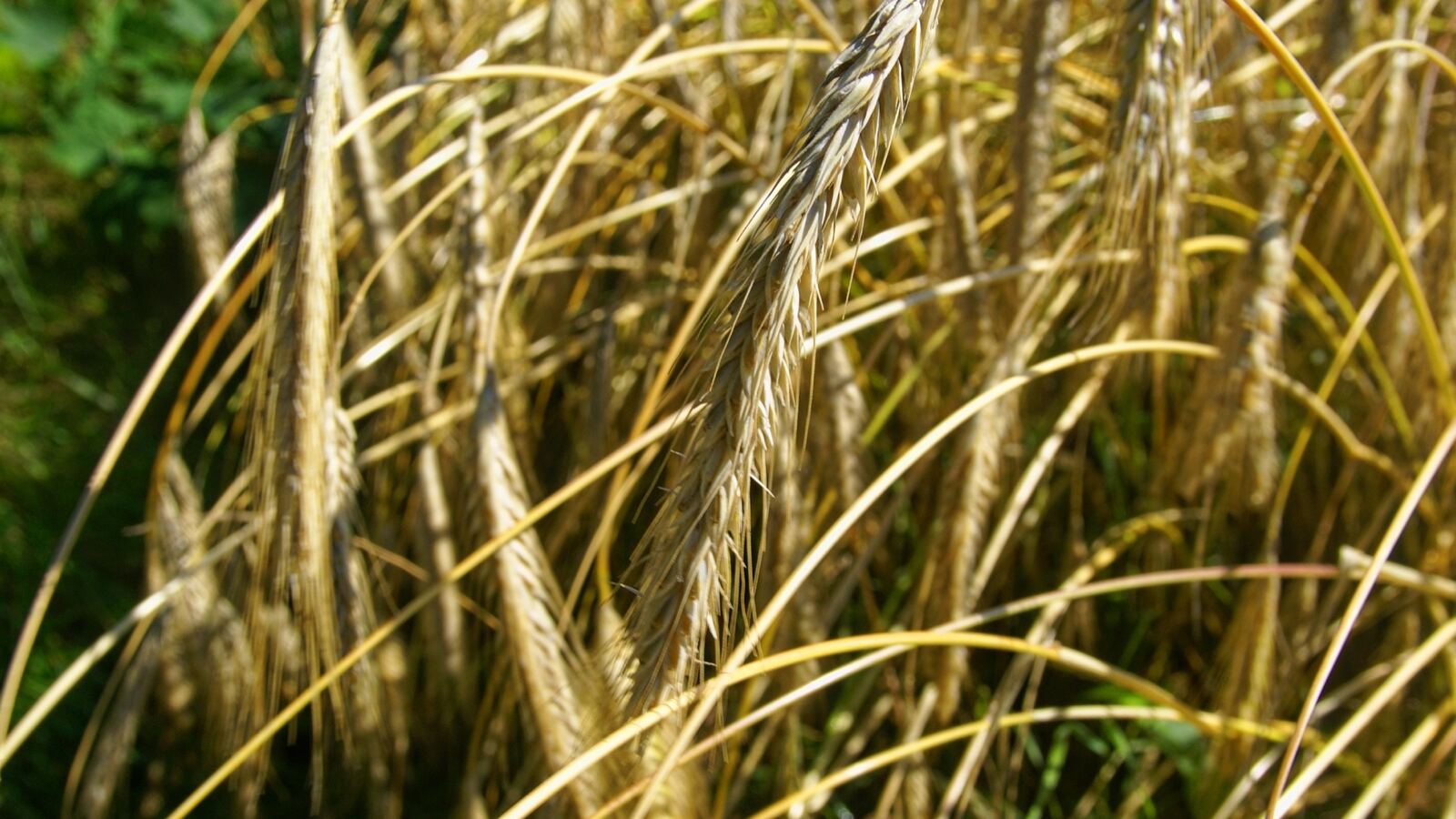
What it is
Hordeum vulgare, domesticated in the Fertile Crescent alongside wheat around 10,000 years ago, and among the earliest crops anywhere.
Instantly recognisable in the field by its long awns — the bristles projecting from the ear, considerably longer than wheat's — which give a ripe barley field its characteristic shimmer.
Fourth largest cereal crop globally, and the great majority of it goes to animal feed and to malting rather than directly to human food.
The toughest cereal
Barley's defining agronomic quality is stress tolerance, and it is why it appears at the margins of cultivation everywhere.
Drought. It has a shorter growing season than wheat and matures faster, so it escapes summer drought rather than enduring it.
Salinity. Barley is the most salt-tolerant of the major cereals by a clear margin, which is why it appears in the archaeological record of southern Mesopotamia as wheat was progressively abandoned. That transition is one of the clearest documented cases of salinisation reshaping agriculture, and it is set out in salinity.
Cold and altitude. Barley grows further north and higher than wheat, which is why it was the bread grain of Scotland, Scandinavia, Tibet, and the Andes fringe.
Poor soil, though it dislikes acidity more than rye and oats do and wants a reasonable pH. See soil pH.
The rule of thumb across much of history: grow wheat if you can, barley if you cannot.
Two-row and six-row
The distinction that determines what a crop is for.
A barley ear has flowers arranged in triplets along the spike.
Six-row barley: all three flowers in each triplet set grain, giving six rows of grain around the ear. Higher protein, more enzymes, smaller and less uniform grains. Favoured for animal feed, and in American brewing traditions.
Two-row barley: only the central flower of each triplet sets, giving two rows. Larger, plumper, more uniform grains with higher starch and lower protein. The preferred malting barley in Europe.
Malting wants low protein and high starch, because starch converts to fermentable sugar and excess protein causes haze in beer. That has a direct agronomic consequence: malting barley is deliberately grown with restrained nitrogen, because heavy feeding raises grain protein and pushes the crop out of malting specification and into the much lower-priced feed market.
It is one of the few crops where over-fertilising costs money directly and immediately.
What malting does
Malting is controlled germination, halted at the right moment, and it is worth understanding because it explains why barley rather than another grain.
Steeping. Grain is soaked to raise moisture to around 45 percent, with rest periods for oxygen.
Germination. The grain is kept moist and cool for several days and begins to sprout. This is the point: germination activates amylase enzymes, which the seedling would use to break its starch reserve into sugars it can metabolise.
Kilning. Drying with heat stops germination before the seedling consumes the starch, and preserves the enzymes.
The result is a grain full of starch plus the enzymes needed to convert it. Add hot water in the mash and the enzymes do the conversion, producing fermentable sugar for the yeast.
Barley dominates malting because its husk stays attached to the grain, and that husk forms a natural filter bed in the mash tun that lets the sweet liquid drain clear. Wheat and rye, which thresh free, produce a sticky mash that is difficult to lauter.
Kilning temperature determines colour and flavour, from pale lager malt through crystal to roasted black malt — one grain, an enormous range of products.
Barley malt also underpins whisky, and peat-smoked kilning is what gives Islay whiskies their character. See peatland restoration for the other side of peat use.
As food
Barley was a staple bread grain for millennia and largely stopped being one when wheat became affordable, because it lacks gluten-forming proteins and makes dense flatbreads rather than risen loaves. See wheat.
It persists in:
Pearl barley, polished to remove the husk and bran, used in soups and stews.
Pot barley, less polished and more nutritious.
Barley flour and flatbreads, still traditional in Tibet as tsampa, in the Middle East, and in Scandinavia.
Barley water and roasted barley tea, common across East Asia.
Nutritionally it is notable for beta-glucan soluble fibre, which has well-supported cholesterol-lowering effects — the same compound that gives oats their reputation.
Growing it
Very similar to wheat, and slightly more forgiving.
Winter and spring types, with winter barley sown in autumn, vernalising, and harvesting earlier than any other cereal — often the first combinable crop off the field.
Sow at roughly 4 to 6 g per square metre for a garden patch, 2 to 3 cm deep.
Do not overfeed if malting quality matters. For feed or straw, nitrogen is fine.
Harvest when the ear droops, the straw is dry, and the grain is hard. Barley ripens fast and shatters if left too long, so timing is tighter than for wheat.
The awns are unpleasant. They are barbed and work into skin and clothing, and handling barley sheaves without long sleeves is a mistake made once. Awnless varieties exist and are grown for whole-crop forage.
Threshing, winnowing, and storage are as for wheat.
At garden scale barley is most worthwhile for straw, for home malting, and as a fast cover crop — it establishes quickly and produces good biomass.
In rotation
Barley traditionally follows the root break in the Norfolk four-course — wheat, turnips, barley, clover — taking advantage of the cleaned ground and undersown with the clover ley that would follow. See crop rotation and turnips and swedes.
It is a good crop to undersow, since it establishes and finishes early, leaving the understorey to develop.
Diseases are the usual cereal set: rhynchosporium, net blotch, mildew, and rusts. See structural diversity for the monoculture argument that applies to every one of them.
See also
- Wheat the grain barley substitutes for
- Rye and Oats the other hardy cereals
- Salinity why barley replaced wheat in Mesopotamia
- Crop Rotation the Norfolk sequence
- Cover Cropping barley as fast biomass
- Harvest and Storage threshing and keeping grain