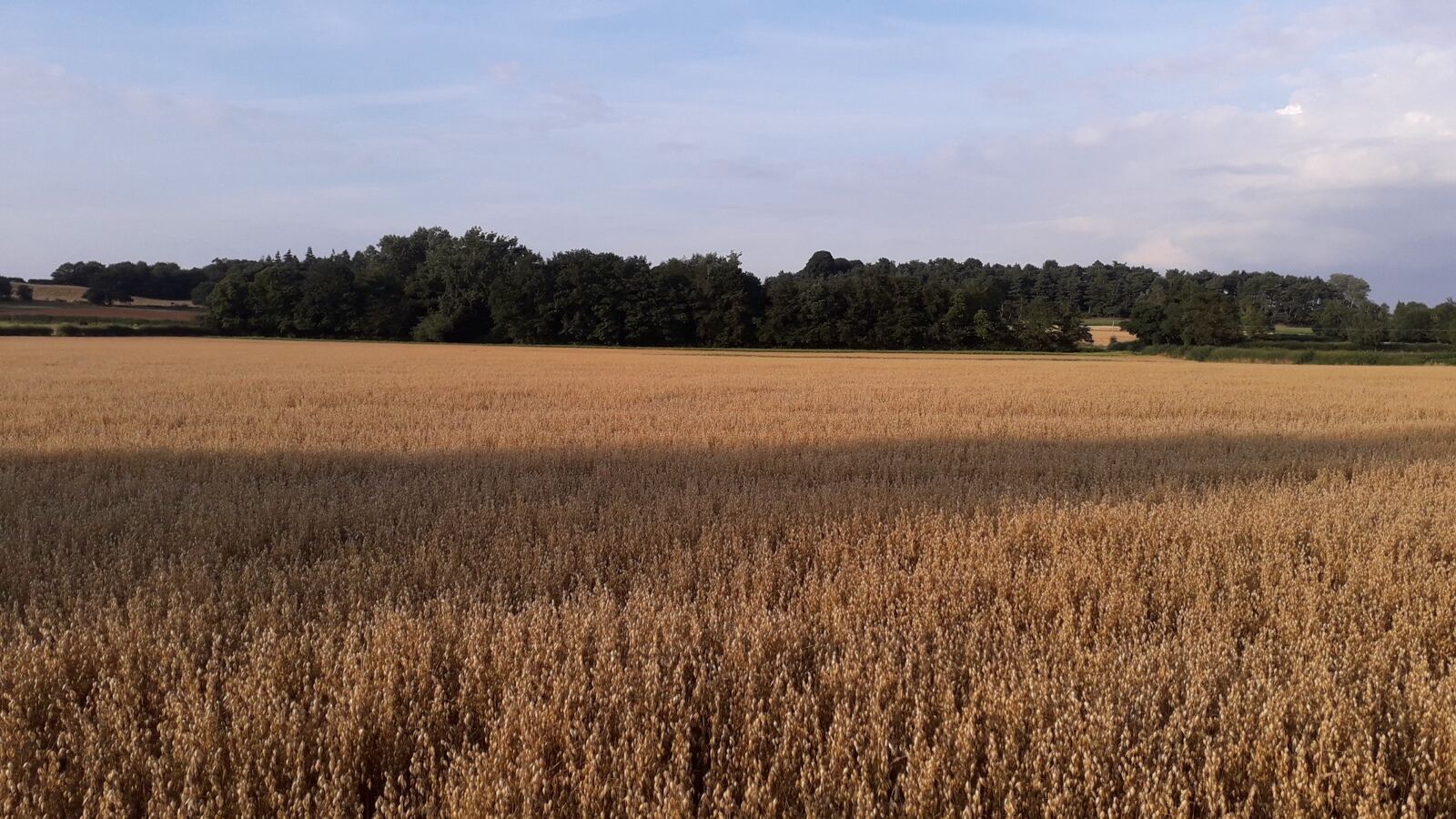
Weeds that were promoted
Both rye and oats began as weeds of wheat and barley fields, and both were domesticated by accident.
As cultivation spread north and to higher ground, wheat and barley struggled while their weed companions did not. Farmers who harvested a mixed crop found that in the poorest fields the weed was most of what came in — and eventually sowed it deliberately.
This is secondary domestication, and it explains why both are hardier than the crops they infested: they were selected by exactly the conditions that defeated wheat.
Rye
Secale cereale, and the toughest of the temperate cereals.
Cold tolerance exceeds every other cereal — winter rye survives to around minus 30 C and grows at soil temperatures barely above freezing, so it keeps growing into late autumn and starts again very early.
Poor and acid soils suit it. Rye tolerates sandy, thin, acid ground where wheat fails outright, which is why it was the bread grain of northern and eastern Europe on sandy soils.
Deep rooting, considerably deeper than wheat, giving drought tolerance and access to leached nutrients.
Rye bread is dense, dark, and long-keeping. It contains gluten but a different profile from wheat's, forming a weaker network — hence dense crumb. Rye is high in pentosans, which hold water, and that plus sourdough acidity is why rye bread keeps for weeks where wheat bread stales in days. Traditional rye baking is nearly always sourdough, because the acidity is needed to control enzyme activity that would otherwise leave the crumb gummy.
Ergot is the historical hazard specific to rye. Claviceps purpurea replaces the grain with a dark sclerotium containing alkaloids that cause ergotism — gangrene, convulsions, and hallucinations. Outbreaks of St Anthony's Fire recur through European history, and the ergot alkaloids are chemically related to LSD. Modern cleaning removes the sclerotia, and rye remains the most susceptible cereal.
Rye's allelopathy
The property that makes rye the outstanding cover crop.
Rye releases benzoxazinoids from its roots and residues, which suppress germination of many small-seeded weeds. Combined with fast dense growth and cold-season activity, that makes it exceptionally good at holding ground clean over winter.
Sown after a summer crop, rye:
Grows when nothing else will, capturing autumn and early spring warmth.
Takes up residual nitrogen before it leaches, holding it in biomass over winter.
Produces very large biomass — often the most of any temperate cover crop.
Suppresses weeds chemically as well as by shading.
Roots deeply, breaking surface compaction. See decompaction.
The caution follows directly from the allelopathy: those same compounds inhibit small-seeded crops for a few weeks after termination. Do not sow carrots, lettuce, or brassicas directly into freshly killed rye residue. Large-seeded transplants and potatoes are unaffected. Allow two to three weeks after termination for small seed.
Terminate by mowing, rolling, or crimping at flowering — rye that has begun to flower does not regrow. See cover cropping and chop and drop.
Oats
Avena sativa, the mildest-mannered of the cereals.
Cool and wet suits them. Oats tolerate high rainfall and cool summers better than wheat or barley, which is why they were the staple of Scotland, Ireland, and Scandinavia. They are less cold-hardy than rye over winter, and most oats are spring-sown outside mild climates.
Acid soils are tolerated well.
Beta-glucan is the nutritional point. Oats are high in this soluble fibre, and its cholesterol-lowering effect is among the better-supported dietary claims, carrying approved health claims in several jurisdictions.
Oats have no gluten-forming proteins, so they cannot make risen bread — hence porridge, oatcakes, and bannocks. Oats are naturally gluten-free but are routinely contaminated in milling and transport, so coeliacs need certified oats.
The grain is hulled and needs dehulling, and the groats are usually kilned to deactivate lipase — otherwise the high oil content goes rancid quickly. That kilning is also what gives oats their toasted flavour.
Oats as a cover crop
Different from rye and useful for different reasons.
Winter-killed cover. In cold climates oats grow fast in autumn and are killed by hard frost, leaving a flat mulch that is easy to plant into in spring with no termination work at all. That makes them the easiest cover crop for a grower without machinery.
Fast establishment and good weed smothering.
Excellent nurse crop for undersowing clover or a grass ley, since they establish quickly and then die back.
Less allelopathy than rye, so no waiting period before small-seeded crops.
Oats plus vetch or peas is a standard mix, combining biomass with nitrogen fixation. See peas and beans and cover cropping.
Growing both
At garden scale, both are more useful as cover crops and straw than as grain, for the reasons of scale set out in wheat.
Sow at roughly 5 to 8 g per square metre broadcast, raked in. Rye in autumn, oats in autumn for winter-kill or spring for a grain crop.
Undemanding. Neither needs fertile ground, and rye positively prefers poor sandy soil.
Harvest when straw is dry and grain hard. Oats shatter readily and are traditionally cut slightly early and stooked to finish.
Rye grows very tall — up to 2 m — and produces a large volume of straw, historically valued for thatching and bedding because of its length and durability.
Threshing and winnowing as for wheat, with the extra dehulling step for oats.
Triticale
Worth knowing: × Triticosecale, a deliberate wheat–rye hybrid combining wheat's yield and grain quality with rye's hardiness and disease resistance.
It is widely grown as animal feed and as a cover crop, and it is one of the few entirely synthetic crop species in general cultivation.
See also
- Wheat the crop they began as weeds of
- Barley the other stress-tolerant cereal
- Cover Cropping where both do their most useful work
- Weed Management rye's allelopathic suppression
- Crop Rotation fitting cereals into the sequence
- Decompaction deep rye roots breaking pans