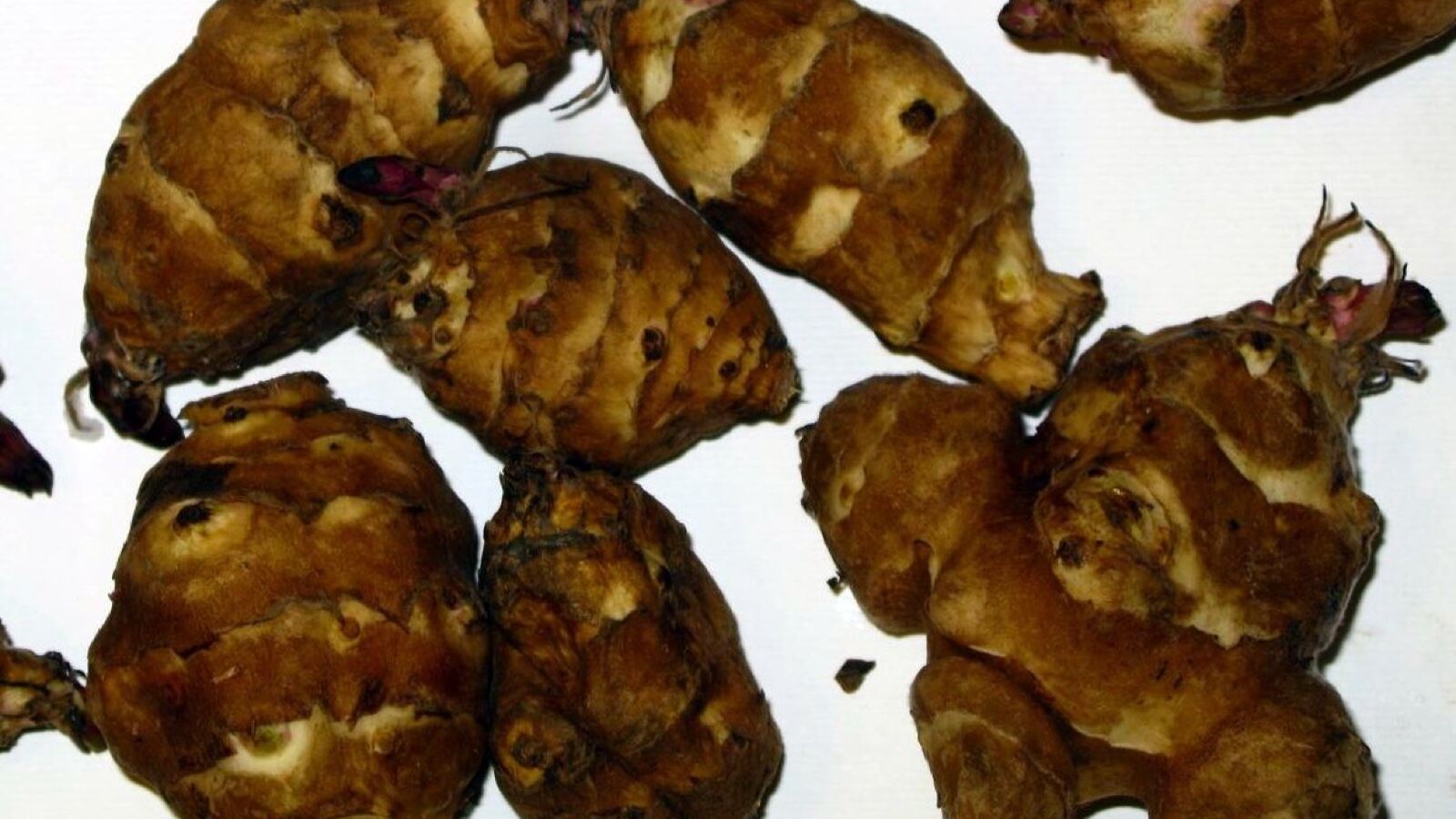
What it is
Helianthus tuberosus, a perennial sunflower from eastern North America, where it was cultivated long before European contact.
Neither from Jerusalem nor an artichoke. The name is probably a corruption of girasole, Italian for sunflower, and the artichoke part came from a comparison of the flavour. Sunchoke is the tidier modern name.
The plant reaches 2 to 3 m with small yellow sunflowers, and stores its reserves in knobbly underground tubers.
Inulin, not starch
The distinguishing fact about this crop, in both directions.
Jerusalem artichokes store carbohydrate as inulin, a fructose polymer, rather than starch. Humans cannot digest inulin in the small intestine — it passes to the colon, where gut bacteria ferment it.
The consequences:
It is a prebiotic, feeding beneficial gut flora, and it has a very low glycaemic impact, which is why it has been recommended for diabetic diets.
It causes flatulence, sometimes spectacularly. This is not a minor caveat and it is the reason the crop never became mainstream despite its productivity. The seventeenth-century writer John Goodyer complained about exactly this, and nothing has changed.
Mitigations that genuinely help: introduce it gradually so the gut adapts; harvest after frost, since cold converts some inulin to fructose; store tubers for a few weeks, which continues that conversion; and cook long and slow. Some people are unaffected and some are severely affected, so serve modest portions to guests the first time.
Enormous yields, minimal effort
Set against that, this is one of the most productive and least demanding crops available.
It grows almost anywhere. Poor soil, partial shade, drought, cold — it tolerates conditions that defeat most vegetables. Fully hardy well below freezing.
Yields are large, commonly 2 to 4 kg per plant, from ground that would grow little else.
It needs essentially nothing. No feeding, no spraying, no staking on a sheltered site, no rotation.
Pests and diseases are negligible, which is genuinely unusual.
It stores itself in the ground, so there is no curing, no clamp, and no shed space required.
For a difficult corner, a poor patch, or a low-input plot, very little competes.
The catch: it is permanent
Every tuber fragment left in the ground regrows. Harvesting is never complete, and a bed planted once is effectively a bed planted forever.
That is not automatically a problem — a perennial patch that returns every year with no work is exactly what you might want. It becomes a problem when you decide you want the ground back, because clearing it takes two or three seasons of digging and removing regrowth.
So treat it as a permanent planting and site it accordingly:
Give it a dedicated bed, an awkward corner, or a boundary strip, not a slot in the vegetable rotation.
Contain it if you must — a bed with edging, or a large sunken container.
Use the height deliberately. At 2 to 3 m it makes a fast summer windbreak or screen, and it can shelter more tender crops. It also shades whatever is north of it, so place it on the northern edge of a plot. See windbreaks.
This is a crop where observation first applies straightforwardly: decide where you are content for it to live for a decade, then plant.
Growing it
Plant tubers in early spring, 10 to 15 cm deep, 30 cm apart, in rows 90 cm apart. Any tuber the size of a hen's egg will do, and pieces with a bud work.
Earth up slightly as they grow for stability.
Stake or shelter on exposed sites. The stems are tall and top-heavy and will go over in an August gale, which does not destroy the crop but makes a mess.
Cut the stems back to about 30 cm once the foliage blackens after frost. This stops wind-rock and makes the rows easy to find. Leaving a short stump marks each plant.
Water in extreme drought only, though tuber size improves with summer moisture.
The stems are a large biomass return — tough, woody, and excellent for the compost heap as a carbon source, or chopped as mulch. See chop and drop and composting methods.
Some varieties are far less knobbly than the wild type and much easier to clean — Fuseau is the classic smooth one, and it is worth seeking out.
Harvest
After the first frosts, from autumn through winter.
Leave them in the ground and dig as needed. They keep far better in the soil than out of it, and frost improves both flavour and digestibility.
Out of the ground they shrivel quickly — the skin is thin and they lose water within days. If you must lift a batch, store them in damp sand in the cold and dark, like carrots, and use within a few weeks.
Save a few of the best tubers to replant, though in practice the ones you miss will do it for you. See harvest and storage.
In wider systems
The combination of productivity, hardiness, indifference to soil, and permanence makes this a natural component of low-input perennial systems — the argument in perennials first and a standard inclusion in the herbaceous layer of a food forest.
The flowers are late-season and useful to pollinators when much else has finished, and the dense stand provides cover. See pollinator habitat.
It is also grown as a fodder crop and as a biomass crop, and it has been used to rehabilitate poor and contaminated ground, since it produces bulk on soils that will not support much else. See bioremediation.
See also
- Perennials First planting once for years of yield
- Potatoes the other tuber crop, and a very different temperament
- Harvest and Storage why they keep best in the ground
- Windbreaks using the height as summer shelter
- Food Forest Design the herbaceous perennial layer
- Chop and Drop what to do with the stems
- Fennel and Chicory