Why it matters more than fertiliser
pH is a measure of acidity, running from 0 to 14, with 7 neutral. It is logarithmic, so pH 5 is ten times more acidic than pH 6 and a hundred times more than pH 7. Small numerical changes are large chemical ones.
It matters because pH controls availability. A soil can contain plenty of a nutrient that plants cannot access because the chemistry holds it in an insoluble form.
Most nutrients are most available between about pH 6 and 7, which is why that band is recommended for most growing.
Below roughly 5.5: phosphorus locks up with iron and aluminium, calcium and magnesium leach away, and aluminium and manganese become soluble enough to be directly toxic to roots. Bacterial activity slows, and nitrogen-fixing rhizobia struggle, which is why clovers fail on acid ground.
Above roughly 7.5: iron, manganese, zinc, copper, and boron become progressively unavailable. Phosphorus locks up again, this time with calcium.
So a plant on the wrong pH shows deficiency symptoms in a soil full of nutrients, and feeding it does very little. See nutrient deficiency.
Testing
Test before you do anything. Adjusting pH blind is how people make soil worse.
Cheap probes are largely unreliable. Do not make decisions on them.
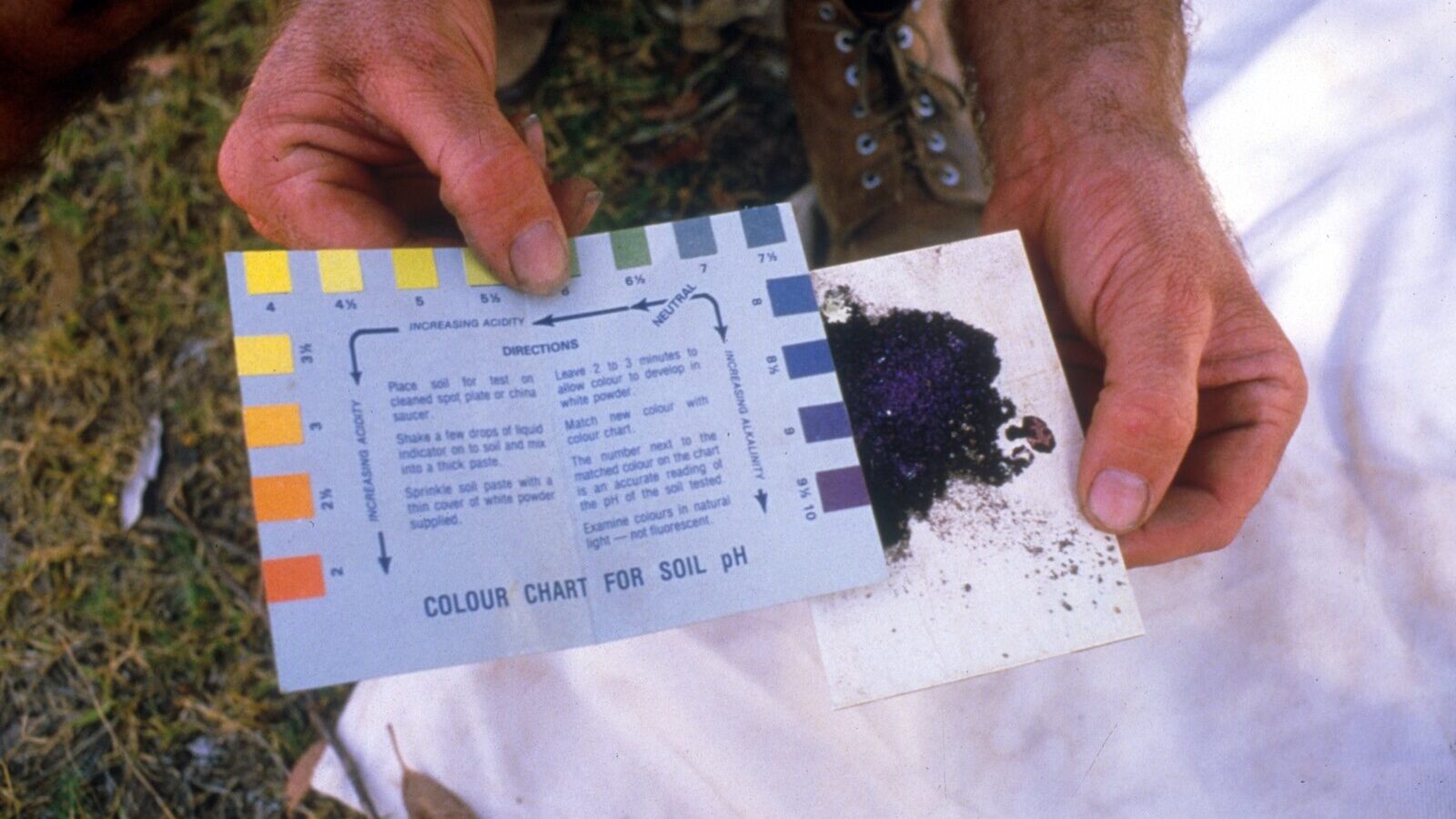
Chemical test kits with a colour indicator are accurate enough for practical purposes and cost very little.
Laboratory tests give pH plus buffer pH, which is the number that actually tells you how much lime a soil needs, and that is worth paying for on anything at scale. See soil testing.
Sample properly. Multiple cores from across the area, mixed together, taken at consistent depth, avoiding unusual spots. pH varies substantially over short distances, and a single sample from beside an old wall will mislead you about the whole plot.
Test topsoil and subsoil separately when planting trees. Roots will spend most of their life in the subsoil, and the two frequently differ.
Retest every three to five years, and more often if you are actively amending.
What the plants tell you
Before testing, the vegetation gives you a strong indication. See indicator species and weed management.
Acid ground: heather, bilberry, sorrel, bracken, rhododendron, plentiful moss in turf, conifer domination. Naturally on sandstone, granite, peat, and in high-rainfall regions where bases have leached out.
Alkaline ground: wild marjoram, viper's bugloss, clematis, many orchids, ash and beech woodland with a distinctive ground flora. Over chalk and limestone.
Rainfall is the underlying driver. Wet climates leach calcium and magnesium out of the profile, so high-rainfall regions trend acid regardless of geology, while dry regions trend alkaline and often saline. See salinity.
Raising pH: liming
Straightforward chemistry, and the commonest amendment in agriculture.
Ground limestone, calcium carbonate, is the standard. Slow, safe, hard to overdo.
Dolomitic lime adds magnesium as well, which suits soils low in magnesium. Do not use it repeatedly on soils that already have plenty, since excess magnesium damages structure.
Wood ash raises pH quickly and adds potassium. Variable, fast-acting, and easy to overdo. Use it in modest amounts and never around acid-loving plants.
Quicklime and hydrated lime act fast and are caustic. Avoid them in gardens.
Amounts depend on texture and current pH, and this is where the buffer pH figure earns its cost. Sandy soils change readily; clay and high-organic soils resist strongly and need much more to shift the same distance.
Apply in autumn to give it time to react, spread evenly, incorporate lightly or let worms do it under a no-dig system. Do not apply lime and manure together, since the combination volatilises nitrogen as ammonia. Separate them by several months.
Lime moves down very slowly, so surface application on established ground takes years to reach depth.
Lowering pH: harder than it looks
Raising pH is straightforward. Lowering it is slow, expensive, and often futile, particularly on calcareous soils.
Elemental sulphur is the effective option. Soil bacteria oxidise it to sulphuric acid over months, and it needs warmth and moisture to work. Effect appears over one to two seasons.
Organic matter acidifies mildly as it decomposes and, more usefully, buffers the soil and improves nutrient availability regardless of pH. Often the best practical response.
Ammonium-based fertilisers acidify as a side effect.
The critical exception: if the soil sits over chalk or limestone, you will not win. Free calcium carbonate continuously buffers the soil back upward. You can acidify a bed for one season and it drifts back. Growing acid-loving plants on chalk in open ground is a permanent, losing maintenance commitment.
The answer there is containers with ericaceous medium, or raised beds isolated from the underlying material, which is how blueberries and acid shrubs are grown on limey ground. See container growing.
Match the plant to the soil
The most sensible response to unusual pH is usually to stop fighting it.
Acid lovers, pH 4.5 to 5.5: blueberry, cranberry, rhododendron, azalea, camellia, heather, most conifers.
Slightly acid, pH 5.5 to 6.5: potatoes, raspberries, most soft fruit, and the majority of vegetables.
Near neutral, pH 6.5 to 7: most brassicas, legumes, and top fruit. Brassicas benefit from the upper end, since clubroot is suppressed by higher pH.
Tolerant of alkaline, pH 7 to 8: many Mediterranean shrubs, lavender, rosemary, brassicas, and a great many wildflowers of chalk grassland.
Chalk grassland is among the most species-rich habitats in Europe precisely because low fertility and high pH prevent vigorous species from dominating. That is worth remembering before treating alkaline ground as a defect. See grassland restoration and native plant selection.
Organic matter buffers everything
The most useful long-term intervention is not an amendment at all.
Organic matter increases cation exchange capacity, which is the soil's ability to hold nutrients against leaching and to resist pH swings. A soil rich in organic matter has more available nutrients at any given pH, and moves less when you do amend it.
It also means the exact pH matters less. Well-structured, biologically active soil at pH 5.8 will outproduce a dead soil at a perfect 6.5.
So the priority order is: get organic matter up, fix drainage and compaction, then adjust pH if it is genuinely outside the workable range, then worry about individual nutrients. See long-term soil care, organic matter building, and composting methods.
See also
- Soil Testing getting the number reliably
- Nutrient Deficiency what wrong pH looks like on a leaf
- Indicator Species reading pH off the vegetation
- Blueberry and Acid Shrubs working with acid ground
- Long-Term Soil Care buffering with organic matter
- Container Growing when you cannot change the ground
- Brassicas
- Spinach
- Beetroot and Chard
- Magnolias
- Barley
- Tea
- Sweetgum
- Witch Hazel
- Banksia and Grevillea
- Sourwood
- Franklinia