What it is
Ipomoea batatas, a member of the bindweed and morning glory family — which is obvious from the trumpet flowers and the trailing habit, and which makes it wholly unrelated to the potato.
It is also not a yam, despite the labelling in North American shops. True yams are Dioscorea, a different family entirely.
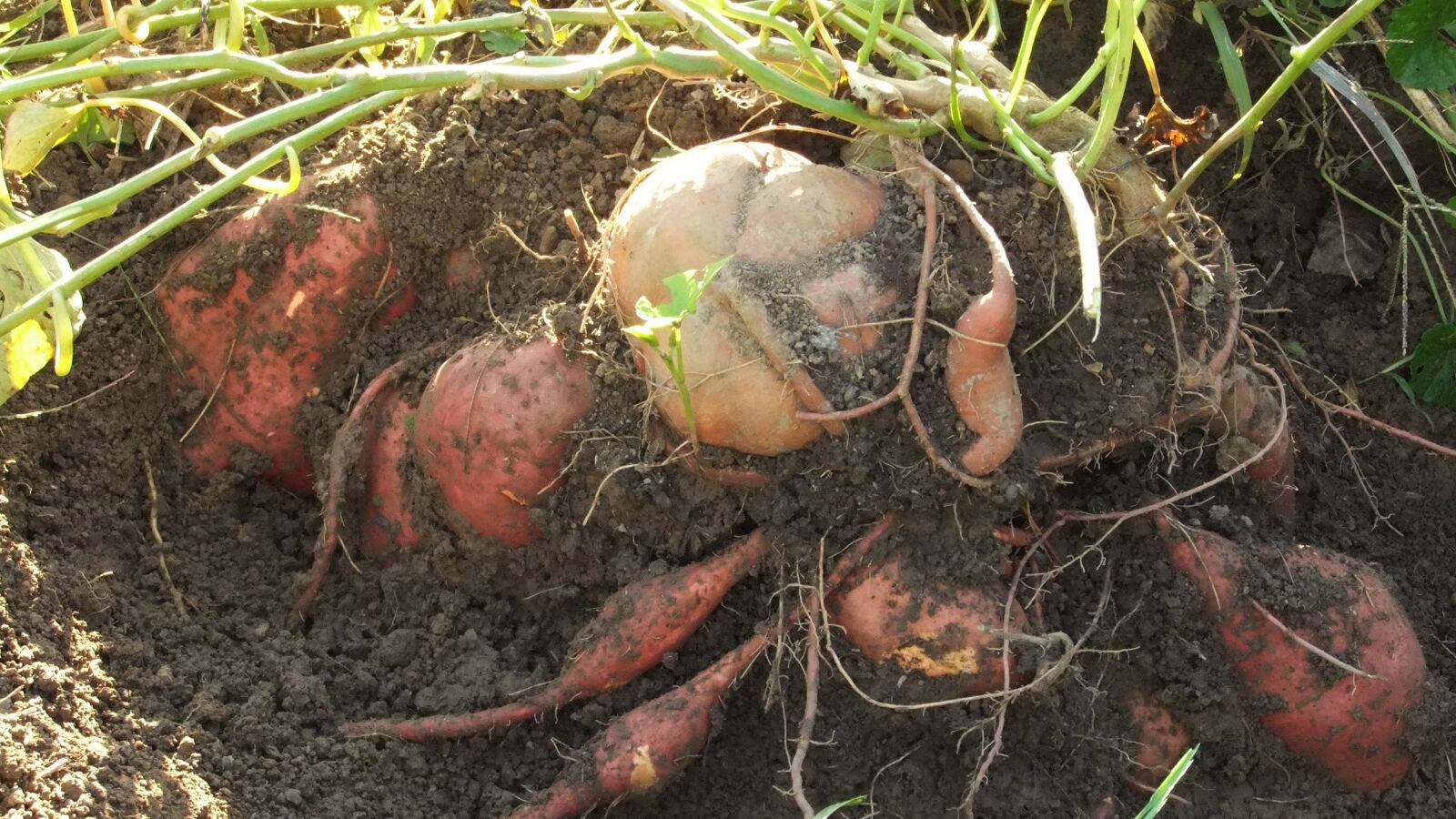
And unlike a potato, the edible part is a swollen storage root, not a tuber. That distinction is why it has no eyes and why it is propagated differently.
Domesticated in Central or South America at least 5,000 years ago, and one of the more important food crops in the world by tonnage.
Grown from slips
Because sweet potato is a root rather than a tuber, you cannot cut it into pieces with buds and plant them the way you plant a potato.
Instead you grow slips — rooted shoots sprouted from a mature root.
To make your own: suspend a healthy root in water, or half-bury it in damp compost, somewhere warm — 24 to 29 C. Shoots appear over several weeks. When they reach 15 to 20 cm, twist or cut them off and stand them in water until they root, then plant.
Or buy slips, which arrive as bare shoots and should be planted immediately.
Use a root from a known variety or a supplier rather than a supermarket one, which may be treated to suppress sprouting and may carry disease. The same logic as seed potatoes.
Start slips 6 to 8 weeks before your planting date, which is well after the last frost.
It wants real heat
This is the constraint that decides whether the crop is worth attempting.
Sweet potato needs warm soil above about 18 C, air temperatures of 21 to 30 C, and a long frost-free season of 100 to 140 days. It has no frost tolerance whatsoever, and growth simply stops in cool weather.
In cool temperate climates that means:
Grow under cover, in a polytunnel or greenhouse, which is the reliable option.
Use black plastic mulch outdoors to raise soil temperature, with slips planted through slits. This makes a genuine difference and is standard commercial practice.
Choose short-season varieties bred for cooler climates, of which there are now several good ones.
Plant into raised ridges, which warm faster and drain better.
Given warmth, it is otherwise undemanding and notably drought-tolerant once established.
Growing it
Soil: light, free-draining, moderately fertile. Heavy clay produces poor, misshapen roots. Sandy loam is ideal.
Do not over-feed nitrogen. It produces magnificent vines and almost no roots — the commonest mistake with this crop.
Space 30 to 45 cm apart in rows 90 cm apart. The vines trail 2 m or more.
Water regularly early on while roots form, then reduce. Heavy watering late causes splitting.
Let the vines run, or train them up a support to save space. Vines that root at the nodes where they touch soil will produce small secondary roots, which diverts energy; lifting and repositioning the vines occasionally prevents it.
The vines are dense and fast, and they make an effective living mulch and weed suppressor once they close over — the same ground-cover role squash plays in the three sisters.
The leaves are a crop too
Sweet potato leaves are edible, nutritious, and widely eaten across Africa and Asia, cooked like spinach.
That makes the plant a dual crop and considerably more useful in a small garden than the roots alone suggest — pick young leaves and tips through the season without meaningfully reducing the root harvest, provided you do not strip the plant.
Worth knowing in cool climates, where the roots may disappoint but the foliage is abundant.
Problems
Sweet potato is relatively trouble-free in cool climates, where most of its specialist pests are absent.
Sweet potato weevil is the serious pest in warm regions, and it is largely why certified slips matter.
Slugs on young slips and on roots in wet ground. See slugs and snails.
Wireworm on ground recently in grass.
Voles and mice, which find the roots readily. See voles and gophers.
Scurf and rots in storage, almost always from damaged or uncured roots.
All leaf, no root, from excess nitrogen or insufficient heat.
Curing is what makes them sweet
The step that transforms the crop, and the one most often skipped.
Freshly dug sweet potatoes are bland, starchy, and store badly. Curing changes both.
Cure at 27 to 30 C and 85 to 90 percent humidity for 5 to 10 days.
During that time, wounds heal over and a protective layer forms, which is what allows long storage; and enzymes begin converting starch to sugars, which is what makes them sweet.
Improvised curing works: a warm airing cupboard, a propagator, or a closed box with a damp cloth and a heat source. It is worth the effort — the difference between cured and uncured is not subtle.
Then store at 13 to 16 C, dry, dark, and airy.
Never refrigerate. Below about 12 C sweet potatoes suffer chilling injury, develop hard centres that will not soften on cooking, and rot faster. This is the opposite of potato storage and the commonest storage mistake. See harvest and storage.
Well-cured roots keep for 6 to 10 months, and the flavour continues improving for the first month or two.
Harvest
Lift before the first frost, or immediately after the foliage is blackened by one — frost damage travels down into the roots and ruins storage.
Dig carefully and well away from the crown, since the roots spread and bruise very easily. Handle them like eggs. Every scrape is a rot entry point, and this crop is far more fragile than a potato.
Do not wash. Cure first, as above.
See also
- Potatoes the unrelated crop it is named after
- Harvest and Storage curing, and why not to refrigerate
- Frost Protection extending a marginal season
- Container Growing growing them in warmth
- Propagation raising your own slips
- Mulching for Moisture black plastic to warm the soil