What they are
Both are legumes of the Fertile Crescent, domesticated alongside wheat and barley around 10,000 years ago, and part of the founder crop package that made settled agriculture possible.
Lentil, Lens culinaris. A small sprawling annual, 30 to 45 cm, with tiny pale flowers and pods containing one or two flat seeds.
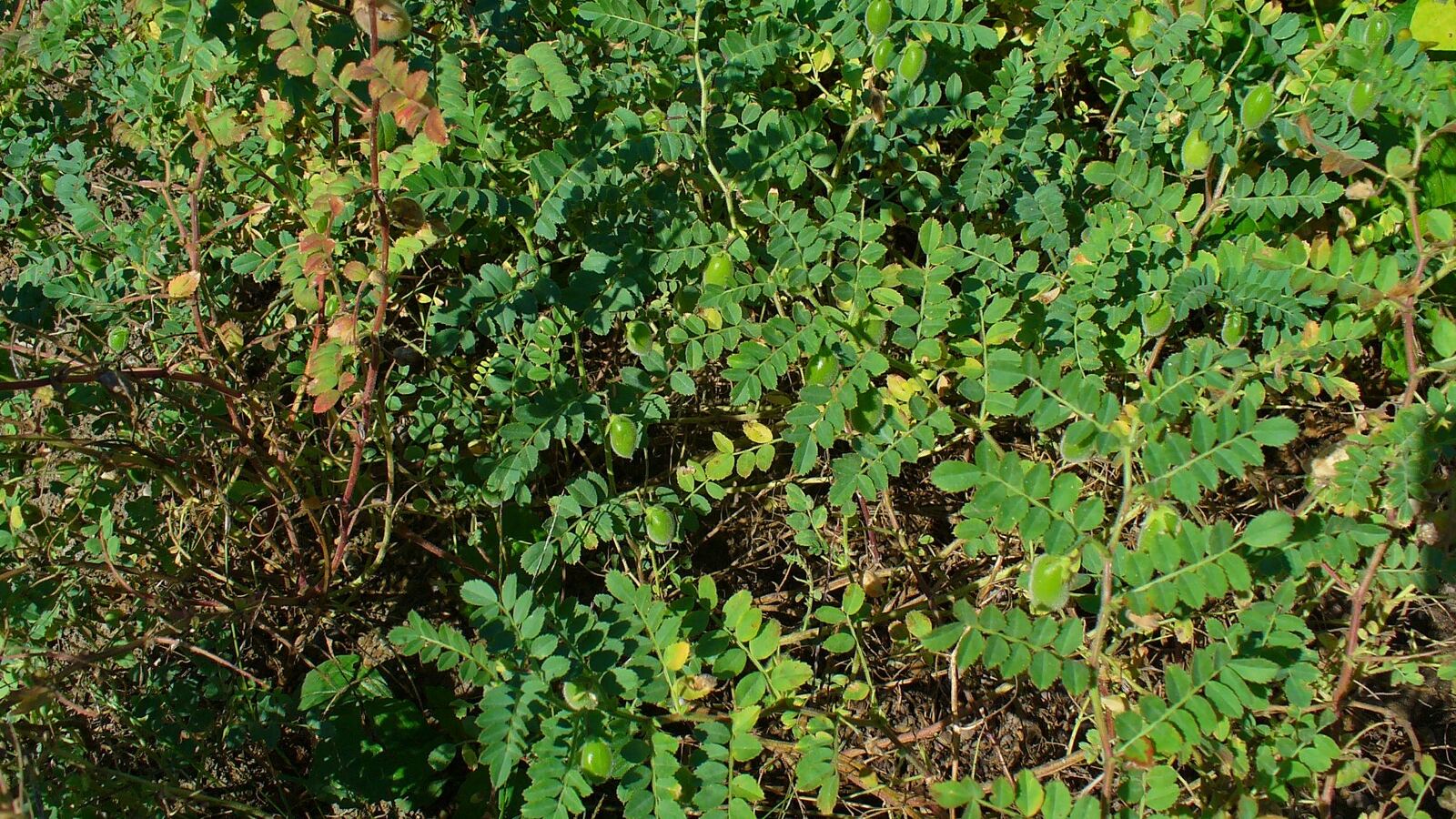
Chickpea, Cicer arietinum. Bushier and taller, 30 to 60 cm, with inflated pods containing one or two seeds.
Two chickpea types: desi, small, dark, angular, higher fibre, dominant in South Asia; and kabuli, larger, pale, rounder, the type sold in Europe as the standard chickpea.
Why the founder crops were cereals plus pulses
The pairing is not accidental, and it explains a great deal about traditional diets.
Cereals are low in lysine. Pulses are high in it. Pulses are low in methionine. Cereals are high in it.
Together they provide a complete amino acid profile, which is why nearly every traditional cuisine pairs them: dal and rice, hummus and flatbread, beans and tortillas, lentils and bread.
The agronomic pairing is equally tight. Pulses fix their own nitrogen through rhizobial nodules and leave residual nitrogen for the following cereal, which is the foundation of the rotations described in crop rotation and peas and beans.
Note that different legumes need different rhizobial strains, so a crop grown on ground that has never carried it may nodulate poorly. Inoculant is available and worth using for a first chickpea or soya crop. See nitrogen-fixing bacteria and soil inoculation.
Dryland crops
Both are adapted to a Mediterranean pattern — winter and spring rainfall, dry ripening — and both are notably drought tolerant.
Chickpea in particular has a deep taproot and is among the more drought-hardy pulses, which is why it is a major crop across India, Turkey, Ethiopia, and Australia.
Both dislike waterlogging absolutely, and both need a dry period at ripening. That is the constraint in cool damp climates: the plants grow perfectly well and then the pods fail to dry, or the crop is spoiled by rain at harvest.
Chickpeas also suffer badly from ascochyta blight in humid conditions, which is the main disease limitation.
So in a maritime temperate climate these are a marginal crop — worth trying, better under cover, and reliably successful only in a dry summer.
The calorie argument
Worth stating plainly, because it is the strongest case for growing them.
Most garden vegetables are water and fibre. Salad leaves, courgettes, and carrots provide very few calories per square metre.
Dried pulses are the most calorie-dense and protein-dense thing a temperate garden can produce, and unlike almost everything else they store for years at room temperature with no processing, no freezing, and no electricity.
For anyone thinking about actual food security rather than salad, pulses and potatoes are the two crops that matter, and pulses supply the protein.
The catch is the same as for wheat: yields per square metre are low, so meaningful quantities need real area. A few square metres gives a novelty; a serious supply needs a field.
Growing them
Sow after the last frost into warm soil, or in autumn in mild Mediterranean climates. Chickpeas at 10 to 15 cm apart, lentils sown more densely and allowed to knit together.
Full sun, free drainage, moderate fertility. Do not add nitrogen — it suppresses fixation and produces leaf instead of pods.
No support needed, though lentils sprawl and are easier to harvest if grown densely enough to hold each other up.
Water during flowering and pod fill, then stop entirely to let the crop dry.
Weeds are the main problem at small scale, since both are short and poor competitors. See weed management.
Harvest and threshing
Wait until the plants are dry and the pods rattle. Both crops shatter if left too long, so timing matters.
Pull or cut the whole plant and dry it further under cover if the weather is uncertain.
Thresh by beating the dry plants in a tub or a sack, then winnow by pouring between containers in a breeze. The same process as wheat, and easier because the seeds are larger.
Dry thoroughly before storing — pulses stored damp go mouldy and can heat.
Freeze for 48 hours before storing to kill bruchid beetle larvae, which are frequently already inside the seed and will otherwise hatch and destroy the batch in storage. This is the single most useful storage tip for home-saved pulses.
Then store cool, dry, and airtight. Properly dried pulses keep for years, though they take progressively longer to cook. See harvest and storage.
Sprouting and green use
Both are excellent sprouted, which is a way to get fresh vegetable value out of a dry store in midwinter with no land at all.
Green chickpeas, picked fresh and eaten raw or lightly cooked, are a genuine delicacy and almost unobtainable commercially — one of the better reasons to grow a few plants even where the dry crop is unreliable.
Chickpea leaves are edible cooked, and are eaten as a green in parts of South Asia. Note that chickpea foliage exudes malic and oxalic acid, which makes it sour and can irritate skin — traditional harvesters collected the dew from chickpea fields as a sour condiment.
Soya and the wider group
Soya, Glycine max, deserves a mention as the other great pulse. Domesticated in China, it is unusually high in both protein and oil, which is why it dominates global oilseed and animal feed production. Edamame — soya harvested green — is a straightforward garden crop in a warm summer.
Broad beans, peas, French and runner beans are covered in peas and beans, and dried varieties of all of them do the same storage job as lentils and chickpeas.
Lupins, cowpeas, and pigeon peas fill the same role in other climates, pigeon pea in particular being an important perennial shrub legume in tropical smallholdings and agroforestry. See nitrogen fixers and alley cropping.
See also
- Peas and Beans the wider legume family and the cut-the-tops rule
- Wheat the cereal partner in the founder package
- Crop Rotation pulses before the hungry crops
- Nitrogen-Fixing Bacteria the partnership and inoculants
- Harvest and Storage drying, freezing, and keeping pulses
- Potatoes the other serious calorie crop