What it is
Terminalia arjuna, the arjuna — a large deciduous tree of the riverbanks and watercourses of the Indian subcontinent, and one of the most important medicinal trees of Ayurveda.
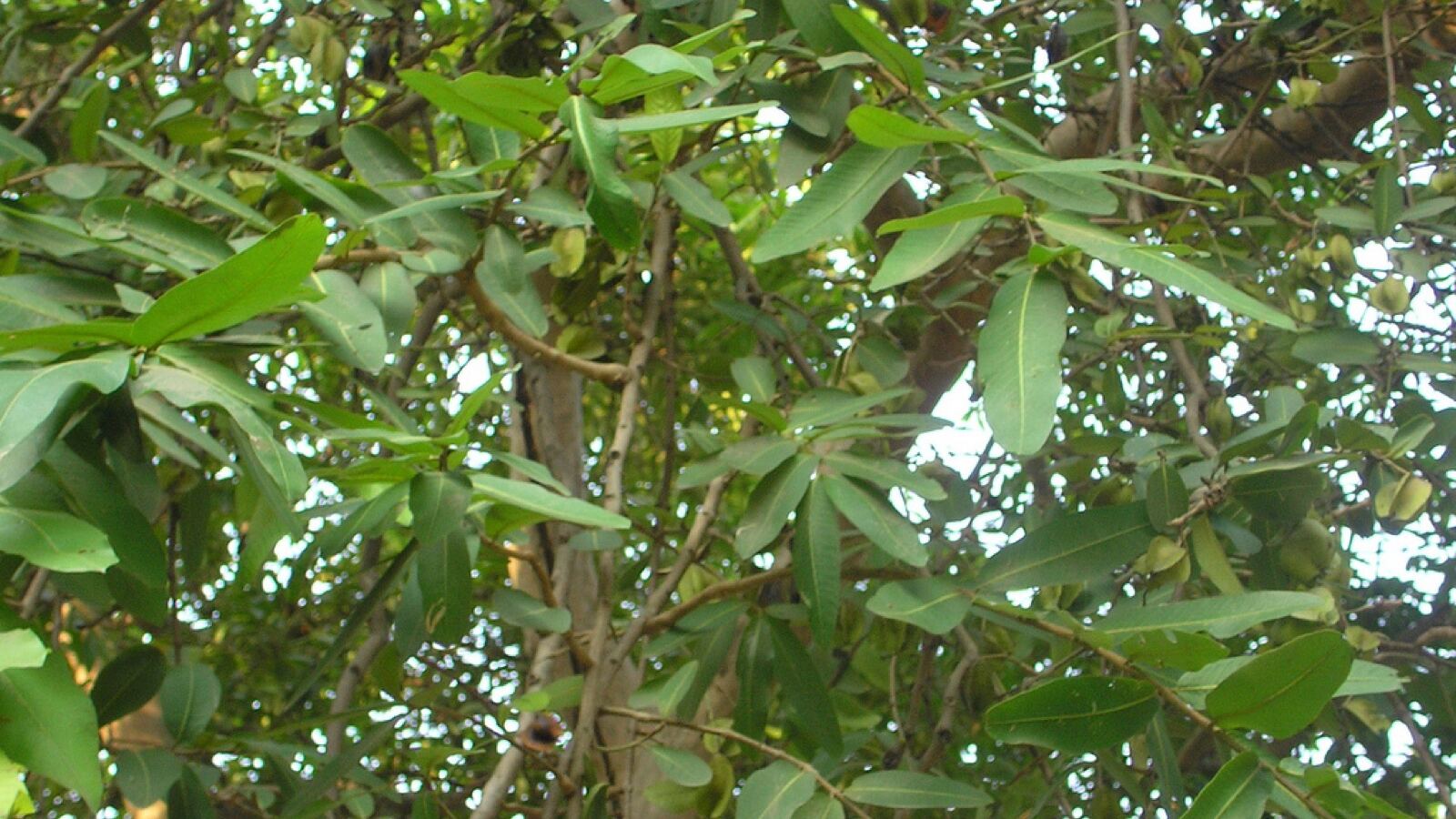
It belongs to the genus Terminalia, which makes it a relative of the tropical almond and of the myrobalans that partner amla in the great Ayurvedic formula triphala — a family of trees whose bark and fruit are rich in tannins and medicinal compounds. The arjuna is a handsome tree with a tall, straight, buttressed trunk, smooth pale grey-to-pinkish bark that flakes in large pieces, and a wide, spreading, often drooping crown.
The tree of the heart
The arjuna's fame rests on one thing: it is, in Ayurvedic tradition, the medicine for the heart, and has been for some three thousand years.
The bark of the arjuna — which the tree conveniently sheds and renews, so it can be harvested sustainably without killing the tree — has been used since ancient times specifically as a cardiac tonic: for strengthening the heart, for chest pain, palpitations, and what would now be called heart failure and coronary disease. The ancient physician Vagbhata described its use for heart conditions, and "Arjuna" preparations remain among the most widely used traditional heart remedies in India.
What makes the arjuna especially interesting is that modern medicine has taken the claim seriously. Scientific studies have found that arjuna bark contains compounds with genuine cardiovascular activity — it appears to have antioxidant, cholesterol-lowering, and heart-muscle-supporting effects, and clinical trials have investigated its use in angina and heart failure with some positive results. It is one of the better examples of a traditional plant medicine whose specific, long-claimed use has found real support in the laboratory and clinic, in the way willow bark's pain relief and quinine's antimalarial action did. This has, in turn, driven demand and made cultivation important. See historical ecology.
A tree of the riverbank
Beyond medicine, the arjuna is an ecologically valuable tree. It grows naturally along rivers, streams, and watercourses, its roots binding the banks and its crown shading the water, so it is a natural component of Indian riparian systems and is planted for streambank stabilisation and erosion control as well as avenue shade.
It is also a host of the tasar silkworm — one of the wild silk moths whose cocoons yield tasar (tussar) silk — so arjuna trees support a traditional wild-silk industry in central India, feeding the caterpillars whose silk is harvested. The tree gives a hard, strong timber, a gum, and a tannin-and-dye bark, and its flowers feed bees — a thoroughly useful tree beyond its famous heart-medicine.
Growing it
Tropical to subtropical, frost-tender, and a tree of warm climates with a monsoon rhythm; it wants full sun and does best on moist ground near water, though it tolerates a range of soils, some drought once established, and periodic flooding — reflecting its riverbank home.
It is fast-growing, large, and long-lived, grown easily from seed, and planted widely for medicine (the bark), for riparian stabilisation, for silk, for shade and avenue, and in reforestation. Because the medicinal bark regenerates, arjuna can be harvested without felling — a rare and valuable trait in a medicinal tree, and one that makes its cultivation genuinely sustainable. See propagation.
See also
- Tropical Almond the close Terminalia relative
- Amla whose triphala partners are arjuna's myrobalan cousins
- Willow and Quinine Tree other traditional bark-medicines borne out by science
- Riparian Buffers the arjuna's streambank role
- Erosion Control binding riverbanks
- Historical Ecology a three-thousand-year medicinal tradition
- Myrobalan
- Kakadu Plum