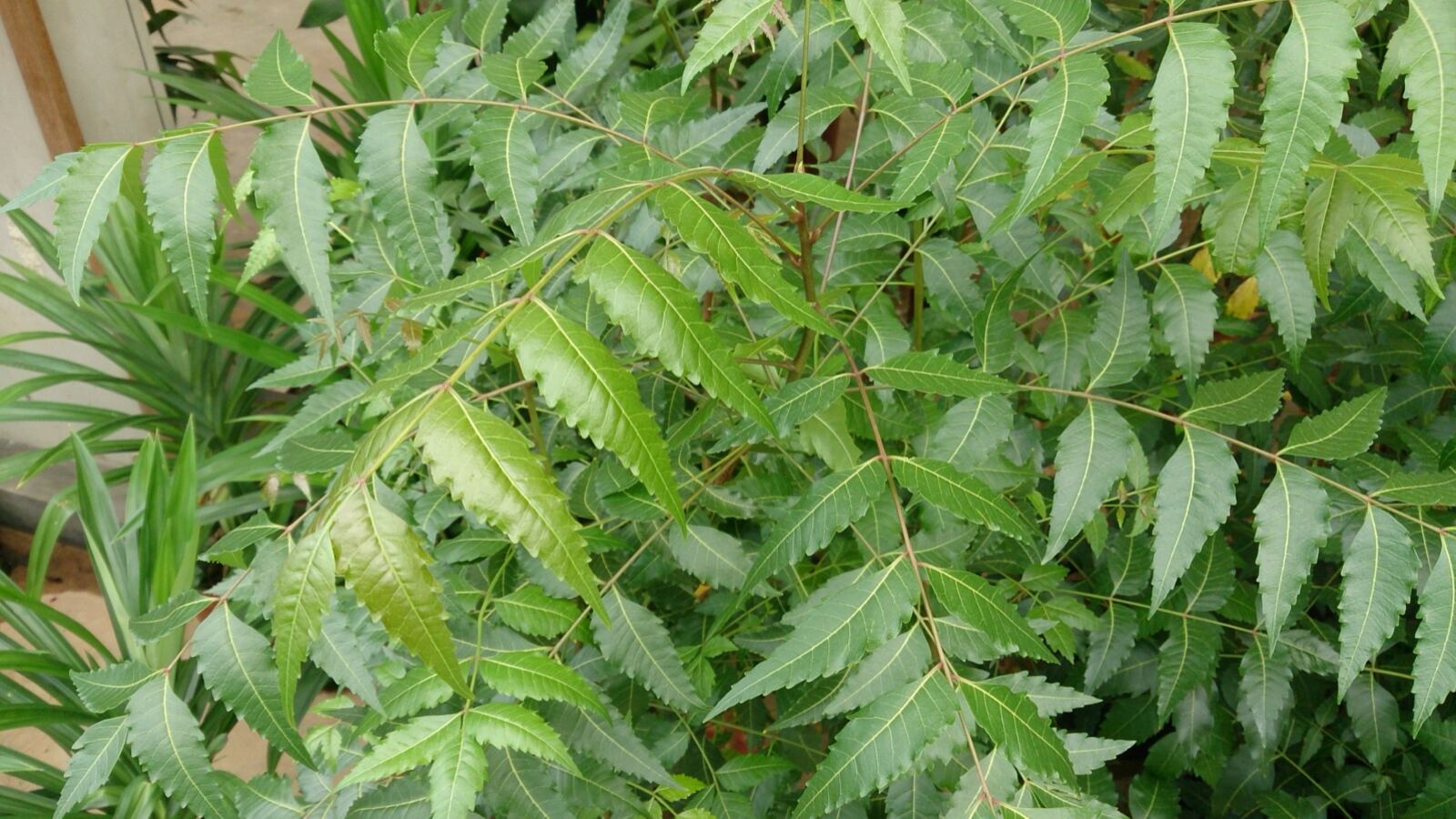
What it is
Azadirachta indica, an evergreen tree of the Indian subcontinent and the dry tropics, in the mahogany family.
Fast, tough, drought-hard, and long-lived, it is one of the most useful trees of the arid tropics — shade, timber, fodder, medicine, and pest control from a single species, which is why it is called the village pharmacy and, in Sanskrit tradition, sarva roga nivarini, the reliever of all ailments.
Not to be confused with the unrelated chinaberry, Melia azedarach, which is superficially similar, in the same family, and toxic.
Azadirachtin
The reason neem matters beyond its native range is one compound: azadirachtin, concentrated in the seed.
It is the active ingredient in the most widely used botanical insecticide in the world, and it works quite differently from the nerve poisons of synthetic and even most natural insecticides.
Azadirachtin is an insect growth regulator and antifeedant. It does not knock insects down on contact. Instead it:
Disrupts moulting by interfering with the hormone ecdysone, so larvae fail to develop.
Deters feeding, so treated foliage is left alone.
Suppresses reproduction and egg-laying.
That mode of action has real advantages: it is relatively selective — far less harmful to bees, ladybirds, and other beneficials than broad-spectrum insecticides, especially when applied to soil or to foliage pests directly — it breaks down quickly in sunlight so it does not persist, and because it works on the insect's development rather than a single receptor, resistance is slow to evolve.
The limitations are equally real: it is slow, needing days rather than minutes; it degrades fast, so it needs reapplication; and "selective" is relative, not absolute — it still harms some beneficial insects and aquatic life, and it is not a licence to spray freely. See organic sprays and predator-prey balance.
Neem is genuinely one of the more useful tools in integrated pest management, used against a very wide range of pests, and neem cake — the residue after oil pressing — is used as a soil amendment that also suppresses nematodes and grubs. See soil-dwelling pests.
The biopiracy case
Neem is the textbook case in the debate over traditional knowledge and patents, and it changed the law.
Neem's pesticidal and medicinal uses had been known and practised in India for well over two thousand years. In 1994 the European Patent Office granted a patent, held by the US Department of Agriculture and the company W. R. Grace, on a method of using neem oil to control fungi on plants.
Indian scientists, farmers, and activists — Vandana Shiva prominent among them — challenged it, on the grounds that the "invention" was existing traditional knowledge that could not be patented. After a decade of legal proceedings the patent was revoked in 2005.
The case became a defining example of biopiracy — the patenting of traditional knowledge and biological resources without recognition or benefit to the communities that developed them — and it helped drive the creation of formal defensive measures, including India's Traditional Knowledge Digital Library, to document prior art and block such patents.
It connects directly to the arguments in seed banking and the social dimension of stakeholder mapping: who owns the genetic and knowledge commons, and who benefits from it.
In dryland systems
Neem is a workhorse of dry-tropical agroforestry and land rehabilitation.
Drought and heat tolerance let it grow where little else will, on poor, degraded, and shallow soils.
Fast growth and deep roots make it good for shade, shelter, and windbreaks — it is planted extensively along roads and around fields across the Sahel, India, and the dry tropics. See windbreaks and dryland restoration.
It has been used at scale in afforestation, most famously in the greening of the plain of Arafat near Mecca, where hundreds of thousands of neem trees were planted to shade pilgrims.
Fodder, timber, and fuel from the same tree, plus the pesticide and medicine, make it a genuine multi-purpose species in the mould of moringa and the nitrogen-fixing food trees — though neem itself is not a nitrogen fixer.
A caution: neem has naturalised and become invasive in parts of West Africa, northern Australia, and the Caribbean, forming dense stands. As ever, its aggressive growth is an asset in cultivation and a liability where it escapes. See invasive species.
Growing it
A tree for the frost-free dry tropics and warm subtropics — neem has little cold tolerance and is killed by hard frost, so outside those climates it is a container or glasshouse plant.
Given warmth it is undemanding: full sun, free drainage, tolerant of poor, sandy, and alkaline soils, and drought-hard once established. It dislikes waterlogging and prolonged cold and wet.
Grows readily from fresh seed, which — like coconut — is recalcitrant and loses viability within weeks, so it must be sown fresh. Also propagated from cuttings and suckers. See propagation.
Fast to establish and long-lived, it is a plant-once tree in the perennials first mould where the climate allows.
See also
- Organic Sprays neem oil as a botanical insecticide
- Integrated Pest Management where neem fits in a strategy
- Moringa the other great multi-purpose dry-tropical tree
- Dryland Restoration neem in afforestation and shelter
- Vandana Shiva the neem patent challenge
- Seed Banking traditional knowledge and the genetic commons
- Mahogany
- Chinaberry
- Amla
- Spanish Cedar
- Langsat and Duku
- Toon