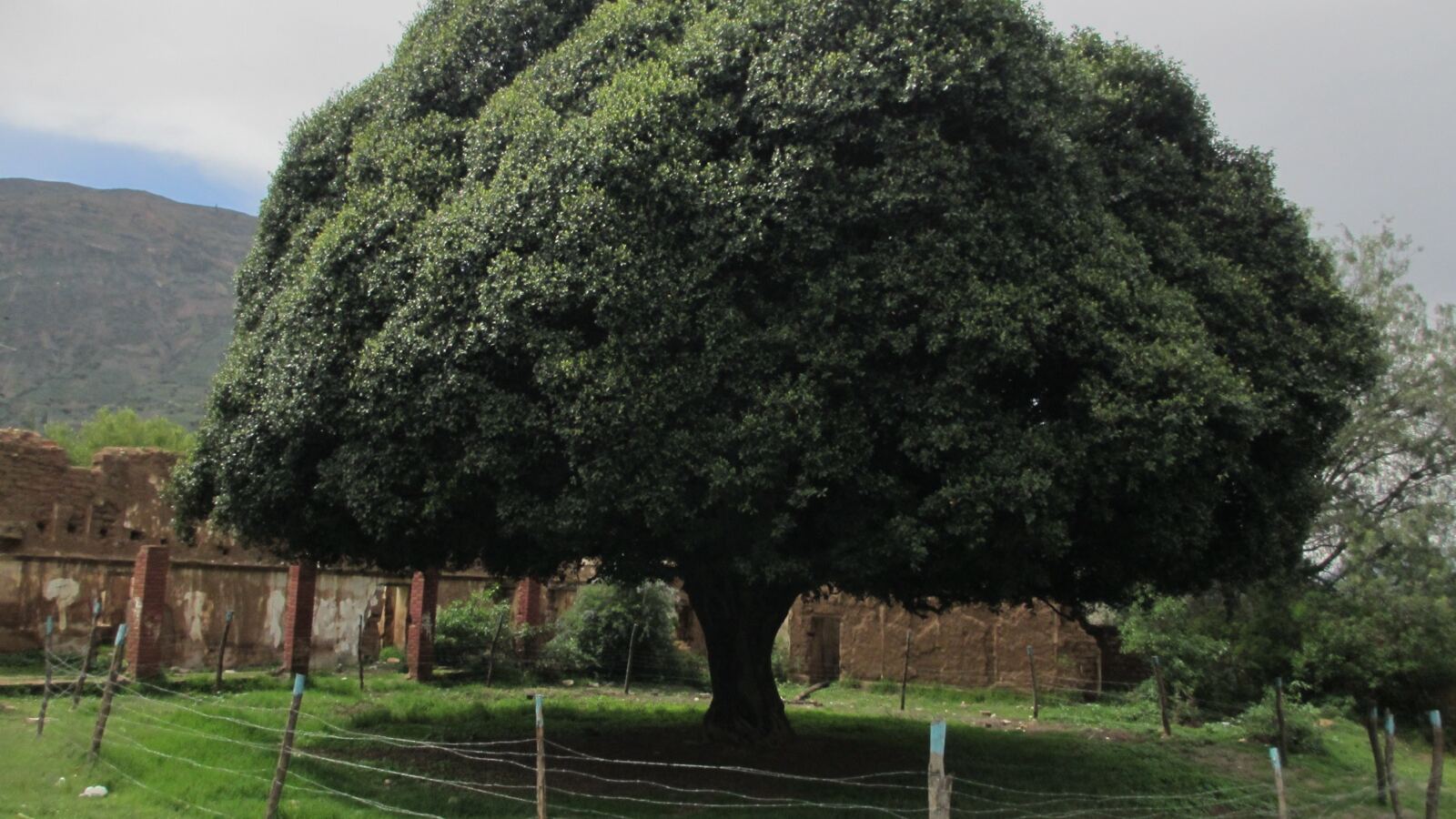
What it is
Cinchona, the quinine tree — evergreen trees and shrubs of the Andean cloud forests of South America, whose bark contains quinine, the compound that was, for three centuries, the world's only effective treatment for malaria.
Few plants have shaped human history as directly. Malaria was one of the great killers and one of the greatest barriers to human movement into the tropics, and the bark of an obscure Andean tree was, for a very long time, the only thing that could touch it.
The fever bark
The story begins with the Indigenous peoples of the Andes, who used cinchona bark against fevers and chills. In the seventeenth century, Jesuit missionaries learned of it and carried it to Europe as "Jesuit's bark" or "Peruvian bark," where — despite suspicion in Protestant countries of a "Catholic" remedy — it proved dramatically effective against the malarial fevers (agues) then common across much of Europe as well as the tropics.
Ground cinchona bark, and later purified quinine (first isolated in 1820), became one of the most important drugs in the world. It suppressed malaria well enough to let people survive in malarial regions, and in doing so it enabled the European colonisation of tropical Africa and Asia — historians have argued, only half in jest, that quinine was as decisive as the gunboat in the expansion of empire, because without it Europeans died too fast in the tropics to hold territory. Quinine was issued to soldiers, administrators, and settlers throughout the malarial world.
The theft that broke a monopoly
For a long time all quinine came from wild cinchona bark stripped in the Andes, and the South American nations that held the trees — Peru, Bolivia, Ecuador — guarded them as a strategic monopoly, banning the export of seeds and live plants.
So the story took the same turn as rubber and cinnamon: the monopoly was broken by biopiracy. In the mid-nineteenth century, British and Dutch agents smuggled cinchona seeds and seedlings out of South America — the Englishman Charles Ledger obtained seeds of an exceptionally high-quinine tree through his Bolivian collector Manuel Incra Mamani (who was reportedly beaten to death for it) — and these were used to establish vast cinchona plantations in Java (by the Dutch) and India and Sri Lanka (by the British). The Javanese plantations, grown from Ledger's high-yielding stock, came to supply the overwhelming majority of the world's quinine, and the Andean monopoly collapsed. It is one of the clearest cases of the transfer of a strategic crop reshaping global trade and power. See historical ecology and restoration economics.
Quinine today — and your tonic water
Quinine remained the frontline antimalarial until the mid-twentieth century, when synthetic drugs (chloroquine and later others) largely replaced it — though quinine and its relatives are still used, and the plant family also gave quinidine (a heart drug). In the perennial arms race with drug-resistant malaria, plant-derived antimalarials remain vital: today's frontline drug, artemisinin, comes from another plant (sweet wormwood), continuing the long story of the plant world against this disease.
Quinine also survives in an everyday and much more pleasant form: it is the bitter flavouring in tonic water. Colonial administrators in India took their daily antimalarial quinine as bitter "Indian tonic water," and mixed it with gin to make it palatable — inventing the gin and tonic, a cocktail that is, at root, a medicine-delivery system. The quinine in modern tonic water is far too dilute to treat malaria, but it still gives the drink its characteristic bitterness and its faint blue glow under ultraviolet light.
Growing it
Tropical highland trees: cinchona wants the cool, moist, humid conditions of tropical mountains and cloud forest — warm but not hot, with high humidity and rich, well-drained, acidic soil — and does poorly in the hot lowlands or in cold or dry climates.
It is grown from seed and cuttings, and was farmed in plantations on a large scale for its bark, which was stripped, dried, and processed for quinine (sustainable systems coppiced or partially barked the trees to keep them alive). As an ornamental it is a handsome evergreen with clusters of fragrant pink flowers. It remains a plant of real strategic and historical importance, and a reminder of how much the world has owed to the chemistry hidden in tree bark. See propagation and reforestation techniques.
See also
- Rubber another strategic crop whose monopoly was broken by smuggled seed
- Cinnamon and Camphor the bark drugs and broken spice monopolies
- Historical Ecology how a tree's chemistry shaped empires
- Kola Nut another plant behind a famous drink
- Frankincense and Myrrh other medicinal tree products of ancient trade
- Restoration Economics the value of a strategic plant crop
- Yerba Maté
- Arjuna
- Star Anise
- Desert Date
- Kadamba