What it is
Agathis australis, the kauri, a giant coniferous tree of the northern North Island of New Zealand, and one of the most massive and long-lived trees in the world.
It belongs to the ancient family Araucariaceae — the same Gondwanan lineage as the monkey puzzle and the Wollemi pine — a group that dominated the forests of the southern supercontinent in the age of the dinosaurs and survives now in scattered relict pockets. The kauri is New Zealand's contribution, and a spectacular one.
A tree that builds a column
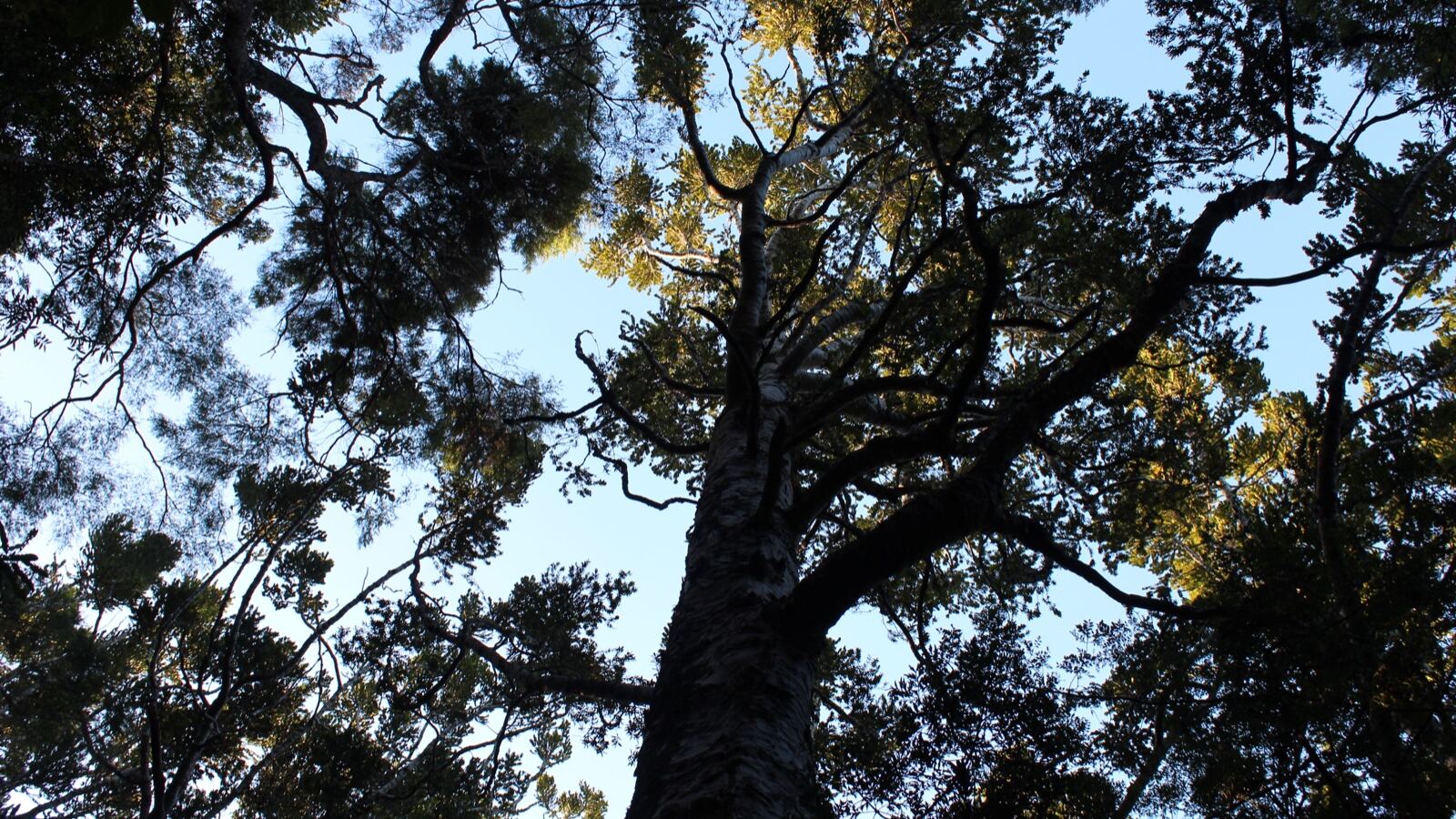
The kauri's form is unmistakable and is the key to its bulk. Rather than tapering steadily like most trees, a mature kauri sheds its lower branches and grows a huge, smooth, near-cylindrical grey trunk that rises like a column with almost no taper, only spreading into a crown high above the canopy.
Because the trunk barely narrows, the timber volume of a big kauri is enormous — the largest living specimen, Tāne Mahuta ("Lord of the Forest") in the Waipoua Forest, has a trunk over 4 m across and is thought to be well over 1,000, perhaps 2,000, years old. Kauri are among the very largest trees by trunk volume outside the Californian redwoods, and among the longest-lived. Such a tree is a whole ecosystem, its high crown and massive limbs carrying gardens of epiphytes, its litter and roots building a distinctive acidic soil beneath.
The forest-maker
The kauri does something unusual: it engineers the soil under itself, and this shapes the whole forest.
Its litter is slow to break down and strongly acidifying, and over centuries a big kauri leaches and podzolises the ground beneath it, stripping nutrients downward and creating a bleached, infertile, acidic soil — a process so pronounced it is studied as a classic example of a single tree altering its own environment. This changes which plants can grow there and helps the kauri hold its ground, a dramatic version of the soil-shaping seen in hemlock and other dominant trees. See soil pH and succession.
Gum, timber, and a lost forest economy
Two products drove the near-destruction of the kauri forests after European settlement.
Timber. Kauri wood is superb — straight, even, strong, easily worked, and produced in vast clear lengths by those columnar trunks — and it was logged relentlessly in the nineteenth and early twentieth centuries for building and shipbuilding, until the great kauri forests were reduced to a few protected remnants. Only a small fraction of the original forest survives.
Kauri gum. The trees exude a resin that, buried in the ground where old forests once stood, fossilises into kauri gum (like a young amber). Digging this fossil gum for varnish and linoleum was a major industry — the "gumdiggers" — that scarred the northern landscape and drew a wave of migrant labour. Today a curious echo continues: ancient kauri logs preserved for thousands of years in swamps ("swamp kauri") are dug up and milled as a prized timber.
Kauri dieback
The kauri now faces an emergency. Kauri dieback, caused by the soil-borne water mould Phytophthora agathidicida, is killing trees across the remaining forests. It attacks the roots and lower trunk, girdling the tree, and there is no cure.
Crucially, the pathogen spreads in soil and water — on boots, tyres, animal hooves, and tools — so human movement through the forest is the main vector. New Zealand has responded with hygiene stations, boardwalks, mandatory boot-cleaning, and closures of tracks and whole forests to keep people (and the mud on their soles) away from the roots, because a few grams of contaminated soil can carry the disease to a new stand. It is one of the clearest and most sobering cases of an introduced Phytophthora threatening a keystone tree, in the manner of the chestnut blight and hemlock adelgid, and a lesson in biosecurity: the visitor is the danger. The kauri is also a taonga — a treasure — of huge cultural importance to Māori, which adds weight to the effort to save it. See tree diseases and woodland management.
Growing it
Warm-temperate, frost-tender when young, and slow — a kauri wants a mild, moist, humid climate and free-draining acidic soil, and it grows very slowly, which is part of why the ancient trees are so precious and so irreplaceable once lost.
It is grown from seed as an ornamental and in restoration plantings within its range, and as a curiosity in mild gardens elsewhere; young trees have a narrow conical form quite unlike the columnar giant they become. Handle soil hygiene carefully where dieback is present. See propagation and reforestation techniques.
See also
- Monkey Puzzle the Araucariaceae relative from South America
- Wollemi Pine the rediscovered member of the same ancient family
- Redwoods the other contenders for largest and oldest trees
- Tree Diseases the Phytophthora behind kauri dieback
- Southern Beech its companion in the Gondwanan southern forests
- Frankincense and Myrrh other trees prized for their resin
- Norfolk and Bunya Pines