Conifers that behave like broadleaves
Most conifers are evergreen, but a handful drop all their needles each autumn — and the swamp cypresses and the dawn redwood are the most striking of them, alongside the larch and the ginkgo.
Bald cypress, Taxodium distichum, and pond cypress, T. ascendens, of the southeastern United States: large trees of swamp and floodplain, "bald" because they stand leafless in winter.
Dawn redwood, Metasequoia glyptostroboides, of China: a close relative, and one of the great botanical stories of the twentieth century.
All have soft, feathery, two-ranked foliage that turns russet, foxy-red, and bronze in autumn before falling — a beautiful and unexpected sight in a conifer — and all are close kin of the giant redwoods.
Growing in standing water
The swamp cypresses are among the very few trees that thrive rooted in permanent standing water, dominating the blackwater swamps and bayous of the American South where few other trees can live.
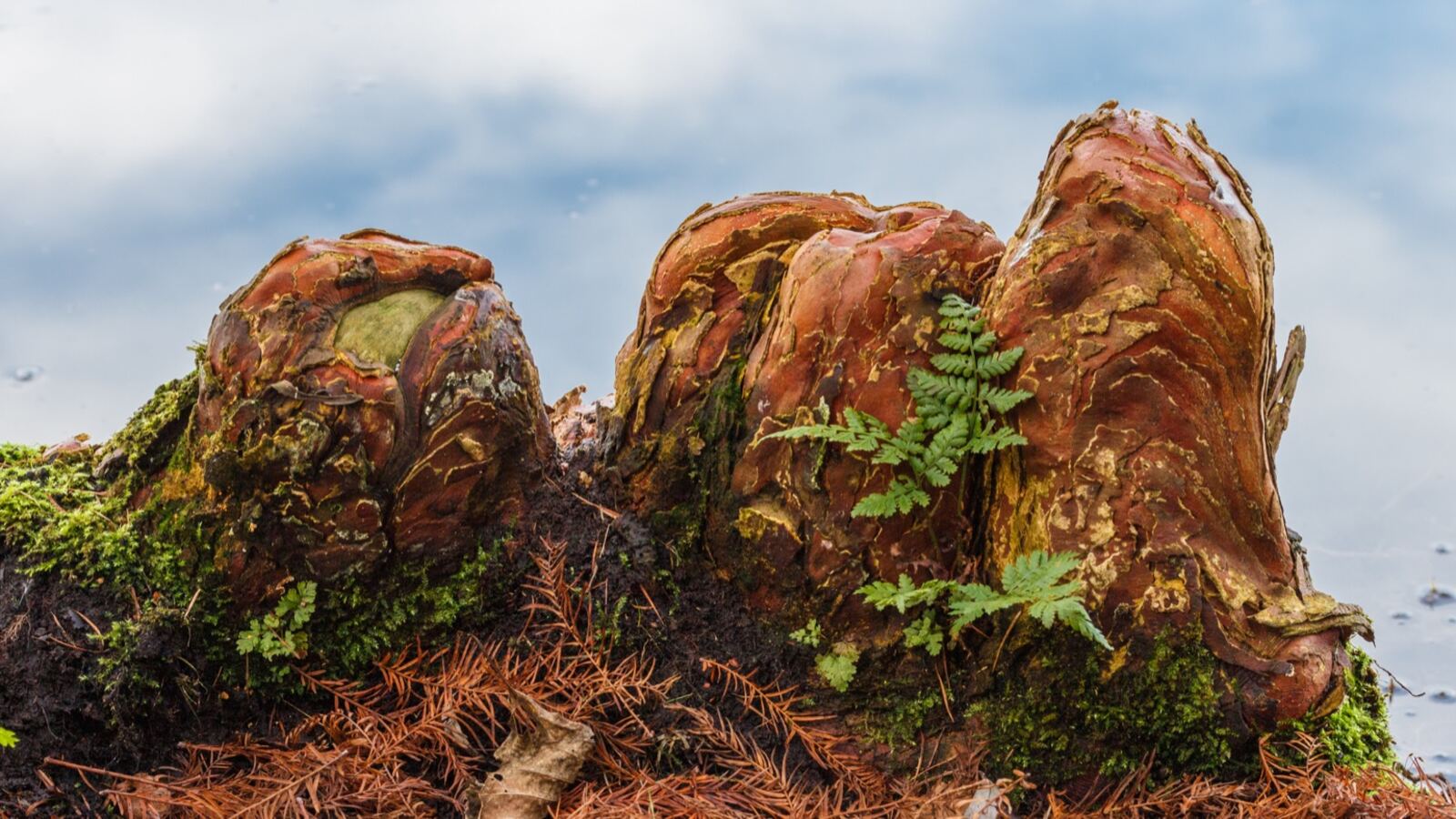
To survive with their roots submerged and starved of oxygen, they grow "knees" (pneumatophores) — woody conical projections that rise from the roots above the water line. These are usually explained as a way of getting air to the waterlogged roots, though their exact function is still debated; they may also anchor the tree in soft mud and against current. Either way, a stand of bald cypress rising from black water, ringed by knees, is one of the iconic sights of the southern wetlands. The breathing-root strategy parallels that of the tropical mangroves, which face the same oxygen-starved-mud problem in salt water. See wetland restoration.
Old bald cypress swamps are extraordinary habitat — for wading birds, alligators, fish, and the whole life of the southern wetland — and the trees are very long-lived, some of the oldest exceeding 2,000 years, making bald cypress among the oldest trees in eastern North America. Because they tolerate flooding, silt, and unstable banks, they are valuable for stabilising riparian margins and restoring degraded wetland.
The timber — "pecky cypress" and heart cypress — is famously rot-resistant, prized for shingles, boats, docks, greenhouses, and outdoor work, the same rot-proof virtue as cedar and redwood, and old-growth cypress was heavily logged for it.
The dawn redwood's return from the dead
The dawn redwood is one of the best-loved of all "living fossil" stories.
Metasequoia was known first only as a fossil — abundant in rocks across the northern hemisphere, and assumed to be long extinct, like the ginkgo once nearly was. Then, in the early 1940s, botanists discovered a grove of unfamiliar living trees in a remote valley in central China, and it was realised that this was the "extinct" Metasequoia, alive after all. The discovery caused a sensation, and seeds distributed from the Chinese trees in the late 1940s were grown in botanic gardens worldwide, so that almost every dawn redwood now growing descends from that one rediscovered wild population.
It turned out to be an easy, fast, hardy, beautiful ornamental — and today it is far more numerous in the world's parks and gardens than in its tiny, threatened wild range, a curious conservation situation it shares with the ginkgo. See seed banking.
Growing them
All three are hardy, easy, and fast for conifers, and all give superb autumn colour.
Bald cypress will grow in ordinary moist garden soil as well as in water — it does not need a swamp, though it will tolerate one, and it produces knees mainly when grown in wet ground. It is heat- and drought-tolerant once established, surprisingly, as well as flood-tolerant, and it makes an excellent tough tree for difficult wet or dry sites, including urban ones. Dawn redwood wants moist, deep soil and full sun, and grows very fast into a tall, narrow, elegant tree. Both are grown easily from seed and cuttings. See propagation and tree planting.
See also
- Redwoods the giant evergreen relatives
- Larch the other common deciduous conifer
- Ginkgo the other great living-fossil deciduous tree
- Mangroves the salt-water parallel of breathing roots in waterlogged mud
- Wetland Restoration swamp cypress in restored wetlands
- Riparian Buffers stabilising wet margins
- Wollemi Pine
- Dove Tree
- Cryptomeria
- Golden Larch