What it is
Cercis siliquastrum, the Judas tree — a small deciduous flowering tree of the Mediterranean and western Asia, and the Old World counterpart of the American redbud (Cercis canadensis), with which it shares the genus Cercis and its whole charming character.
It is a legume — kin to the silk tree and the pea-flowered trees — with rounded, heart-shaped leaves and, above all, a spectacular spring flowering that makes it one of the best-loved small trees of Mediterranean gardens and hillsides.
Flowers straight from the wood
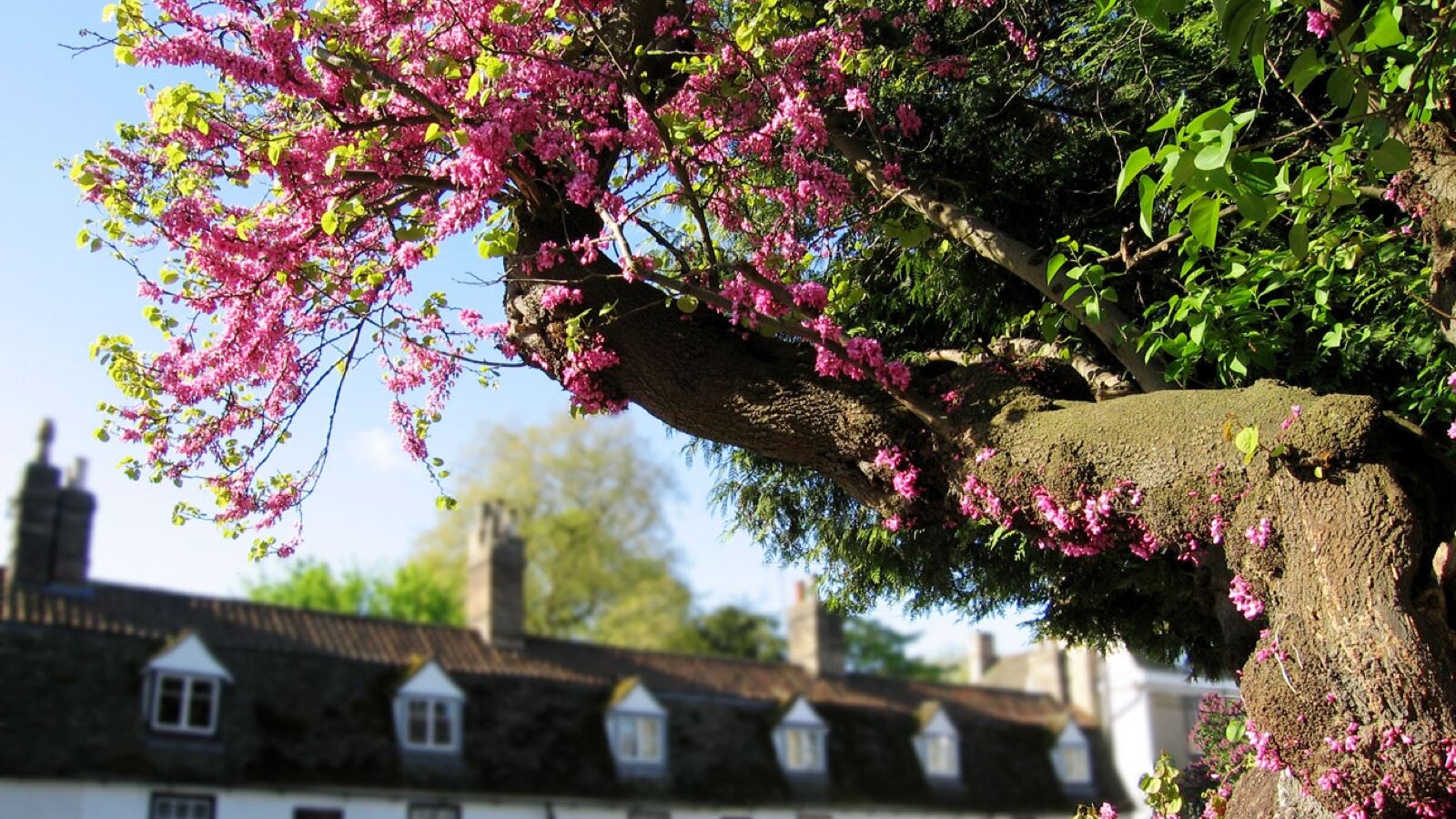
The Judas tree's glory is the way it flowers. In spring, before the leaves, it covers itself in dense clusters of small, bright pink-to-magenta pea-flowers — and, strikingly, these open not just on the twigs but directly from the older branches and the trunk itself, bursting straight out of the bare bark.
This is cauliflory — flowering on the trunk and old wood — the same habit that makes the jaboticaba and cannonball tree so startling, here producing the lovely effect of a whole tree, trunk and all, wreathed in pink before a leaf appears. The flowers are followed by flat, purplish, hanging seed pods (it is a legume, after all), and the heart-shaped leaves give clear yellow autumn colour. It is a small, rounded, often multi-stemmed tree of great beauty and modest size, perfect for a small garden. The nectar-rich flowers are excellent for early bees and pollinators.
Legend and the edible bloom
The tree's ominous name comes from a legend: it is said to be the tree on which Judas Iscariot hanged himself after betraying Christ, and that the tree's flowers — white before, on this telling — blushed pink or red with shame ever after. (More prosaically, the name may be a corruption of "Judaea tree," from the region where it grows.) Whatever the origin, the association has stuck, giving a beautiful spring tree a dark and memorable name, and a folkloric kinship with the pagoda tree of the Chinese emperor's end. See historical ecology.
Happily, the tree's reality is the opposite of grim: its flowers are edible and delicious — sweet-sour, slightly crunchy, and richly coloured — eaten fresh in salads, pickled, or made into fritters, a pretty pink garnish and a spring treat, as the flowers of its American redbud cousin are also eaten.
Growing it
Well suited to Mediterranean and warm-temperate climates, the Judas tree is tough and drought-hardy once established — it wants full sun and well-drained soil, tolerates poor, dry, and alkaline (chalky) ground, and dislikes waterlogging and deep cold when young — which makes it an easy, low-water small tree for hot, dry gardens. As a legume it fixes a little nitrogen.
It is slow-to-moderate growing, long-lived, and resents root disturbance, so it is best planted young and left alone; it can be grown from seed (scarified) and is sometimes grafted for named forms (including white- and deep-pink-flowered ones). For a sunny garden, few small trees give a more spectacular spring than the Judas tree in full trunk-to-tip bloom. See propagation and mediterranean shrubs.
See also
- Redbud and Sassafras the American redbud, its close Cercis cousin
- Silk Tree another legume flowering tree
- Jaboticaba and Cannonball Tree other cauliflorous trees
- Pollinator Habitat the early bee-nectar of its flowers
- Mediterranean Shrubs its dry-climate companions
- Pagoda Tree another flowering tree of dark legend