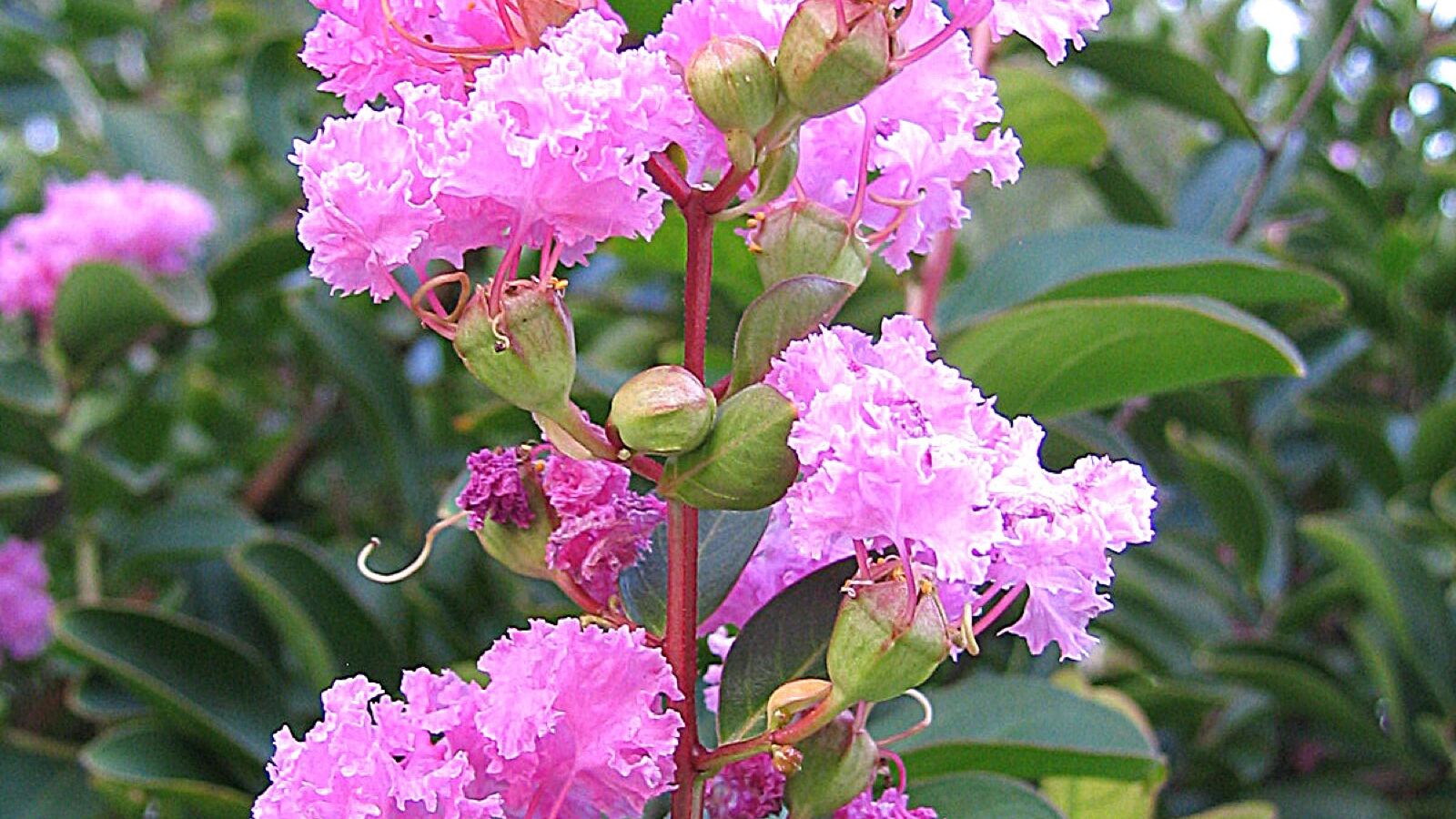
What it is
Lagerstroemia, the crape myrtles (or crepe myrtles) — deciduous trees and large shrubs of South and East Asia, above all the common crape myrtle (L. indica) and the larger, more disease-resistant Japanese crape myrtle (L. fauriei) and their hybrids. They belong to the loosestrife family, Lythraceae, which makes them relatives of the pomegranate and of henna.
Though Asian in origin, the crape myrtle has become the defining ornamental tree of the American South, planted in enormous numbers along streets, in gardens, and in car parks from Virginia to Texas, and increasingly worldwide in warm-temperate and subtropical climates. Its Chinese name translates as the "hundred days' red," which captures its whole appeal.
A hundred days of flower
The crape myrtle's great virtue is the length of its bloom. Where most flowering trees give a week or two, the crape myrtle flowers for much of the summer and into autumn — six to twelve weeks or more — in large, dense, showy panicles of crinkled, crepe-paper-textured flowers in white, pink, red, lavender, and purple. The crimped, tissue-paper petals are the source of the name (from "crape," an old spelling of crepe).
This marathon of high-summer colour, at a season when few trees flower, is why it is so beloved and so ubiquitous, and modern breeding (the U.S. National Arboretum's hybrids, named for Native American tribes — 'Natchez', 'Muskogee', 'Tuscarora') has extended the range of colours, sizes, and disease resistance enormously. The flowers are worked by bees and give a long pollinator season.
The bark and the seasons
The flowers are only half the tree. In winter, when bare, the crape myrtle reveals a superb sculptural trunk: smooth, sinuous, and multi-stemmed, with bark that exfoliates in thin flakes to leave a mottled patchwork of grey, brown, cinnamon, and cream — a winter feature to rank with the plane, stewartia, and birch. The autumn foliage adds orange, red, and yellow. A well-grown crape myrtle is a genuine four-season tree: flowers in summer, colour in autumn, bark in winter, fresh growth in spring.
That "well-grown" is doing a lot of work, though — because of what people do to it.
Crape murder
The crape myrtle is the victim of one of the most notorious bad-pruning habits in all of horticulture, known across the American South as "crape murder."
Every late winter, millions of crape myrtles are topped — their graceful branching crowns hacked back to ugly stumps and knuckles, in the mistaken belief that this is necessary to make them flower. It is not. Crape myrtles flower on new growth and will bloom perfectly well left unpruned; topping them:
- destroys the beautiful natural form and the sculptural trunk that is half the tree's value;
- produces a mass of weak, whippy regrowth from the stubs, with top-heavy flower clusters that flop and break;
- leaves permanent knuckled scars and decay-prone stubs, in exactly the way that topping any tree causes harm.
The correct approach is minimal: remove only crossing, dead, or crowded stems and low suckers to reveal the trunk, and otherwise let the tree build its natural shape. If a crape myrtle is too big for its spot, the answer is to have planted a smaller cultivar (they range from 60 cm dwarfs to 10 m trees), not to butcher a large one every year. "Crape murder" is the standard cautionary tale of pruning done from habit rather than understanding, and of topping's damage, the same lesson as the abandoned pollard. See tool care and safety.
Growing it
Warm-temperate to subtropical: crape myrtle wants heat and full sun to flower well — it is a sun-lover that sulks and mildews in shade or cool, damp climates — and it is hardy in the warmer temperate zones, with the hardiest cultivars taking real winter cold (dying back and reshooting at the cold edge of the range).
Soil. Tolerant of most well-drained soils, drought once established, and urban conditions, which is part of its value as a street tree. It resents wet, heavy, poorly-drained ground. See urban forestry.
Problems. Powdery mildew (worst in shade and humidity — choose resistant L. fauriei hybrids), aphids and the sooty mould that follows them, and, recently, the spreading crape myrtle bark scale. Otherwise easy. Grown readily from cuttings and seed. Prune lightly, if at all — and never top it. See propagation.
See also
- Pomegranate its relative in the loosestrife family
- Plane Trees another tree grown for exfoliating bark
- Stewartia more prized patchwork bark
- Pruning Basics why topping ("crape murder") harms trees
- Urban Forestry the crape myrtle as a Southern street tree
- Pollinator Habitat its long summer nectar season
- Seven-Son Flower