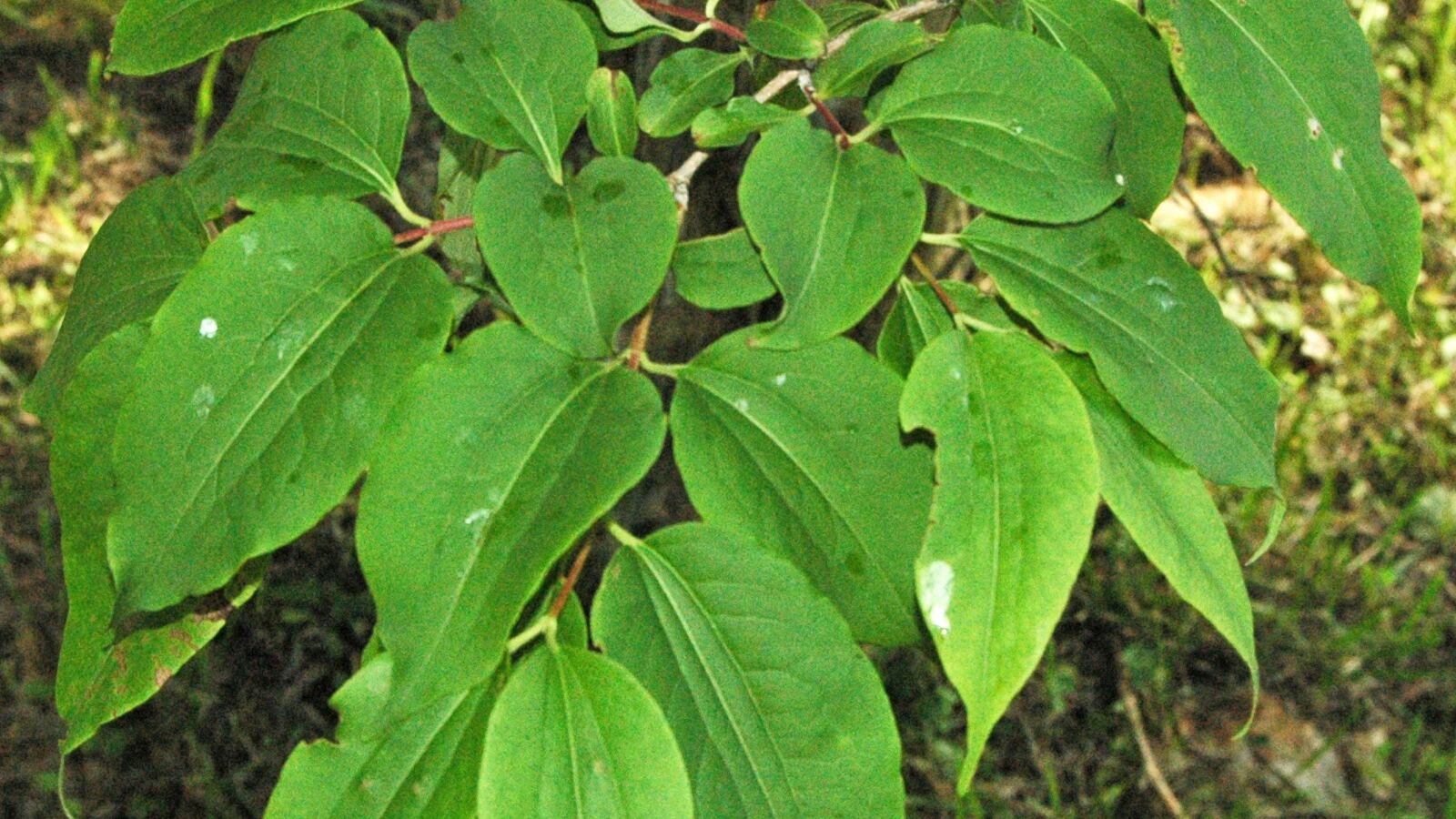
What it is
Heptacodium miconioides, the seven-son flower — a rare deciduous shrub or small tree of China, once known from only a few wild populations and nearly lost, now grown worldwide as a choice four-season ornamental.
It belongs to the honeysuckle family, Caprifoliaceae, and its name (Heptacodium means "seven-flowered," and "seven-son flower of Zhejiang" is its Chinese name) comes from the way its small flowers are arranged in whorls of seven — one central flower surrounded by six — in tiered clusters. It is a tree of quiet distinction that offers something remarkable in three of the four seasons.
Flowers, then a second bloom, then bark
The seven-son flower's great appeal is a sequence of displays, one after another, from late summer into winter.
Late-summer flowers. In August and September — the high-summer lull when few woody plants bloom — it opens masses of small, creamy-white, fragrant flowers in those tiered whorls of seven, sweetly scented and much loved by bees and butterflies, a valuable late nectar source at a lean time. See native bees.
The second bloom. Then comes its best trick. As the white flowers fade, the sepals (the calyces) enlarge and turn a bright cherry-pink to rose-red, so that the tree stages an entirely second display — a haze of rosy-red that is showier than the flowers themselves and lasts for weeks into autumn, as if the tree bloomed twice. It is one of the most striking of all "second bloom" effects among trees.
Winter bark. And when the leaves and calyces finally drop, the tree reveals a fine, tan-and-grey, exfoliating bark that peels in long strips to give winter interest, in the manner of the crape myrtle, stewartia, and plane. So the seven-son flower carries the garden from late summer, through a rosy autumn, into a handsome winter — an unusually generous small tree.
Its rarity in the wild, and its rescue into wide cultivation, place it among the trees — like the franklinia and dawn redwood — that are now far commoner in gardens than in nature, conserved by being grown. See seed banking.
Growing it
Hardy and adaptable, the seven-son flower wants full sun (for the best flowering and calyx colour) and moist, well-drained soil, and it tolerates a range of soils, heat, and some drought once established; it dislikes deep shade and waterlogging. It grows as a large multi-stemmed shrub or, trained up, a small single-trunked tree, moderately fast and long-lived.
It is grown from seed and cuttings, and is increasingly planted as a tough, four-season, late-flowering small ornamental and street tree — its late nectar, its double display, and its winter bark making it a valuable diversifier of the garden and the urban canopy. See propagation and urban forestry.
See also
- Crape Myrtle, Stewartia, and Plane Trees other trees of fine exfoliating bark
- Pollinator Habitat and Native Bees its valuable late-summer nectar
- Franklinia and Swamp Cypress and Dawn Redwood other rare trees saved by cultivation
- Tree Lilac and Pagoda Tree other late-flowering small trees
- Urban Forestry a four-season diversifier for the garden and street
- Seed Banking conserving a once-rare tree by growing it