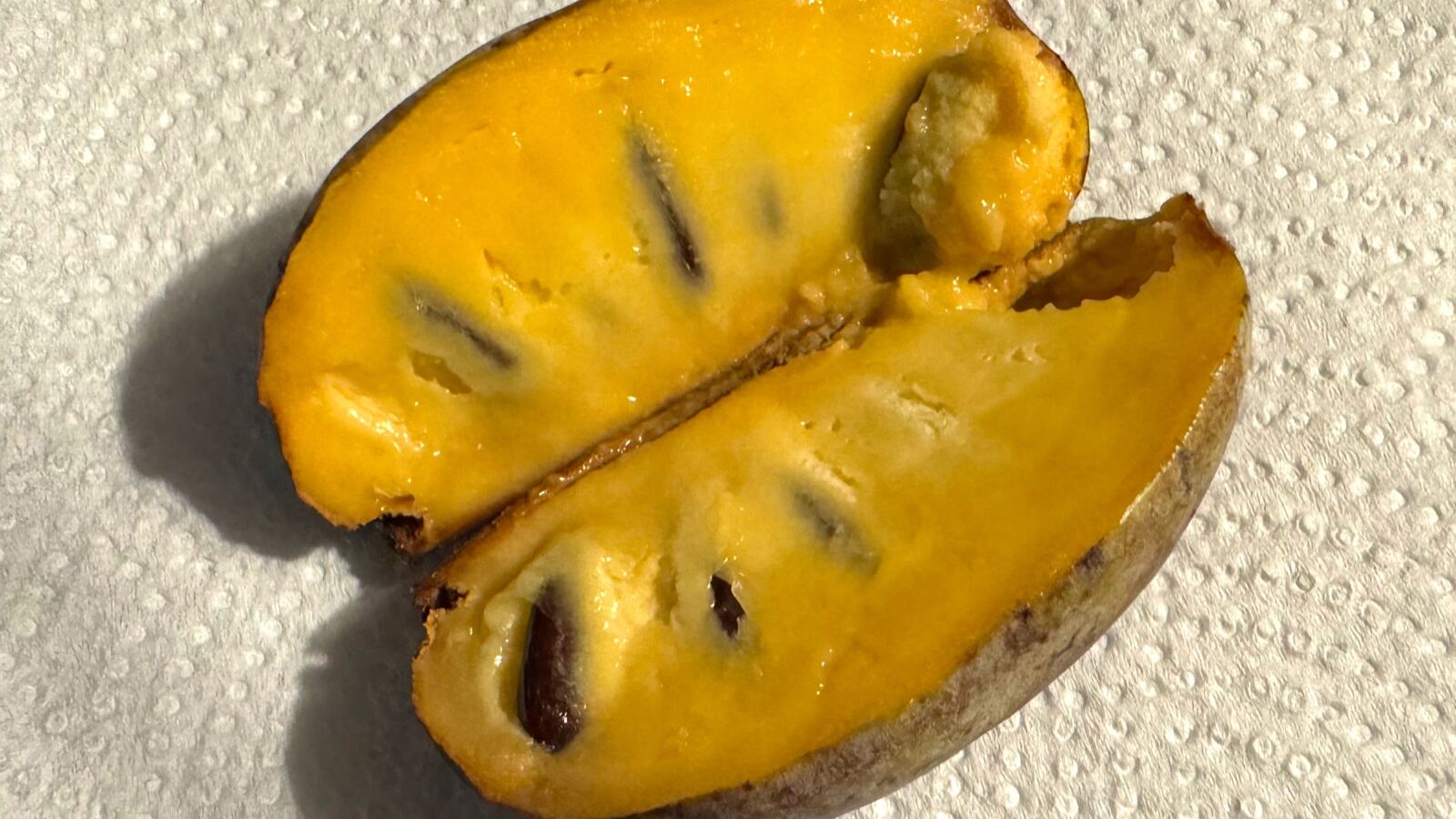
Two native fruits nobody grows
Both are native to eastern North America, both produce genuinely good fruit, and neither reached commercial scale for reasons that turn out to be about handling rather than flavour.
Pawpaw, Asimina triloba. The largest edible fruit native to North America, with custard-textured flesh tasting of banana, mango, and vanilla. A member of the custard apple family, Annonaceae — otherwise entirely tropical, making pawpaw the family's one temperate outpost.
American persimmon, Diospyros virginiana. Smaller and sweeter than the Asian persimmon, and mouth-puckeringly astringent until fully ripe.
Pawpaw: dispersed by animals that no longer exist
Pawpaw has a large fruit with big seeds and no effective native disperser.
The usual explanation is evolutionary anachronism: the fruit evolved to be eaten by Pleistocene megafauna — mastodons, giant ground sloths — that went extinct roughly 12,000 years ago. Nothing left in the fauna swallows a pawpaw whole and carries the seed any distance.
The same argument is made for the avocado, mentioned in tropical fruit trees, and for honey locust pods.
Consequently pawpaw spreads mainly by root suckering, forming clonal patches, and its distribution owes a great deal to deliberate planting by Indigenous peoples and later by settlers.
The flower nobody wants to pollinate
Pawpaw flowers are dark maroon, hang downward, and smell faintly of rotting meat.
They are pollinated by carrion flies and beetles, not bees — and the pollinators are inefficient and often scarce, so natural fruit set is frequently poor.
Compounding it, pawpaw is self-incompatible: a single tree, or a clonal patch of suckers from one plant, will not set fruit. You need two genetically distinct trees, which means seedlings or named grafted varieties rather than suckers from one clone.
Growers routinely hand-pollinate with a small brush, transferring pollen between varieties, and it reliably transforms the crop. Some hang meat or fish near the trees to attract flies, which works and is not pleasant.
Why you cannot buy a pawpaw
The fruit ripens to a soft custard, bruises if looked at, and has a shelf life of two to three days at room temperature.
It cannot be shipped, stacked, or stored, which is the same problem mulberry has and the reason both remain the preserve of people who grow them.
Ripe fruit is picked when it yields to gentle pressure and detaches easily, or gathered from the ground. It freezes well as pulp, which is the practical way to keep it, and it makes excellent ice cream, custard, and bread.
Note: the seeds and skin contain annonacin, a neurotoxin, and should not be eaten. Some people react to the fruit itself. Do not eat the seeds or blend them into pulp.
Persimmon and the frost myth
American persimmon is intensely astringent when unripe — high in soluble tannins that bind salivary proteins and produce a dry, furry, genuinely unpleasant mouthfeel.
The traditional advice is to wait for frost. Frost is not actually the mechanism. The tannins polymerise and become insoluble as the fruit ripens fully, and that ripening happens to coincide with autumn frosts in most of the range. A fully ripe persimmon in a frost-free autumn is equally sweet.
So the rule is wait until it is genuinely, softly ripe — wrinkled, jelly-textured, and falling from the tree. Anything firm is a mistake you will remember.
Asian persimmon, D. kaki, includes non-astringent varieties such as Fuyu that can be eaten crisp, which is why they dominate commerce. The astringent Asian types like Hachiya need the same full ripening as the American.
American persimmon is dioecious — separate male and female trees — so a crop needs both.
Persimmon wood is in the ebony genus, and the heartwood is dense, hard, and nearly black. It was the traditional timber for golf club heads, shuttles, and billiard cues.
In the forest
Pawpaw is a small understorey tree, 3 to 10 m, and notably shade-tolerant — one of the few fruiting species that will crop in the understorey of a closed canopy, though it fruits better with more light.
That makes it an unusually good candidate for the sub-canopy layer of a temperate food forest, where most fruit needs full sun. Its large drooping leaves also give it a curiously tropical look.
Pawpaw foliage contains acetogenins, which are strongly insecticidal — so it has almost no pest problems, and deer avoid it. In heavily browsed eastern woodlands, dense pawpaw thickets are frequently a symptom of too many deer removing everything else. See deer and rabbits and indicator species.
It is the sole larval host of the zebra swallowtail butterfly, which occurs nowhere pawpaw does not. See caterpillars.
Persimmon is a light-demanding pioneer of old fields and edges, and its fruit is a major autumn food for deer, raccoons, opossums, foxes, and birds. See seed-dispersing birds.
Growing them
Pawpaw. Deep, moist, fertile, slightly acid, well-drained soil. Seedlings need shade for the first year or two and then progressively more light — the reverse of most fruit trees, and a common cause of failure. Taprooted and brittle-rooted, so transplant only when small and handle carefully. Plant two different varieties. Grafted plants fruit in 3 to 5 years, seedlings in 5 to 8.
Seed must not dry out and needs 90 to 120 days of cold stratification. It cannot be stored dry, which is why pawpaw seed is sold moist and refrigerated. See seed saving.
Persimmon. Far tougher — tolerates poor, dry, and heavy soils, and is deeply taprooted and drought-resistant once established. Transplants badly for the same reason as hickory. Plant small or direct-seed.
Both are hardy well below freezing — American persimmon to about minus 25 C, pawpaw to about minus 25 C as well — so they are viable far outside where they are usually grown, including much of temperate Europe.
See also
- Tropical Fruit Trees the family pawpaw belongs to
- Food Forest Design pawpaw as a shade-tolerant fruiting layer
- Mulberry the other fruit too fragile to sell
- Hickory and Pecan the taproot transplanting problem
- Deer and Rabbits why pawpaw thickets spread
- Seed Saving recalcitrant seed that cannot be dried
- Catalpa
- Osage Orange
- Buckthorn
- Avocado
- Cherimoya and Annonas
- Ebony and Blackwood
- Papaya
- Ylang-Ylang