What it is
Chionanthus, the fringe tree — chiefly the American fringe tree (C. virginicus) of the southeastern United States and the Chinese fringe tree (C. retusus) — small deciduous trees whose botanical name means "snow flower," which describes them perfectly.
They belong to the olive family, Oleaceae, which makes them close relatives of the olive, the ash, lilac, jasmine, and privet — a family connection that turns out to matter a great deal for the tree's future, as explained below.
A cloud of fringe
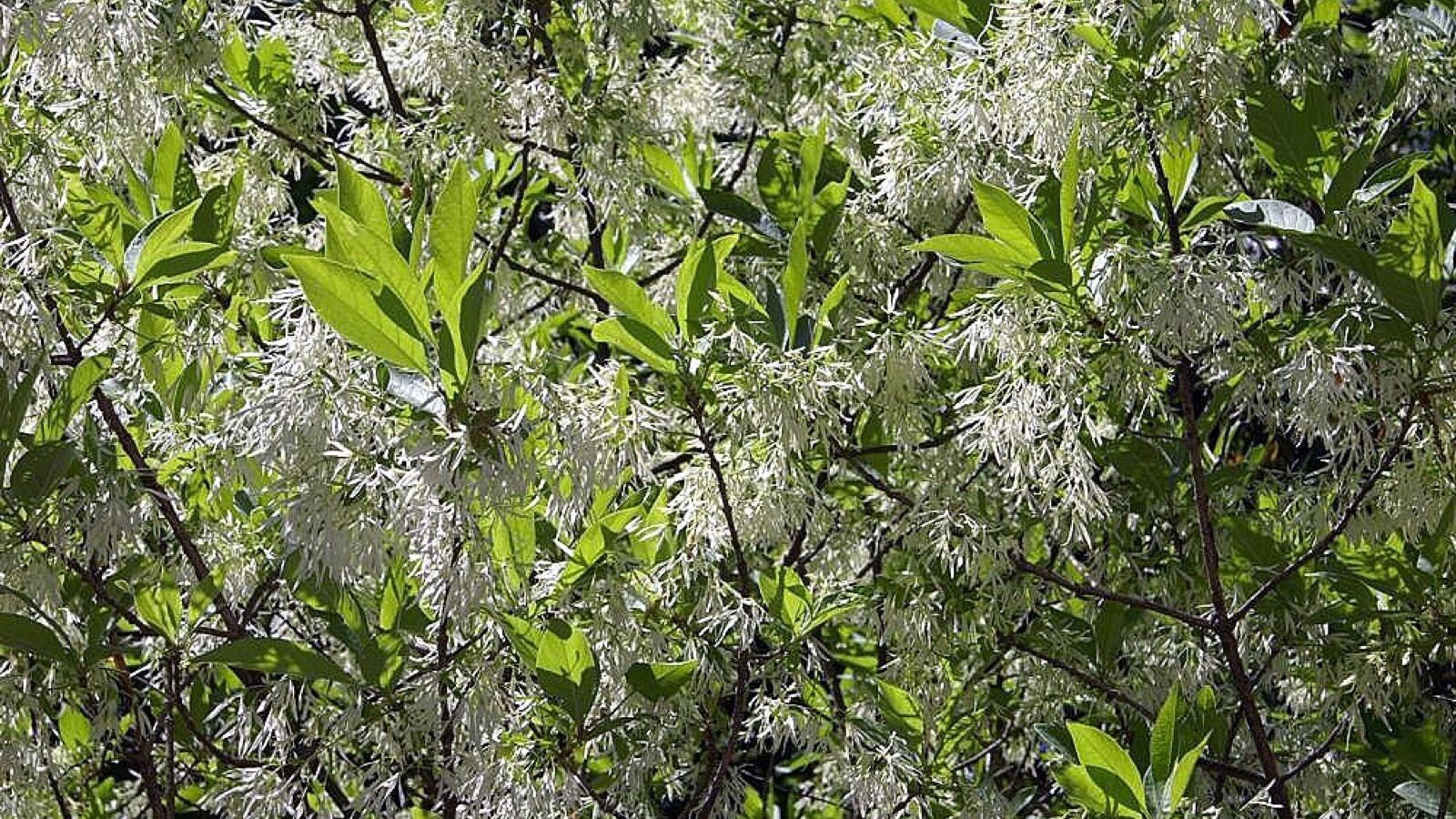
For a week or two in late spring the fringe tree does something few plants match: it disappears under a cloud of fleecy, drooping, pure-white flowers, each with four (or more) narrow, strap-like petals, borne in loose feathery panicles that hang and sway. The overall effect is of a tree covered in soft white fringe or fleece — hence "fringe tree" and the folk name "old man's beard" (a name it shares with a couple of unrelated fluffy plants). The American species flowers with the emerging leaves; the flowers are lightly, sweetly fragrant, and they are a good source of nectar for pollinators and native bees.
The fringe tree is usually dioecious — separate male and female plants — with the male trees carrying slightly showier flowers, and the females, if pollinated, following the flowers with clusters of small dark-blue, olive-like fruit (it is in the olive family, after all) that are relished by birds. It is a slow, small, rounded tree, ideal for a small garden or as an understorey and specimen tree, and it colours a clear yellow in autumn.
The emerald ash borer threat
The fringe tree's family membership has recently become a source of real concern. The emerald ash borer (Agrilus planipennis), the Asian beetle whose larvae have killed hundreds of millions of North American ash trees, was long thought to attack only true ashes (Fraxinus).
Then it was discovered attacking and killing fringe trees — the first confirmed host outside the genus Fraxinus, and a worrying sign that the borer can jump to other members of the olive family. Fringe trees appear somewhat more resistant than ash, and many survive infestation, but the discovery means this lovely small tree is now drawn into one of the most destructive tree disease and pest events in North American history, and it is watched closely as an indicator of how far the borer's tastes may spread. See integrated pest management.
Growing it
Undemanding and adaptable, which makes its beauty all the more welcome.
The fringe tree tolerates a wide range of soils, including clay and alkaline ground (unlike the acid-loving stewartia and silverbell), and it stands heat, humidity, urban conditions, and pollution well, which makes it a good tough small tree for city and difficult sites as well as gardens. It prefers moist, fertile, well-drained soil and full sun to light shade, flowering best in sun. See urban forestry.
It is slow-growing and long-lived, and — apart from the emerging ash-borer threat — largely free of problems. For fruit, a male and female are needed; for flowers alone, either will do (males flower a little more showily). Grown from seed, which is famously slow and doubly dormant (often taking two years to germinate), and with difficulty from cuttings, so nursery plants are often grafted. See propagation.
A fringe tree in full bloom is one of the memorable sights of the late-spring garden, and its toughness means it belongs in far more gardens than grow it.
See also
- Olive the family's most famous member
- Ash its close relative — and the borer they now share
- Tree Diseases the emerald ash borer's spread to the fringe tree
- Magnolias another choice small flowering tree
- Silverbell and Snowbell fellow white-flowered small trees
- Pollinator Habitat the nectar its flowers provide
- Tree Lilac