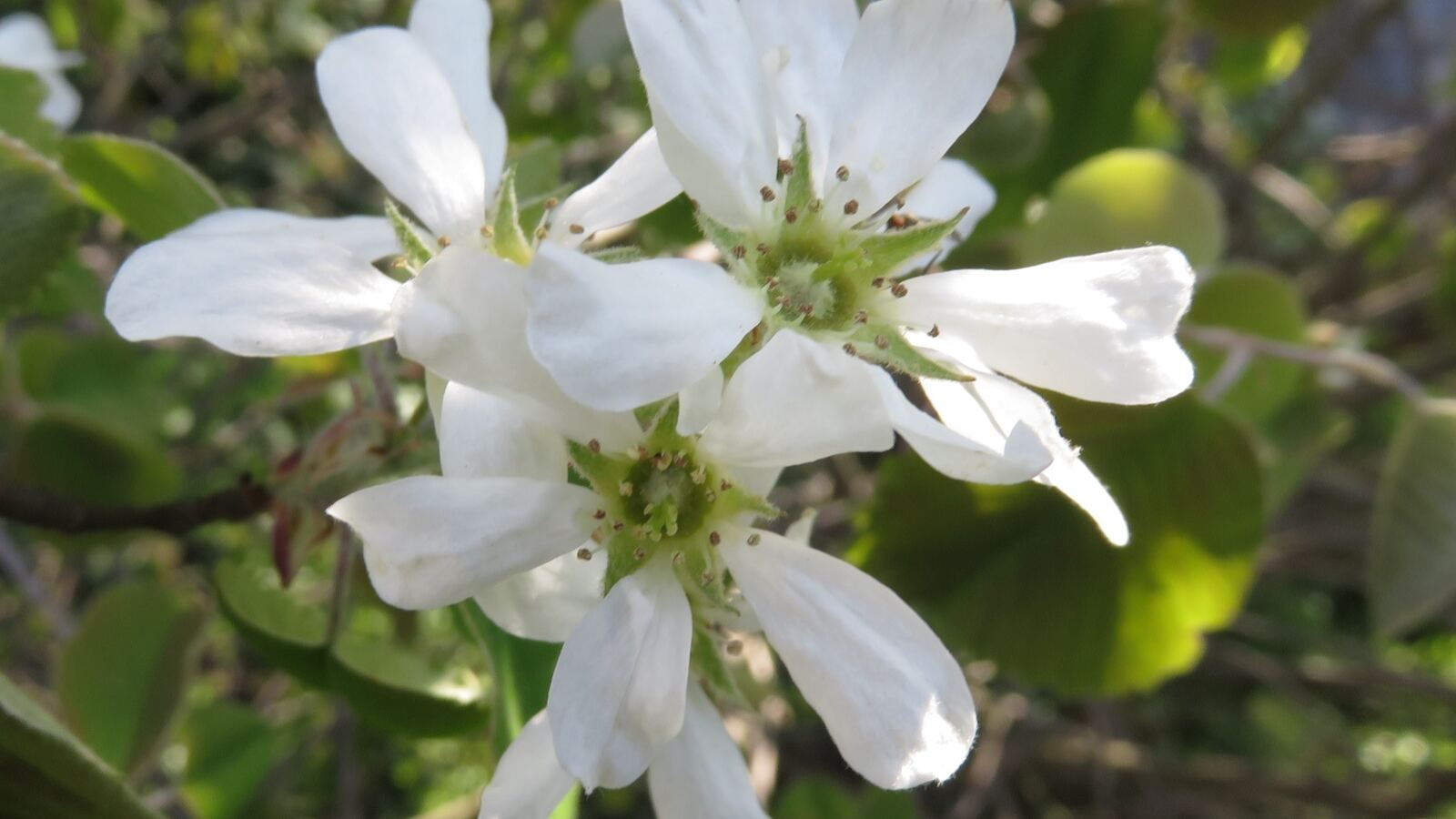
What it is
Amelanchier, around 20 species, mostly North American with a few in Europe and Asia. In the rose family, related to apples and pears, hawthorn, and rowan.
It carries more common names than almost any tree: serviceberry, juneberry, shadbush, shadblow, saskatoon, sugarplum, chuckley pear.
Most of those names are seasonal markers. Shadbush because it flowers when shad run up the rivers to spawn. Serviceberry is often explained as marking when the ground thawed enough for burials and funeral services to resume — the etymology is disputed and probably derives from sorbus, but the association stuck.
Four seasons of use
The strongest case for serviceberry is that it earns its place in every season, at a size that fits an ordinary garden — 4 to 8 m.
Early spring: among the first trees to flower, with drifts of white star-shaped blossom on bare or barely-leafing branches. It comes before hawthorn and around blackthorn, when very little else is open.
Early summer: fruit, in June in much of its range — hence juneberry — which is earlier than any other tree fruit.
Autumn: reliable orange and scarlet colour, among the better small trees for it.
Winter: smooth grey striped bark and a fine branch structure.
The fruit
Small pomes, 6 to 12 mm, ripening from red to deep purple, with a sweet flavour close to blueberry with an almond note from the seeds.
Saskatoon, A. alnifolia, is the commercially grown species, farmed at scale across the Canadian prairies, where it is genuinely important — a hardy fruit crop for a climate too cold for most others, and a traditional staple.
It was a principal ingredient in pemmican: dried meat pounded with fat and serviceberries, the high-energy portable food of northern plains peoples and later of the fur trade.
The fruit is excellent fresh, and makes good pies, jams, and wine. It dries well.
Birds get there first. This is the practical problem. Serviceberry fruit is taken enthusiastically by robins, waxwings, thrushes, and everything else, and an unnetted tree is stripped within days of ripening. Net it or accept that you have planted a bird feeder — which is a legitimate choice. See seed-dispersing birds and wildlife shrubs.
Wildlife value
Disproportionate for its size, and worth spelling out.
Very early nectar and pollen at a point when queen bumblebees and emerging solitary bees have almost nothing available. Early-flowering trees are worth more per flower than midsummer ones for exactly this reason. See native bees and pollinator habitat.
Early fruit, filling a genuine gap — most tree fruit ripens in late summer and autumn, and serviceberry provides for birds feeding nestlings in early summer.
Larval host for a considerable range of moths and butterflies, including several hairstreaks and the viceroy. See caterpillars.
Browse for deer and rabbits, which is a liability when establishing. See deer and rabbits.
It is one of the better small trees for a wildlife-focused garden, and comfortably better than most ornamental cherries planted for the same purpose.
Apomixis and the identification problem
Serviceberry is notoriously difficult to identify to species, and the reason is genetic.
Many Amelanchier are apomictic — they set viable seed without fertilisation, producing clonal offspring — and they also hybridise freely between species. The result is a swarm of stable clonal microspecies with intermediate characteristics and blurred boundaries.
This is the same phenomenon described in rowan and whitebeam, and in both genera it produces localised populations that are hard to name and easy to overlook in conservation terms. See minimum viable populations.
For practical purposes, garden serviceberries are usually A. lamarckii, A. canadensis, A. × grandiflora, or A. alnifolia, and the differences that matter are size, habit, and fruit quality rather than name.
Growing it
Genuinely easy, which is part of the case for it.
Tolerates a wide range of soils, acid to neutral, and dislikes only shallow chalk and waterlogging. Prefers moist well-drained ground.
Sun or part shade. It fruits and colours better in sun, and it will grow in light woodland shade, which makes it useful for the sub-canopy layer of a food forest.
Hardy, several species to minus 40 C, which is why saskatoon works on the prairies.
Suckering in some species, which produces a thicket — useful for hedging and screening, and worth knowing before planting in a border. A. lamarckii and the tree forms behave better.
Few problems. Occasional fireblight, rust, and powdery mildew, being in the rose family. See tree diseases.
Propagate from seed, which needs cold stratification, or from suckers and layering. Named fruiting varieties are grafted. See propagation.
For a productive planting, choose a named saskatoon cultivar; for ornament and wildlife, almost any will do.
See also
- Hawthorn the close relative and the other great small wildlife tree
- Rowan and Whitebeam the same apomictic complexity
- Native Bees why very early flowering matters
- Wildlife Shrubs fruit timing across the season
- Food Forest Design serviceberry in the sub-canopy
- Berry Bushes the soft fruit it tastes like