What it is
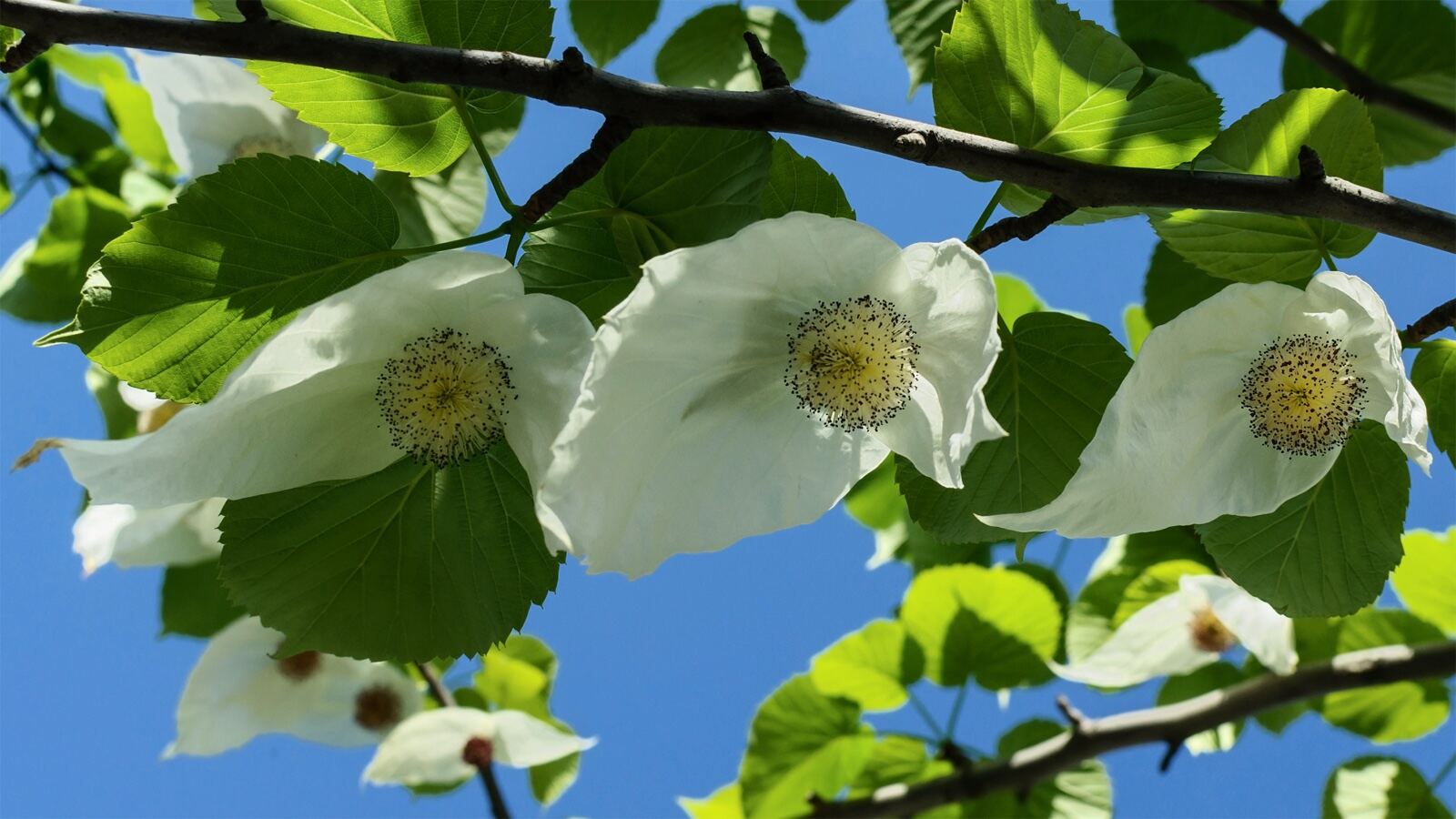
Davidia involucrata, the dove tree — also called the handkerchief tree or ghost tree — a medium-sized deciduous tree of the mountain forests of central and southwestern China, and the sole species in its genus, standing alone with no close living relatives.
It is grown for one spectacular feature. The tiny true flowers are gathered into small round heads of no beauty in themselves — but each flower head is flanked by a pair of large, unequal, pure white bracts (modified leaves), one bigger than the other, that hang down on either side. In late spring a mature tree is covered in hundreds of these paired white bracts, fluttering and twisting in the breeze, and the effect has been described, unforgettably, as a tree hung with white handkerchiefs, or a flock of doves settling with folded wings, or drifting ghosts — hence its three common names. It is one of the most admired of all flowering trees, and the sight of a big dove tree in full "bloom" is a highlight of the spring garden.
The tree that launched an expedition
The dove tree's fame in the West rests as much on the drama of its introduction as on its beauty, and the story is one of the classics of the golden age of plant hunting.
The tree was first described for Western science by the French missionary-naturalist Père Armand David (for whom it is named, and who also made known the giant panda and Père David's deer) in the 1860s. Word of this extraordinary "handkerchief tree" reached the great nurseries of Europe, and it became one of the most coveted plants in the world — a tree everyone wanted and no one could get.
In 1899 the English nursery firm Veitch sent a young, unknown plant collector, Ernest "Chinese" Wilson, on his very first expedition, with essentially one instruction: find the dove tree and bring back its seed. The journey was epic and calamitous — Wilson crossed the world, survived illness, river accidents, and the collapse of his boat — and when he finally reached the single tree whose location he had been given, he found that it had been cut down and made into a house. It was a devastating moment. But Wilson pressed on, located other dove trees in the wild, and succeeded in collecting the seed that established the tree in Western cultivation. He went on to become one of the most important plant collectors in history, introducing over a thousand species — but it was the dove tree that began it. The tale stands with the discoveries of the Wollemi pine and dawn redwood, and the saving of the franklinia, as one of the great stories of the search for trees. See historical ecology.
A patient tree
There is one famous frustration for anyone who plants a dove tree: it makes you wait. A seed-grown dove tree typically takes ten to twenty years to produce its first flowers, so it is a tree planted by the patient, or for the next generation — which only deepens the sense of occasion when the white bracts finally appear. Grafted plants and selected clones flower somewhat sooner.
The showy white bracts are, like those of the flowering dogwoods, an advertisement to draw pollinators to the insignificant true flowers at their centre — beauty in the service of pollination, and the bracts also protect the developing flowers. A hard, walnut-like fruit follows.
Growing it
Hardy and, once established, not difficult — but slow, and needing space and shelter to do itself justice.
The dove tree wants moist, deep, fertile, well-drained soil in sun or light shade, sheltered from strong wind and late frost (which can spoil the emerging bracts), in the manner of a woodland-edge tree. It grows into a shapely, medium-sized, broadly conical tree of 10 to 20 m, so it needs room, and it is happiest in cool, moist, temperate climates. See tree planting.
It is largely free of pests and diseases and long-lived. Grown from seed, which is slow and famously doubly dormant (often taking two winters to germinate), and increasingly from grafting and cuttings of selected early-flowering, large-bracted forms. Plant one, be patient, and one spring the tree will hang out its doves. See propagation.
See also
- Magnolias the other aristocratic spring-flowering trees
- Franklinia another storied plant-hunting and conservation tale
- Wollemi Pine a comparable great discovery
- Spindle and Dogwood the flowering dogwoods with the same bract trick
- Historical Ecology the age of the plant hunters
- Pollinator Habitat the bracts that advertise to insects