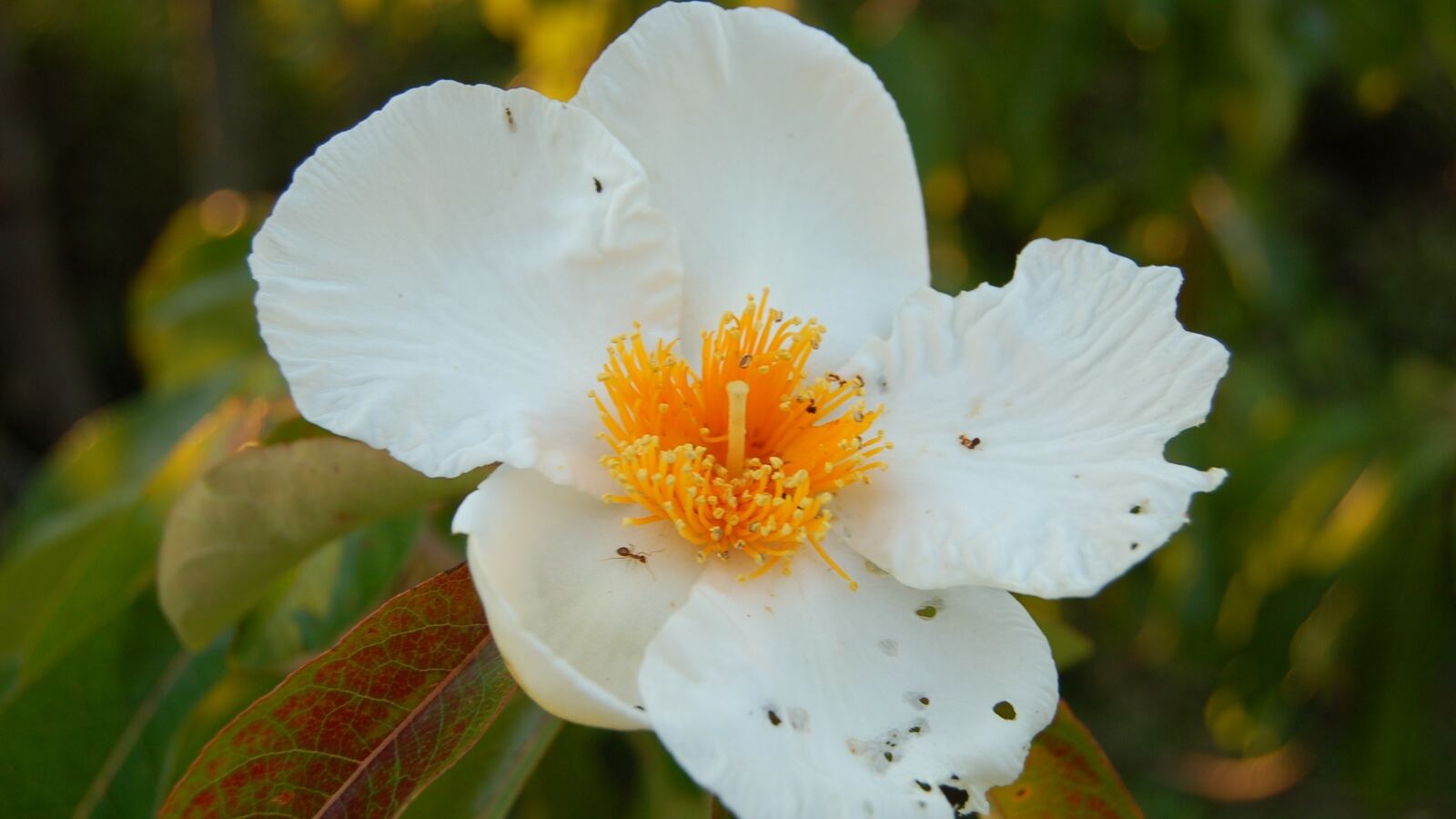
What it is
Franklinia alatamaha, the Franklin tree, a small deciduous flowering tree in the tea family, Theaceae — a close relative of the tea plant and the camellias, and the sole species in its genus. It bears large, white, camellia-like flowers with golden centres in late summer and autumn, often at the same time as its leaves turn scarlet — a rare and lovely combination.
But its beauty is not why it is famous. Franklinia is famous because it is extinct in the wild, and has been for over two hundred years, so that every Franklin tree alive today descends from seed collected by hand before it vanished.
Found once, then gone forever
The whole known history of Franklinia in the wild fits into a few decades. In 1765 the botanists John and William Bartram, exploring the Altamaha River valley in Georgia, came upon a stand of unfamiliar flowering trees growing in a small area — just a few acres — and nowhere else. They recognised it as something new, and William Bartram later returned and collected seed, naming the tree for the family's friend Benjamin Franklin.
That tiny population by the Altamaha was the only place the tree was ever found growing wild. Over the following decades it was seen there a handful of times, and then, by around 1803, it was gone — the last confirmed wild sighting. Despite repeated, determined searches over the two centuries since, no wild Franklinia has ever been found again. It disappeared entirely from nature.
Why it vanished is still debated: its wild range was extraordinarily small and vulnerable to begin with; a fungal root disease (possibly introduced with cotton cultivation in the region) may have finished it off; and collection, fire, and flooding have all been suggested. Whatever the cause, a tree that grew in one small place, and nowhere else, had almost no margin for survival.
Saved by seed
Here is what makes Franklinia extraordinary: it survives at all only because the Bartrams collected its seed and grew it in their garden in Philadelphia. Every Franklinia now growing in the world's gardens, arboreta, and nurseries is a descendant of that cultivated Bartram stock — the tree exists entirely in human care, a living thing preserved past its own extinction in the wild.
It is the most complete example in this encyclopedia of conservation by cultivation. The ginkgo, the dawn redwood, and the Wollemi pine were all reduced to tiny wild remnants and then spread widely in gardens as insurance — but Franklinia went one step further and lost its wild population entirely, so that cultivation is not merely insurance but the only thing standing between the species and total extinction. Without a few eighteenth-century botanists and their seed, the tree would be known today only as a name and a pressed specimen. It is a powerful argument for botanic gardens, seed banks, and living collections, and a sobering reminder of how narrow the line can be. See historical ecology.
A curious consequence of descending from a single small seed collection is that all Franklinias are genetically very uniform — a natural bottleneck, like the Wollemi pine's — which is part of why the tree can be difficult and disease-prone in cultivation.
Growing it
Franklinia is beautiful but notoriously fussy and difficult, which adds poignancy to its dependence on gardeners.
It wants moist but sharply drained, acidic, humus-rich soil — the conditions of its tea-family relatives and of the blueberry and acid shrubs — in a sheltered spot with sun or light shade, and it resents heavy clay, drought, wet feet, alkaline soil, and root disturbance. It is especially prone to Phytophthora root rot (very possibly the disease that helped kill it in the wild), which makes drainage critical. Slow, tender when young, and never easy, it is a connoisseur's tree.
Grown from seed and cuttings, it flowers young. To grow a Franklinia well is to keep alive, in your own garden, a tree that no longer exists anywhere in nature — perhaps the strongest reason of all to try. See propagation and soil pH.
See also
- Tea its close relative in the tea family
- Stewartia another beautiful Theaceae garden tree
- Ginkgo a tree saved from near-extinction by cultivation
- Wollemi Pine the same conservation-by-cultivation story
- Seed Banking preserving species outside the wild
- Blueberry and Acid Shrubs the acid-soil conditions Franklinia needs
- Seven-Son Flower