What it is
Liriodendron tulipifera, from eastern North America, and L. chinense in China — the only two species in the genus, and a classic example of the eastern Asia–eastern North America disjunction that puzzled early botanists and turned out to be the fragmented remnant of a once-continuous northern forest.
It is a magnolia relative, not a poplar, despite the name yellow poplar or tulip poplar used throughout the American timber trade. See magnolias.
Two features identify it instantly:
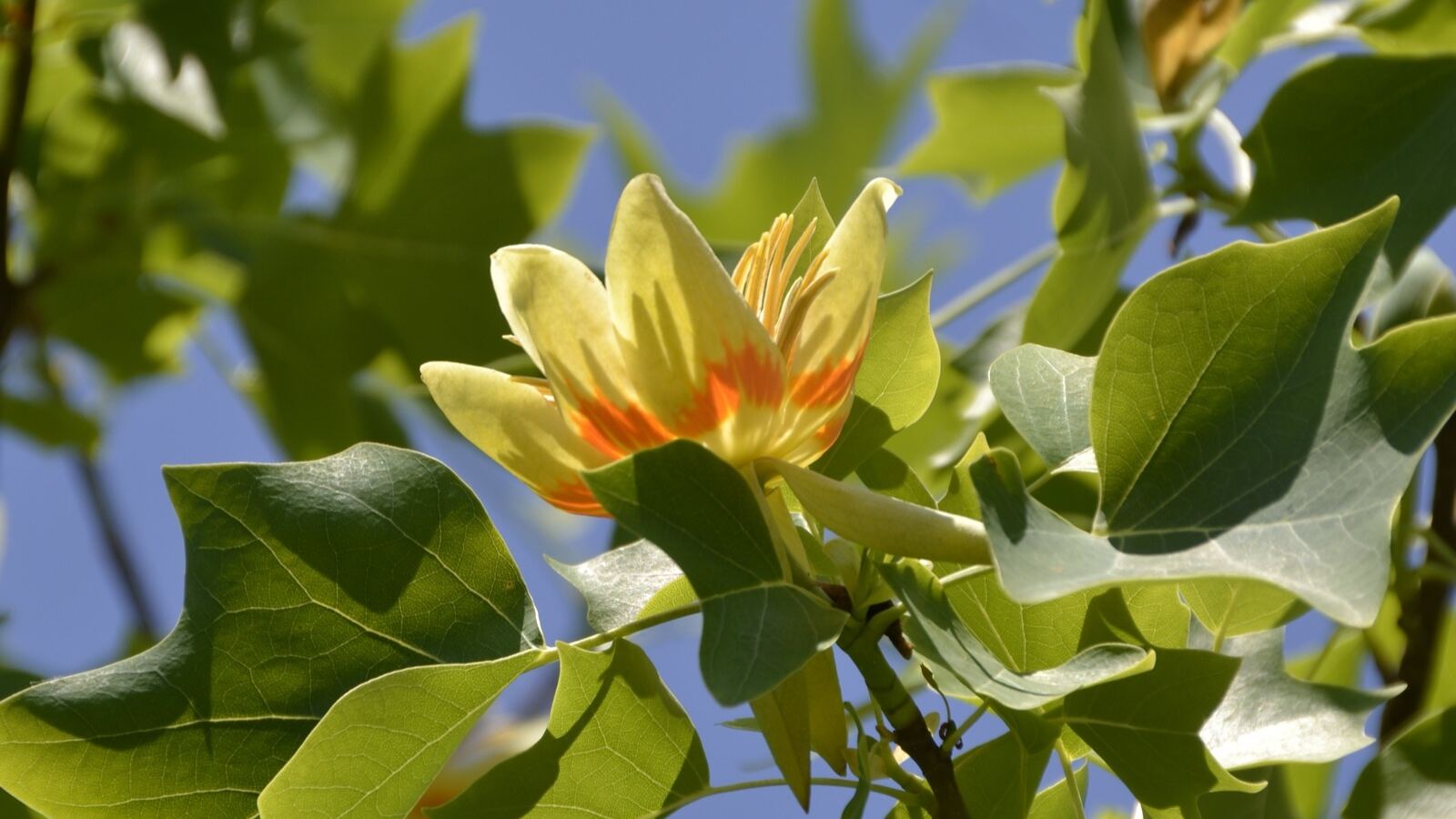
The leaf. Four-lobed and squared off at the tip, as though the end had been cut away with scissors. Nothing else in a temperate forest has it.
The flower. Large, cup-shaped, greenish-yellow with a bright orange blotch at the base of each petal — genuinely tulip-like, and held high in the canopy where they are frequently missed from the ground.
The tallest eastern hardwood
Tulip tree is the tallest broadleaf in eastern North America, routinely reaching 45 to 55 m and occasionally over 60 in the coves of the southern Appalachians, where the best examples grow alongside the tallest eastern hemlocks and white pines.
It grows fast and straight, with a long clean cylindrical bole and no lower branches once established — which is exactly what a sawmill wants.
Old-growth tulip trees in the Great Smoky Mountains are among the largest hardwoods on the continent.
The timber
Sold as yellow poplar or tulipwood, and it is one of the most widely used American hardwoods.
Light, soft for a hardwood, straight-grained, stable, and available in wide clear boards from a straight bole — an easy, forgiving timber that machines and paints beautifully.
Used for furniture frames and carcass work, mouldings, interior joinery, plywood cores, pallets, and pattern-making. It takes paint so well that it is the standard American timber for painted trim.
The heartwood is a greenish-yellow to olive-brown, sometimes with purple streaking, and it fades on exposure.
Not durable outdoors. It is an interior timber.
Indigenous peoples of the eastern woodlands made dugout canoes from single tulip tree trunks, which the size and straightness of the boles made possible.
Nectar
Tulip tree is one of the most productive nectar trees in North America.
A mature tree in flower produces very large quantities, and tulip poplar honey is a significant commercial monofloral honey across the Appalachians and mid-Atlantic — dark, strong, reddish-amber, and slow to crystallise.
The flowering is brief but heavy, and it comes at a useful point in late spring. See native bees and pollinator habitat.
The flowers are structurally primitive, as magnolia family flowers are — many separate parts arranged in spirals rather than fused whorls — and they are beetle-pollinated as well as bee-pollinated, a very old arrangement predating the specialised bee-flower relationships of most later families.
Where it fits ecologically
Tulip tree is light-demanding and fast, so it behaves as a gap-phase species: it colonises openings, old fields, and disturbed ground, grows rapidly to canopy height, and then persists as a dominant for a couple of centuries.
It does not regenerate under its own shade, so a mature stand is eventually succeeded by more shade-tolerant species — oaks, maples, beech — unless disturbance opens it again. See pioneer species and structural diversity.
That makes it a useful component in restoration planting on cleared or abandoned ground, where fast canopy closure is wanted. See reforestation techniques.
Seed viability is low — often only 5 to 20 percent of the samaras in a cluster are filled — so natural regeneration relies on very large seed production rather than high success rates.
Growing it
Deep, moist, fertile, well-drained soil. This is not a tree for thin, dry, or compacted ground, and it performs poorly on chalk.
Full sun.
Space. It is very large and it grows fast — a poor choice for a small garden, and a good one for a park, an estate, or a woodland planting.
Hardy across most of temperate Europe and widely planted there as an ornamental since the seventeenth century.
Transplants poorly once past sapling size, with fleshy brittle roots. Plant small, in spring rather than autumn. See tree planting.
Fast — 60 cm to 1 m a year on a good site when young.
Relatively free of serious pests and diseases, though prone to aphid honeydew and sooty mould in some seasons, and to yellow-poplar weevil. See aphids.
Autumn colour is a clear butter-yellow, and the four-lobed leaves are as recognisable on the ground as on the tree.
See also
- Magnolias the family, and the primitive flower structure
- Native Oaks the species that succeed it
- Pioneer Species gap colonisation and fast canopy closure
- Native Bees what the nectar flow supports
- Reforestation Techniques tulip tree on cleared ground
- Hickory and Pecan the eastern forest companions
- Katsura