What they are
Coccinellidae, around 6,000 species worldwide. Beetles, not bugs, and among the most effective aphid predators available to a grower.
Most people can identify the adult and almost nobody recognises the larva — which is a problem, because the larva does most of the killing.
Know the larva
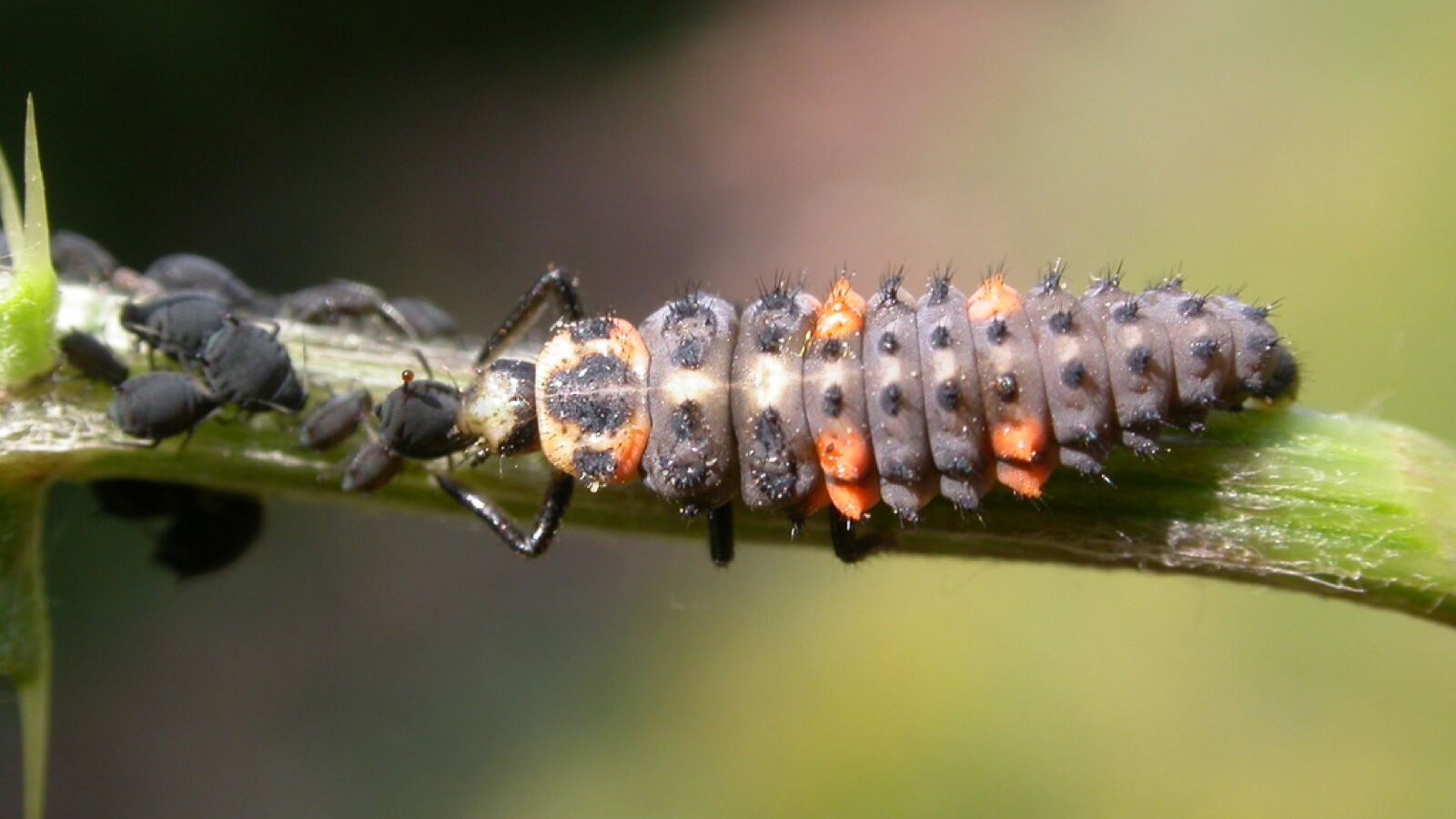
Ladybird larvae look nothing like the adult: elongated, segmented, spiny or warty, usually black or slate-grey with orange, yellow, or white markings. Alligator-shaped, and about 1 cm at full size.
They are routinely mistaken for pests and squashed. If you learn one thing from this entry, learn to recognise them.
The numbers explain why it matters. An adult seven-spot ladybird eats perhaps 30 to 60 aphids a day. A single larva eats 300 to 500 aphids over its two to three weeks of development, and consumption accelerates sharply in the final instar.
The eggs are also worth knowing: small yellow-orange ovals stood on end in tight clusters of 10 to 50, usually on the underside of a leaf near an aphid colony. They are frequently mistaken for pest eggs.
The pupa is a rounded, hunched, orange-and-black object glued to a leaf, motionless, and often assumed to be a dead insect or a scale.
The whole cycle depends on aphids
The central paradox of biological control, and the reason spraying defeats it.
Ladybirds lay near aphid colonies, because the larvae are relatively immobile and must find food immediately on hatching. No aphids, no eggs.
So a garden with no aphids has no ladybirds — and when aphids arrive, there is nothing resident to respond. The predator population always lags the prey population, which is exactly why a tolerable level of aphids is a requirement rather than a failure.
Spraying an aphid outbreak removes the food source and usually kills the predators too, since broad-spectrum insecticides are far more damaging to slow-breeding predators than to fast-breeding aphids. The aphids recover first, and the next outbreak is worse.
This is the argument set out in predator-prey balance and integrated pest management, and ladybirds are its clearest illustration.
Overwintering
Adults hibernate, and providing for that is the most practical thing a grower can do to keep a resident population.
They aggregate in sheltered dry cavities — hollow stems, seed heads, leaf litter, log piles, dry stone walls, bark crevices, and inside sheds and window frames.
Which means the two most useful interventions are omissions:
Do not cut everything down in autumn. Hollow stems and seed heads left standing through winter are overwintering habitat. Cut them in spring instead.
Do not clear leaf litter and log piles. See rock and log piles and rewilding edges.
Ladybird houses sold in garden centres are largely decorative; standing dead stems and undisturbed litter do the job.
Some species aggregate in enormous numbers, and the 1976 ladybird swarms in Britain — following a hot summer and an aphid population crash — remain the best-remembered example.
The harlequin problem
Harmonia axyridis, the harlequin ladybird, is native to East Asia and was introduced to North America and Europe deliberately as a biological control agent from the late twentieth century.
It has become one of the fastest-spreading invasive insects on record, and it is displacing native ladybirds.
The mechanisms are specific:
It is larger and more voracious, outcompeting natives for aphids.
It is intraguild predatory — it eats the eggs and larvae of other ladybird species directly.
It carries a microsporidian parasite that is largely harmless to itself and lethal to native species that consume it.
It has a broader diet and a longer season, including fruit, so it persists when aphids are scarce.
Declines in the British seven-spot and, more severely, the two-spot have been documented alongside its spread.
It is extremely variable in appearance — orange to black, 0 to 21 spots — which makes identification awkward. The useful features are large size, a white pronotum with a black M or W marking, and brown rather than black legs.
It is a textbook case of a biological control introduction becoming the problem, and it belongs alongside the cautions in invasive species.
Encouraging them
Tolerate aphids. The single most important thing.
Grow the plants that feed adults, which take nectar and pollen when prey is scarce. Umbellifers are the standard — dill, fennel, coriander, angelica, wild carrot — plus yarrow, buckwheat, and alyssum. See culinary herbs, hoverflies, and pollinator habitat.
Provide overwintering structure, as above.
Stop spraying, including so-called organic broad-spectrum insecticides — pyrethrum and insecticidal soaps kill ladybird larvae readily. See organic sprays.
Beware of ants. Ants farm aphids for honeydew and actively defend them against ladybirds, which is why aphid colonies attended by ants persist. Greasing bands on fruit tree trunks interrupt it. See aphids.
Bought ladybirds are generally poor value: they disperse rapidly from the release site, and releasing non-native species is a bad idea for the reasons above.
The rest of the guild
Ladybirds are one part of a group of aphid predators that work together, and habitat that suits one usually suits the rest.
Hoverfly larvae, which are legless maggots and often more numerous than ladybirds. See hoverflies. Lacewing larvae, ferocious and generalist. Parasitoid wasps, which lay inside aphids and leave the bronzed mummies behind. Ground and rove beetles, working the soil surface. Earwigs, genuinely useful in fruit trees despite their reputation. Birds, especially tits feeding nestlings. See insectivorous birds.
A functioning system has all of them, and the way to get them is habitat rather than purchase. See beneficial predators.
See also
- Aphids the prey, and the ants that protect them
- Beneficial Predators the wider guild
- Predator-Prey Balance why tolerating pests works
- Hoverflies the other major aphid predator
- Rock and Log Piles overwintering habitat
- Invasive Species the harlequin introduction
- Ants and Wasps
- Tree of Heaven
- Lacewings