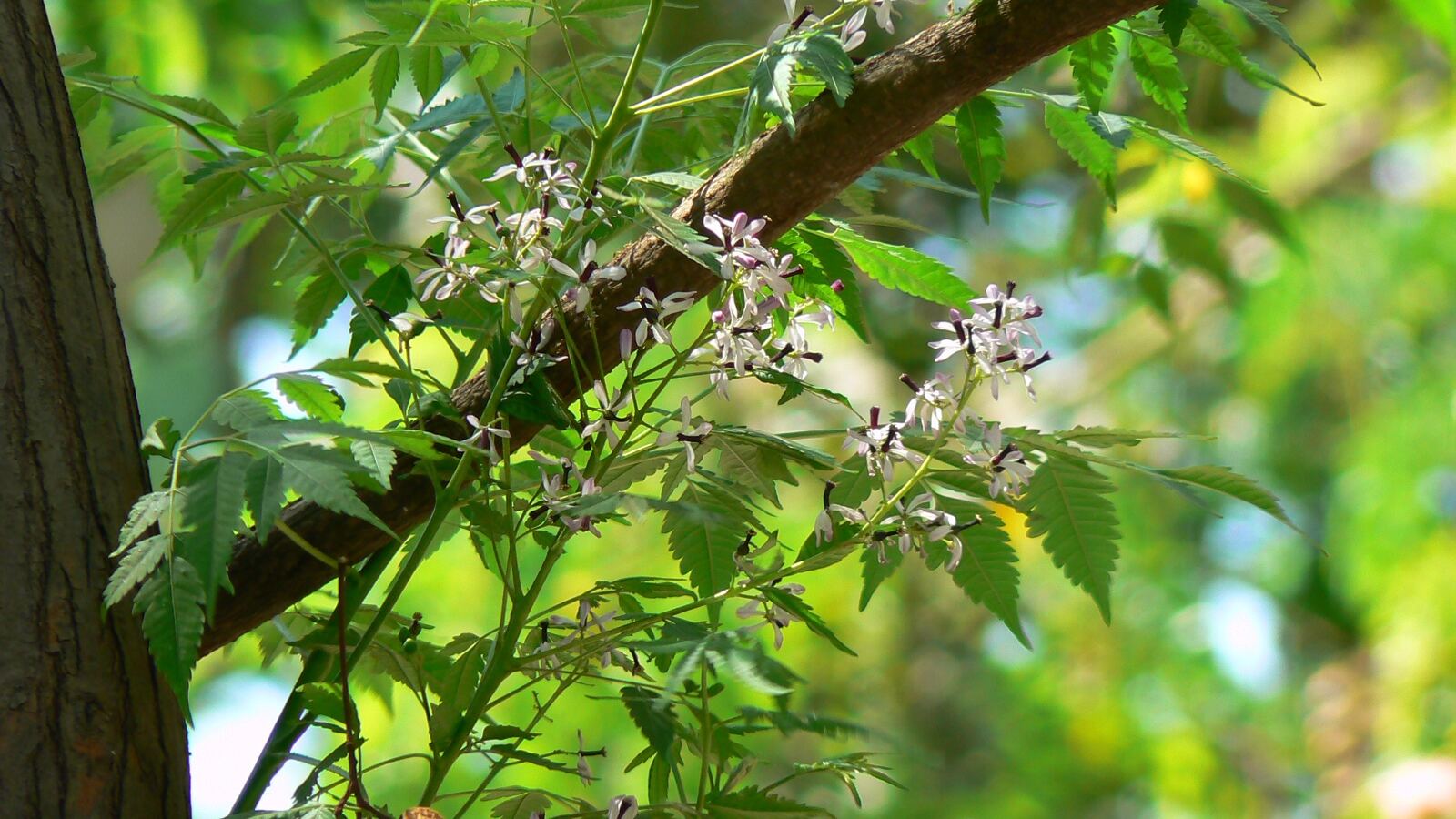
What it is
Melia azedarach, the chinaberry, bead tree, or Persian lilac — a fast-growing deciduous tree of southern Asia and Australia, now planted and naturalised across the warm-temperate and subtropical world.
It belongs to the mahogany family, Meliaceae, which makes it a close relative of the neem and the true mahogany — a kinship that shows in its insecticidal chemistry and its fine timber. For a time it was among the most-planted ornamental and shade trees of the American South, the Mediterranean, and other warm regions, valued for its fast growth, fragrant flowers, and dense shade — before its darker sides became clear.
Flowers, beads, and poison
The chinaberry has genuine charms. In spring it produces abundant clusters of small, fragrant, lilac-purple flowers (hence "Persian lilac," though it is no relation of the true lilac), followed by masses of hard, round, pale-yellow berries that hang on through winter after the leaves fall.
Those berries give the tree its other old name, bead tree. The hard stones, with a natural hole through them, were strung for centuries into rosaries, necklaces, and prayer beads — the name azedarach traces to a Persian word, and the beads were a real article of trade and devotion. But the berries carry a warning: they are poisonous to people and to some animals (containing meliatoxins), and children have been poisoned by eating them, though birds eat them freely and — as usual — spread the seed far and wide. The foliage and bark are toxic too.
Neem's cousin: a natural insecticide
Like its relative neem, the chinaberry is rich in insecticidal compounds (limonoids related to neem's azadirachtin), and it has been used in the same ways: chinaberry leaves are laid among stored grain and clothes to repel insects, and extracts of its leaves and fruit have a long folk and research history as a botanical insecticide and pest repellent. It shares neem's reputation as a "pesticide tree," and this — along with its fast growth and toughness — is part of why it was spread so widely. The wood, too, is good: a fine-grained, attractive, workable timber used for furniture and turnery, a modest echo of its mahogany relatives.
The invasive problem
The chinaberry's speed, toughness, heavy bird-sown seeding, and ability to resprout have made it, in country after country, a serious invasive species.
Across the southern United States, southern Europe, Australia, southern Africa, and elsewhere, chinaberry has escaped from gardens and old homesteads to invade roadsides, riverbanks, field edges, and disturbed woodland, forming dense thickets that shade out native plants, and its poisonous berries and allelopathic leaf litter discourage competitors. It is the familiar story of a fast, tough, pretty, bird-dispersed ornamental turning into a weed tree — the same pattern as the tree of heaven, cherry laurel, and so many others — and it is now discouraged or listed as a weed in many of the places that once planted it as a favourite shade tree. Check local status before planting; in much of its introduced range the responsible choice is not to.
Growing it
Warm-temperate to subtropical, hardier than most of its tropical relatives (it takes moderate frost, dying back and reshooting at the cold edge), and extremely tough — tolerant of drought, heat, poor soil, salt, and urban conditions, which is exactly why it succeeded as a street tree and then as an invader.
It is very fast-growing, short-to-medium-lived, and grows with almost no care from seed (spread by birds) and from suckers and cuttings, resprouting readily when cut — qualities that make it both easy and hard to be rid of. Where it is not invasive it gives quick shade, fragrant flowers, and useful insect-repellent leaves and timber; where it is, it is best avoided in favour of a well-behaved alternative. See propagation and organic sprays.
See also
- Neem its close relative and fellow "pesticide tree"
- Mahogany the family's great timber
- Invasive Species chinaberry as a weed tree abroad
- Tree of Heaven another fast, tough, bird-sown invader
- Organic Sprays botanical insecticides from neem and chinaberry
- Bay and Laurels the cherry laurel, another ornamental-turned-invader
- Soap Nut
- Amur Cork Tree
- Chinese Parasol Tree
- Toon