What it is
Sciadopitys verticillata, the Japanese umbrella pine or koyamaki — an evergreen conifer of Japan that is one of the most extraordinary and ancient of all living trees, not for its size or age but for its sheer isolation in the tree of life.
It is not a true pine. In fact it is not closely related to any other living tree: it is the sole surviving species of its entire family (Sciadopityaceae) and genus — a lineage that stands completely alone, with no close relatives left on Earth. It is one of the great living fossils, in the company of the ginkgo, the wollemi pine, and the cycads.
The spokes of the umbrella
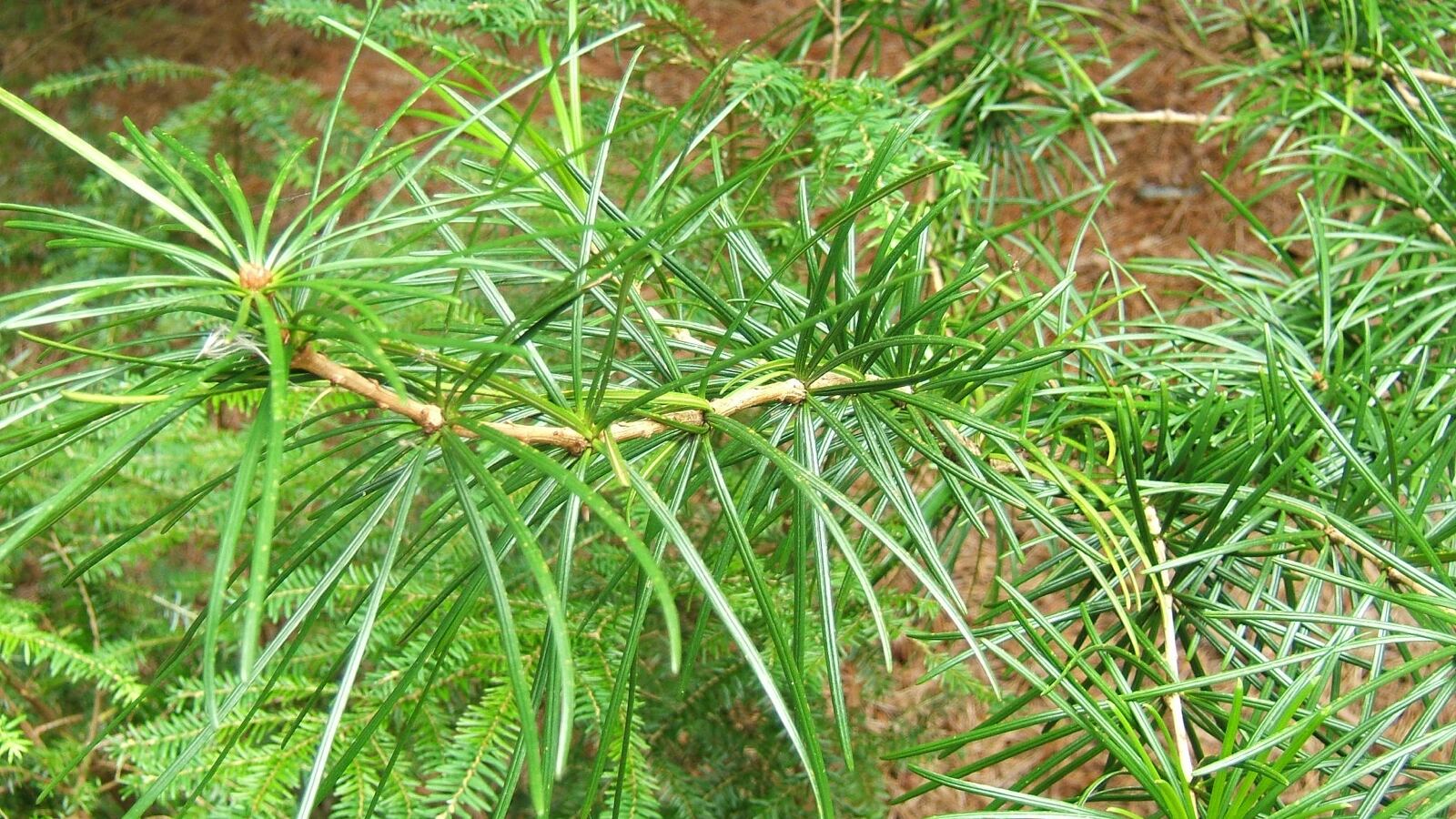
The umbrella pine's name comes from its unmistakable foliage. What look like long, glossy, dark-green needles are arranged in whorls radiating out from the tips of the shoots, exactly like the ribs or spokes of an umbrella — a dense rosette of green spokes at the end of each branch.
Stranger still, those "needles" are not ordinary leaves at all: they are cladodes — flattened, leaf-like shoots fused from pairs of highly-reduced leaves — a peculiar and primitive arrangement found in almost no other tree. The whole plant has an odd, dense, glossy, sculptural quality, growing slowly into a neat, columnar-to-conical tree, and it is this combination of strangeness and beauty that makes it a prized (if slow and expensive) ornamental and bonsai subject.
A relic of deep time
The umbrella pine's lineage is astonishingly old. Its family flourished across the northern hemisphere in the age of the dinosaurs, some 230 million years ago, and was once widespread and diverse — and then it dwindled, family and genus contracting over the eons until only this single species remained, hanging on in the mountains of Japan. Every umbrella pine alive is the last twig of a once-great branch of the conifer tree.
Fossil evidence even connects it to one of the natural world's treasures: much of the amber of certain deposits — fossilised tree resin, sometimes preserving ancient insects — is thought to have come from Sciadopitys or its close relatives, so this obscure Japanese tree may be the source of some of the world's most famous amber. See historical ecology and seed banking.
Sacred in Japan
Like the sugi, the umbrella pine (koyamaki) is revered in Japan. It is counted among the five sacred trees of Kiso, it is planted at temples and shrines, and its foliage has been used in religious offerings and, historically, its wood — rot-resistant and water-resistant — for boats, buckets, and coffins. It is the heraldic tree of a Japanese imperial prince. Its cultural standing, as with so many trees in this encyclopedia, has helped keep it valued and protected.
Growing it
The umbrella pine wants a cool, moist, humid climate and deep, moist, well-drained, acidic soil in full sun to light shade — the oceanic mountain conditions of Japan — and it dislikes drought, heat, alkaline soil, and pollution.
It is famously, almost frustratingly, slow-growing — a few centimetres a year when young — which, with its distinctiveness, makes it an expensive and treasured specimen conifer for the patient gardener, building over decades into a dense, glossy, columnar tree. It is hardy to considerable cold once established. Grown from seed (slow to germinate) and, with difficulty, from cuttings. To grow an umbrella pine is to keep a living relic of the age before the flowering plants. See propagation.
See also
- Ginkgo another living fossil that stands nearly alone
- Wollemi Pine and Cycads more relics of deep time
- Cryptomeria the fellow sacred Japanese conifer
- Monkey Puzzle another ancient, distinctive conifer
- Conifers the wider group
- Historical Ecology the umbrella pine as an amber source and living fossil