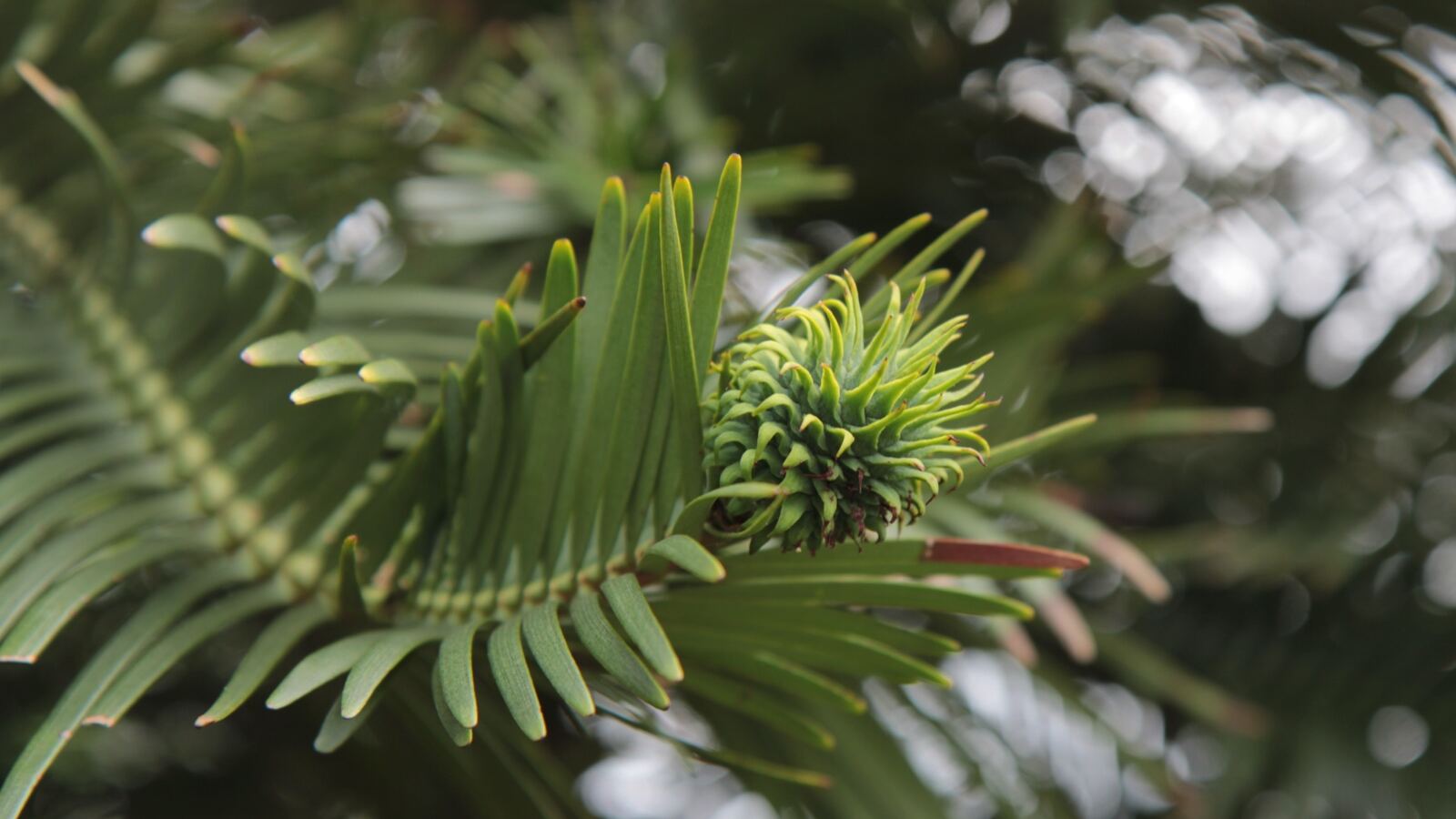
What it is
Wollemia nobilis, the Wollemi pine, a coniferous tree of the ancient family Araucariaceae — the same Gondwanan lineage as the monkey puzzle and the kauri — and one of the greatest botanical discoveries of the twentieth century.
It is not a true pine. Its nearest relatives are those Araucariaceae, and its lineage was known only from fossils dating back to the age of the dinosaurs, with the most recent fossils around two million years old. On the evidence, the tree was assumed to have been extinct for ages — a name for an imprint in stone, not a living plant.
Found alive in 1994
Then, in 1994, a park ranger and bushwalker named David Noble, exploring a deep, narrow, rainforest-filled canyon in the Wollemi wilderness less than 150 km from Sydney, abseiled into a gorge and noticed a stand of unfamiliar trees with odd, fern-like foliage and strange bubbly bark. Specimens were taken out, and botanists realised, astonished, that this was the "extinct" Wollemia — a living member of a lineage known only from fossils, hidden in a slot canyon on the edge of Australia's largest city.
The discovery was a global sensation, ranked with finding a live dinosaur, and it is the most famous of the handful of cases — with the dawn redwood and the ginkgo — where a tree presumed lost to deep time turned up alive. It was a powerful reminder of how much the natural world can still conceal, and of how a whole ancient lineage can hang on, unnoticed, in one tiny refuge.
Down to a hundred trees
The wonder came with alarm: the entire wild population is fewer than about a hundred adult trees, in a handful of small groves in that one canyon system. It is one of the rarest trees on Earth.
Such a tiny, single-site population is desperately vulnerable — to fire, to disease, and to people. The exact location is kept secret to protect it, and access is strictly forbidden, because the greatest fear is that a visitor will carry in Phytophthora root-rot spores on muddy boots, exactly the soil-borne threat now killing the related kauri; Phytophthora has indeed been detected at the site and is a live danger. In the catastrophic Australian bushfires of 2019–2020, firefighters mounted a covert, specially-targeted operation to protect the secret grove from the flames — an extraordinary effort for a single stand of trees, and a measure of what the species means. See fire management.
Insurance by propagation
The response to the Wollemi pine's rarity became a model of conservation thinking: rather than lock it away entirely, propagate it everywhere.
The tree proved surprisingly easy to grow from cuttings and seed, and a deliberate programme put commercially propagated Wollemi pines into botanic gardens, collections, and private gardens around the world. The logic is a kind of insurance: by spreading the species widely in cultivation, its survival no longer depends on the fate of one canyon, and the pressure to poach wild plants is removed because anyone can buy a legal, nursery-grown tree. Every cultivated Wollemi pine is part of a living seed bank for the species. It is the same conservation-by-cultivation strategy that saved the ginkgo and the dawn redwood, applied deliberately and fast. See reforestation techniques.
Interestingly, despite the wild population's tiny size, the trees are genetically almost uniform — nearly clones — probably the result of surviving through repeated bottlenecks over millions of years, which is itself a subject of study in what makes a minimum viable population.
Growing it
Hardier than expected for a relict rainforest tree — it tolerates a range from light frost to heat, and is grown outdoors in mild-temperate as well as warm climates — though it wants sheltered, moist, well-drained, humid conditions to do best, and resents waterlogging (and the Phytophthora it invites).
It is an easy, curious, and beautiful garden conifer, with drooping, fern-like, two-ranked foliage, unusual knobbly "bubbly" bark, and the habit of multiple trunks (coppicing) from the base. Growing one is a small act of conservation. Propagated from cuttings and seed; buy nursery-grown stock. See propagation.
See also
- Monkey Puzzle the Araucariaceae relative from South America
- Kauri the giant cousin, facing the same Phytophthora threat
- Ginkgo another living fossil saved by cultivation
- Swamp Cypress and Dawn Redwood the dawn redwood's parallel rediscovery
- Seed Banking conservation by spreading a rare tree widely
- Minimum Viable Populations the genetics of a tiny population
- Franklinia
- Umbrella Pine