What they are
Two members of Araucaria — the ancient southern-hemisphere conifer genus of the monkey puzzle, and part of the same Gondwanan family, Araucariaceae, as the kauri and wollemi pine:
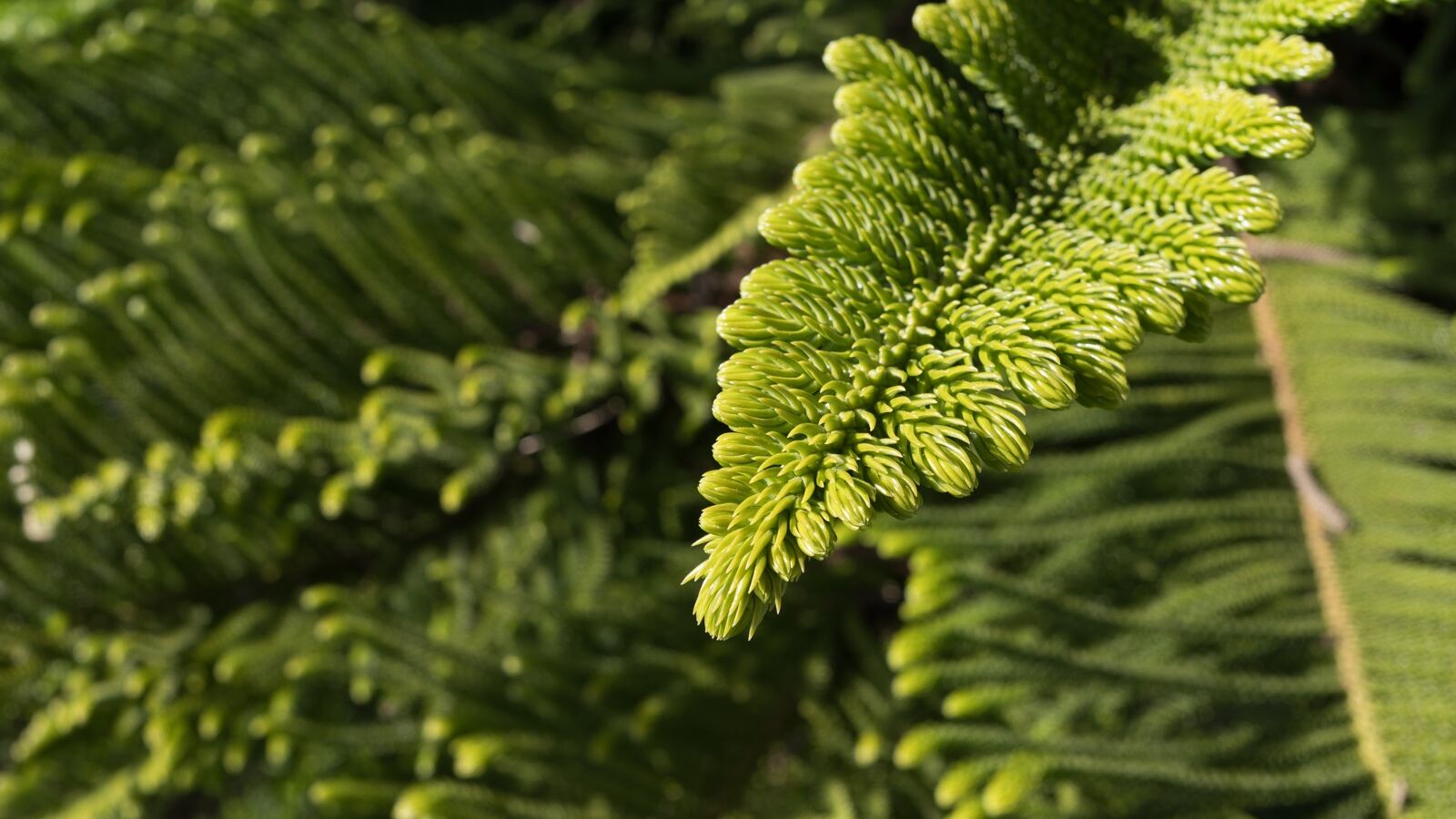
Norfolk Island pine (Araucaria heterophylla) — from tiny Norfolk Island in the South Pacific, famous for its almost unnaturally perfect symmetry;
Bunya pine (Araucaria bidwillii) — a giant of southeastern Queensland, famous for its enormous edible-nutted cones and the great Aboriginal gatherings they fed.
Like all the araucarias, they are relics of the age of the dinosaurs, when this family dominated the southern forests, and they carry the same stiff, symmetrical, prehistoric look.
The Norfolk Island pine: living-room symmetry
The Norfolk Island pine is one of the most symmetrical of all trees: it grows in near-perfect, evenly-spaced, horizontal tiers of branches around a dead-straight trunk, each whorl a neat ring, building a geometric, layered, almost artificial-looking green pyramid.
That striking symmetry, plus its tolerance of poor light and neglect, made it one of the world's most popular houseplants and living "Christmas trees" — the potted Norfolk Island pine on windowsills far from any tropics is a familiar sight, kept small indoors for years. Outdoors, in frost-free coastal climates, it becomes a huge landmark tree, and — being extremely salt- and wind-tolerant — it is planted along seafronts and promenades throughout the warm coastal world, where its dark tiered spires line the beaches. When Captain Cook found the island's tall straight trees he hoped they would make ships' masts and spars, though the timber proved less suitable than hoped. See coastal dunes.
The bunya pine: the feasting tree
The bunya pine is a very different araucaria — a massive, dark, domed forest tree bearing some of the largest cones of any conifer: enormous, football-sized cones weighing up to 10 kg, packed with large, edible, chestnut-like nuts.
Those nuts made the bunya one of the most culturally important trees of Aboriginal Australia. Every few years the bunya trees produce a great mast crop of nut-laden cones, and this triggered the famous bunya gatherings (or bunya feasts): Aboriginal groups travelled great distances, sometimes hundreds of kilometres, to congregate in the bunya forests of the Bunya Mountains, feasting on the nutritious nuts, trading, settling disputes, holding ceremonies, and renewing alliances — great intertribal assemblies timed to the tree's cropping, and among the most significant social events of the region. Custodianship of particular bunya trees was inherited. The nuts are genuinely good — eaten roasted, boiled, or ground — and bunya nuts are now enjoying a small revival as a native bush food. (A word of caution the gatherers knew well: the giant cones fall without warning and are heavy enough to kill, so the trees are treated with respect and given a wide berth in season.) See nut pines for the parallel of pines grown for edible seed, and historical ecology.
Growing them
Both are tender to hard frost and want mild, frost-free or nearly-frost-free climates and well-drained soil in full sun. The Norfolk Island pine is strictly frost-tender (hence its life as a houseplant in cold regions), superbly salt- and wind-tolerant, and easy, slow, and long-lived; the bunya pine is a little hardier and becomes a very large, long-lived forest tree needing plenty of space (and siting away from where its cones can fall on people).
Both are grown from seed — the bunya from its large nuts (which must be sown fresh) — and both make magnificent, prehistoric-looking specimen trees where the climate and space allow, as well as, in the Norfolk pine's case, one of the world's favourite potted conifers. See propagation.
See also
- Monkey Puzzle the fellow Araucaria, with its own edible nuts
- Kauri and Wollemi Pine the other Araucariaceae relicts
- Nut Pines the parallel of conifers grown for edible seed
- Conifers the wider group
- Historical Ecology the bunya feasts of Aboriginal Australia
- Coastal Dunes the Norfolk pine as a salt-proof coastal tree