What they are
The ipês and trumpet trees — Handroanthus and Tabebuia — are trees of tropical and subtropical Latin America in the trumpet-vine family, Bignoniaceae, the same family as the catalpa, jacaranda, and sausage tree.
They lead double lives: they are among the most spectacular flowering trees in the world, and they yield one of the hardest, heaviest, most durable timbers in commercial use. Few trees combine such beauty and such iron.
A city turned to colour
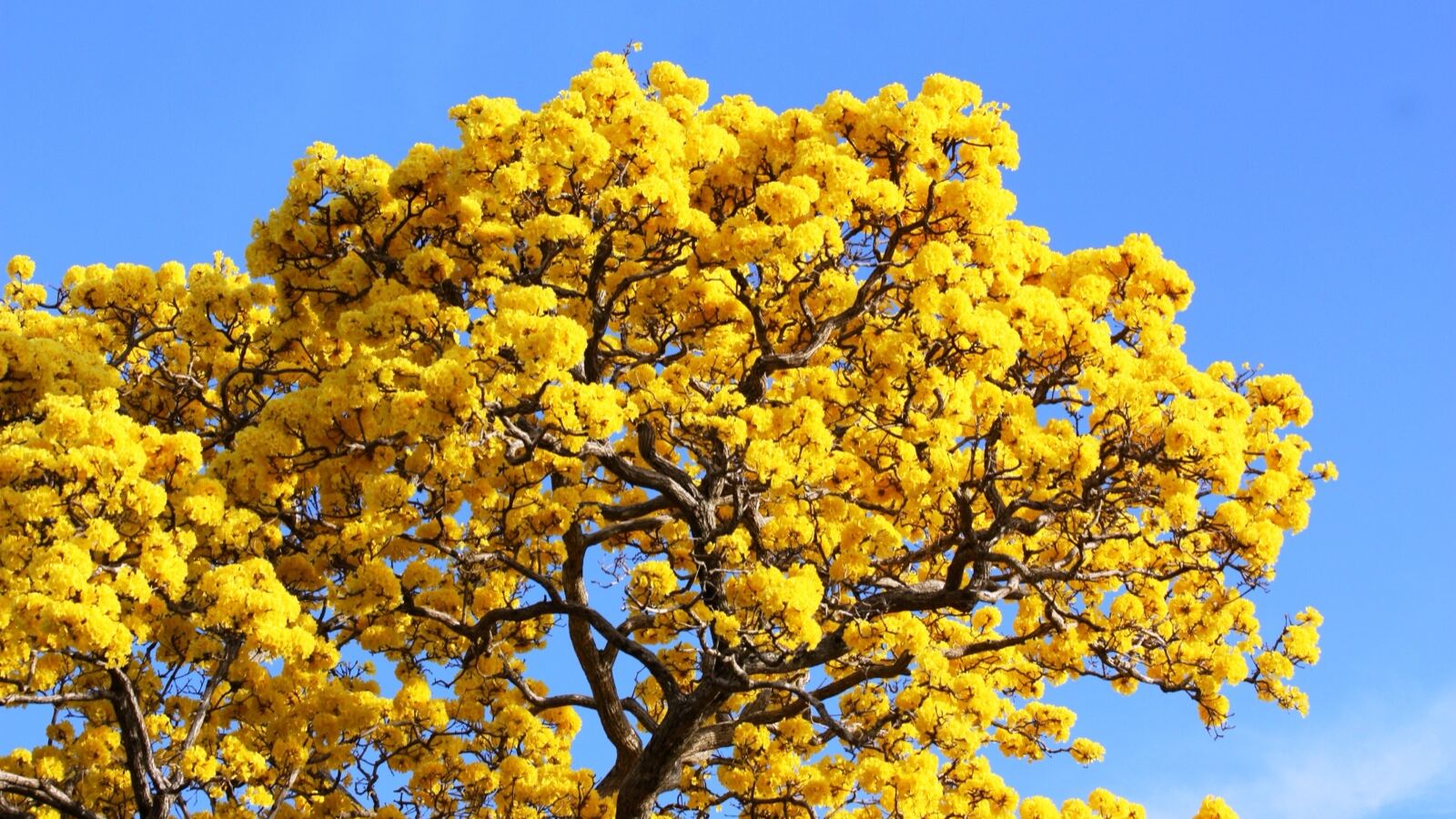
The ipês' flowering is legendary. In the dry season, an ipê drops all its leaves and then bursts into flower on the bare branches, covering itself completely in a solid mass of trumpet-shaped blooms — brilliant golden yellow (the yellow ipê is a national symbol of Brazil), or shocking pink, purple, or white in other species — so that a flowering ipê is a single pure blaze of colour with not a leaf in sight.
When avenues and whole city districts are planted with them, as in many Brazilian and Latin American cities, the synchronized flowering turns entire streetscapes gold or pink for a few glorious weeks — one of the great floral spectacles of the Americas, rivalling the jacaranda cities. The flowers are rich in nectar and heavily worked by bees and hummingbirds, making the ipês valuable pollinator trees as well as ornamental ones, and they are widely planted as street and park trees for exactly this. See urban forestry.
Wood like iron
The same trees produce ipê wood (also sold as Brazilian walnut, lapacho, or by the trade name for the timber), which is at the opposite extreme of tree products from the delicate flowers.
Ipê is one of the densest and hardest commercial timbers — dense enough to sink in water, extraordinarily strong, and so naturally resistant to rot, insects, and decay that it lasts decades outdoors with no treatment. It even carries a Class A fire rating, the same as concrete and steel. This has made ipê the premium wood for outdoor decking, boardwalks, piers, and cladding — the famous boardwalks of Coney Island and Atlantic City were ipê, and it is the luxury decking timber of choice worldwide, prized for lasting a generation or more where ordinary wood rots in a few years. It sits among the elite ultra-hard timbers with lignum vitae and ebony.
That value has a dark side. Ipê grows scattered through the Amazon and other forests, not in stands, so — exactly like mahogany — harvesting it means cutting roads deep into intact rainforest to reach individual trees, and the booming demand for ipê decking has driven illegal and unsustainable logging across the Amazon, with much ipê on the market of questionable or illegal origin. Several species are now of conservation concern and are moving onto CITES protection. The responsible buyer seeks certified, legal, sustainably-sourced ipê or, better, uses an alternative decking material. See restoration economics and reforestation techniques.
Pau d'arco: the bark tea
The trees have a third life in medicine. The inner bark of the pink ipê, known as pau d'arco or lapacho, has a long history in South American traditional medicine, brewed into a tea and taken for a wide range of complaints, and it is sold worldwide as a herbal supplement.
Its active compounds (lapachol and related naphthoquinones) have genuine biological activity and have been studied for anti-inflammatory, antimicrobial, and anti-cancer effects — though, as with soursop and many such remedies, the popular health claims run well ahead of the clinical evidence, and high doses have real toxicity. It is another case of a tree whose bark chemistry has drawn both folk use and serious research, in the tradition of the quinine tree and willow.
Growing them
Tropical to warm-subtropical and frost-tender (some of the pink trumpet trees take light frost and are grown in the warm subtropics), wanting full sun and well-drained soil; they are drought-tolerant once established — indeed the dry season is what triggers their flowering — which makes them tough, low-water street and garden trees where the climate allows.
They are slow-to-moderate growing, and the timber species are very slow to reach a usable size, which is central to their over-harvesting problem. Grown from seed (which, like their dipterocarp neighbours in the wet tropics, is often short-lived) and cuttings. As ornamentals they are among the finest flowering trees for a frost-free climate; as timber they are a resource to buy only with care for its origin. See propagation.
See also
- Jacaranda and Flame Tree the other great flowering trees that colour Latin cities
- Catalpa and Sausage Tree the trumpet-family relatives
- Mahogany the same scattered-tree, road-into-forest logging problem
- Lignum Vitae another sink-in-water, ultra-hard timber
- Quinine Tree another tree whose bark became a medicine
- Restoration Economics the value driving ipê logging
- African Tulip Tree
- Greenheart and Purpleheart
- Quebracho