What it is
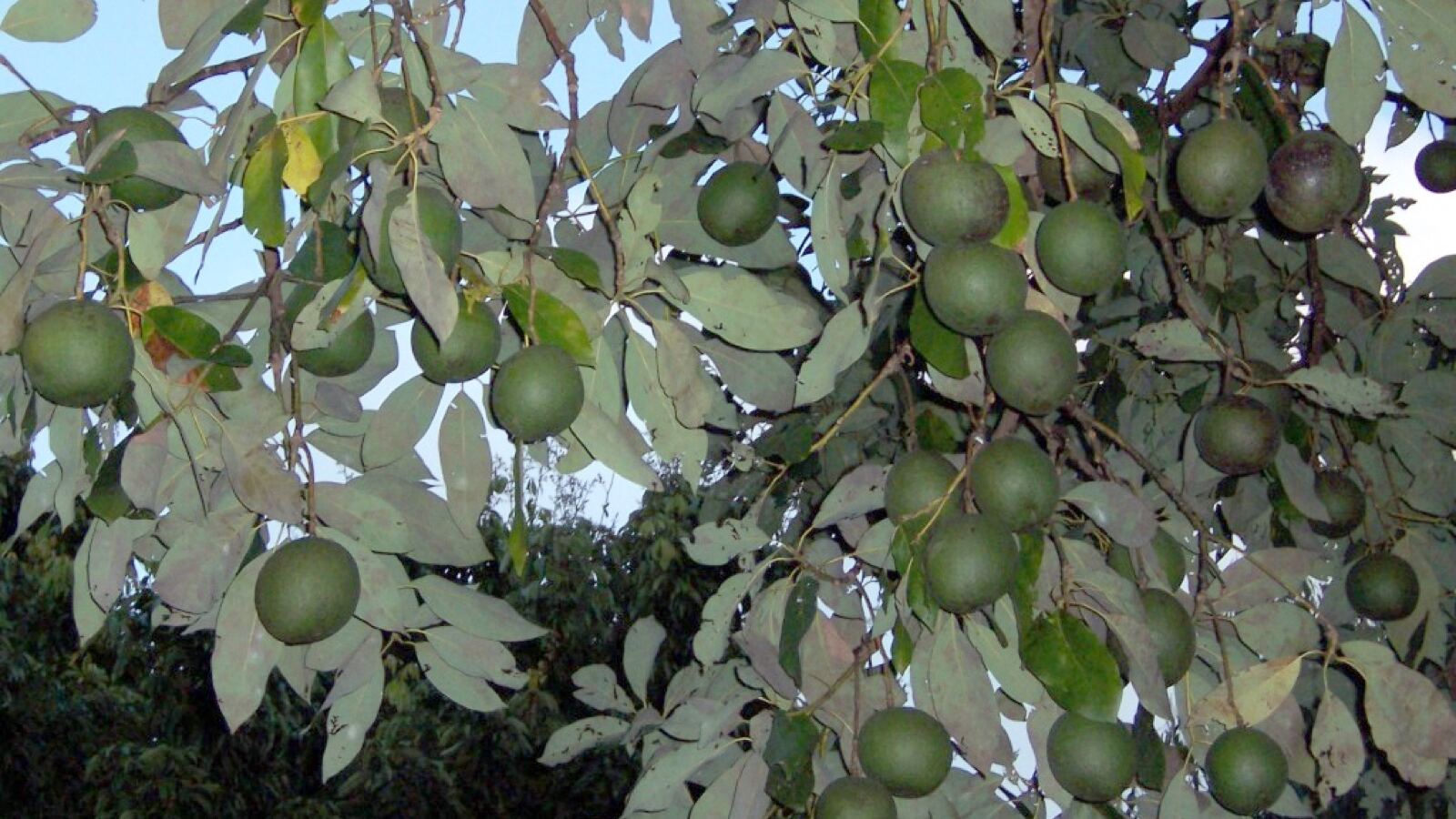
Persea americana, the avocado, an evergreen tree of Mexican and Central American origin, domesticated there thousands of years ago and now a major world fruit crop.
It belongs to the laurel family, Lauraceae — the same family as the bay, cinnamon, and camphor — and like them the leaves are aromatic when crushed. The fruit is a single-seeded berry, botanically, unusual for its very high fat content: where most fruits store energy as sugar, the avocado stores it as oil, up to a third of the flesh by weight, which is why it is rich and buttery rather than sweet. The old name "alligator pear" describes the rough dark skin of some kinds.
The megafauna ghost
The avocado is one of the most-cited examples of an evolutionary anachronism — a fruit apparently adapted to disperser that no longer exists.
The reasoning is straightforward: the fruit is large and the single seed is enormous, far too big for any bird or small mammal to swallow and carry off. A fruit invests in a big seed and sweet or fatty flesh in order to be eaten whole by a large animal that then deposits the seed at a distance. In the avocado's case the animals it was built for — the giant ground sloths, gomphotheres, and other megafauna of Central American — went extinct around 13,000 years ago, and the wild avocado was left with fruit no living native animal can properly disperse. It survives today largely because humans took over the job, exactly the argument made for the osage orange, honey locust, and pawpaw. Without cultivation the wild avocado would be a far rarer tree.
The strange flowering
Avocado has one of the odder pollination systems of any crop, called synchronous dichogamy.
Each flower opens twice, and functions as female on the first opening and male on the second — but the timing is arranged so that a tree's flowers are never female and male at the same moment, which prevents self-pollination. Varieties fall into two types, A and B, which run the female and male phases on opposite morning/afternoon schedules. In principle you need an A-type and a B-type flowering together for good cross-pollination, and orchards are often interplanted accordingly, though in practice a single variety usually sets some fruit. It is a beautiful natural mechanism for forcing outcrossing, and a genuine practical consideration for the grower.
One clone, most of the crop
Nearly all the avocados in world trade are a single variety — Hass — and every Hass avocado tree descends by grafting from one seedling grown by a postman, Rudolph Hass, in California in the 1920s. That original tree stood until 2002.
This is a striking case of the clonal narrowness common in fruit crops: like the Cavendish banana or a grafted apple variety, the world's Hass avocados are genetically one individual, endlessly copied, with all the vulnerability to pest and disease that a monoculture implies. Seedling avocados do not come true, so all named varieties are grafted onto seedling rootstocks.
The water controversy
Avocado's popularity has made its thirst a live issue.
The trees are shallow-rooted, sensitive to drought, and need a lot of water — and much of the crop is grown in dry regions (central Mexico, Chile, southern Spain, California) where that water is scarce and contested. Avocado expansion has been linked to aquifer depletion, illegal water extraction, deforestation, and cartel involvement in parts of Mexico, making it one of the fruits whose environmental and social footprint is most debated. It is a case where the irrigation demand of a booming export crop collides with local water security. The trees are also acutely sensitive to root rot (Phytophthora cinnamomi), the major disease of the crop, worsened by the overwatering the shallow roots tempt. See tree diseases.
Growing it
Warm subtropical to tropical; most types are frost-tender, though some Mexican-race varieties tolerate light frost, which sets the crop's cool limit.
Soil and water. Deep, very well-drained soil is essential — avocado will not tolerate waterlogging, and root rot follows wet heavy ground. It needs steady moisture but hates wet feet, a narrow window that makes drainage the first priority. Mulch heavily; the shallow feeder roots want a cool, moist, organic surface. See mulch for moisture.
Propagation. Grafted named varieties on seedling rootstock; the stone sprouts readily (the classic windowsill experiment) but the seedling is variable and slow to fruit. See grafting and propagation.
A home tree is rewarding in a frost-free garden — evergreen, handsome, and productive — and a good component of a tropical or subtropical food forest where water allows.
See also
- Tropical Fruit Trees avocado in the wider warm-climate orchard
- Osage Orange another fruit built for vanished megafauna
- Honey Locust the same anachronism argument
- Banana and Plantain another crop reduced to a single clone
- Grafting how avocado varieties are propagated
- Irrigation Scheduling the water demand behind the controversy
- Bay and Laurels
- Greenheart and Purpleheart