What it is
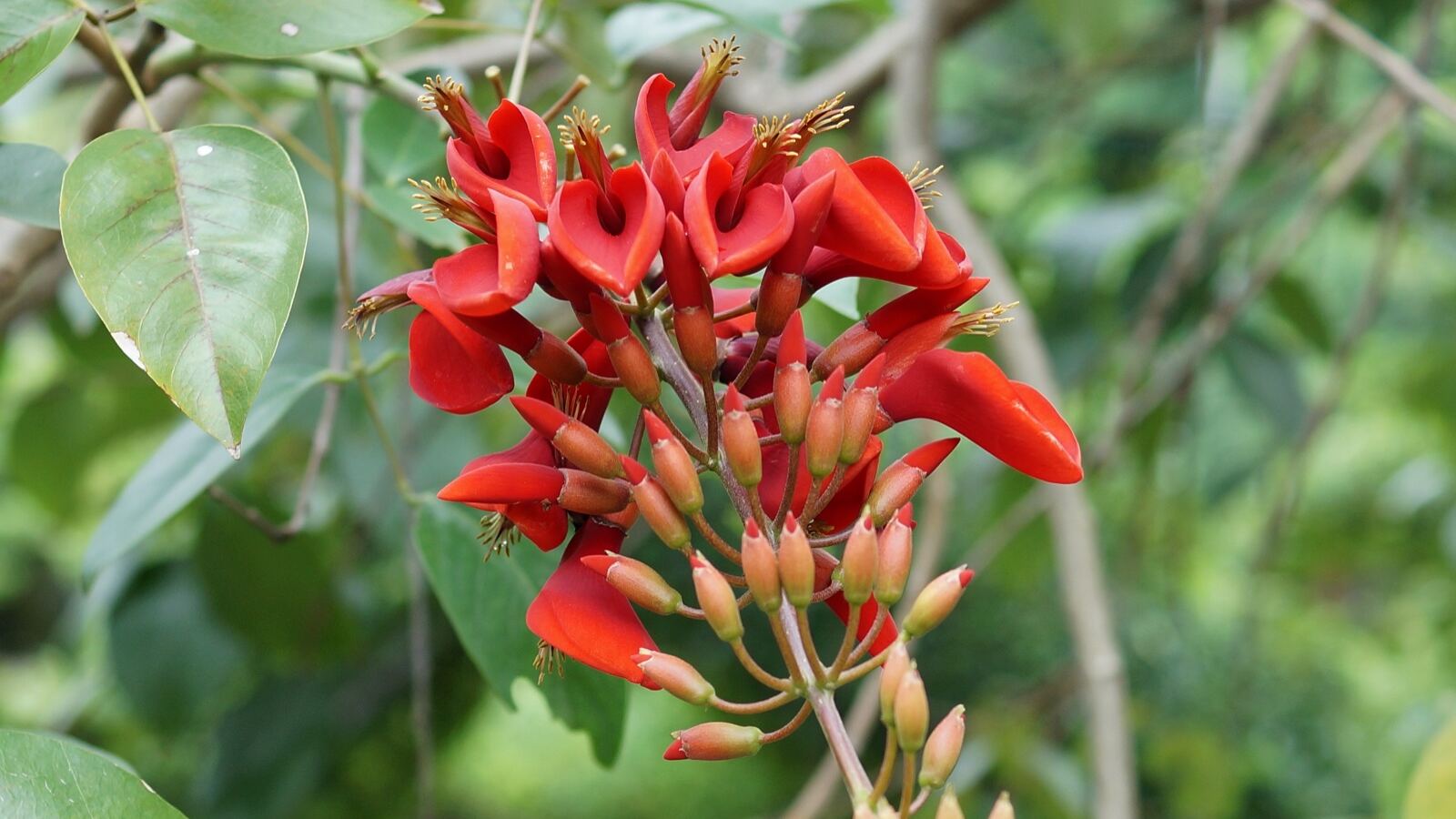
Erythrina, the coral trees — a pantropical genus of some 130 species of thorny, fast-growing leguminous trees and shrubs, named for the brilliant coral-red flowers most of them carry. The name comes from the Greek for red, and the scarlet blooms and bright red seeds run through the genus.
Coral trees are grown across the warm world for their spectacular flowering, for shade, and for a set of practical agroforestry virtues, and several are national or civic emblems — Erythrina is the national tree of several countries and the floral emblem of Argentina and Uruguay (the ceibo).
Flowers for birds
The coral tree's flowering is its glory: dense spikes of narrow, waxy, brilliant red (sometimes orange or cream) flowers, very often carried on the bare branches before the leaves appear, so the whole tree becomes a torch of scarlet against the sky in the dry season.
These flowers are built for bird pollination. Rich in nectar, sturdy enough to perch on, and coloured the red that birds see well and many insects do not, they are worked by sunbirds in the Old World and hummingbirds and orioles in the New — the same bird-nectar strategy as the banksias and many eucalypts. In the tropical dry season, when the tree flowers leafless, a coral tree in bloom is a major nectar source and a magnet for birds, which makes it a valuable pollinator and wildlife tree as well as an ornamental. The trees also produce the bright red-and-black "lucky seeds" used as beads — which, importantly, are poisonous, containing alkaloids, and should never be eaten, a hazard shared with several ornamental legumes like laburnum.
The instant living fence
Coral tree's most useful trick in tropical farming is the ease with which it grows from a cut stake — and this makes it, with gliricidia, one of the classic living fence trees.
Cut a thick branch, push it into the ground, and it roots and grows into a tree. Rows of such stakes, strung with wire, become a living fence post that never rots, keeps growing, and can be cut back hard year after year. The same quality lets coral trees be pollarded repeatedly for fodder, green manure, and chop-and-drop mulch, and used as living shade and support trees — coral tree is a traditional shade for coffee and cacao and a living trellis for vanilla, pepper, and yams. Underlying all of this is that Erythrina, as a legume, is a nitrogen fixer: it enriches the soil around it, so a coral tree fence or shade tree feeds the crop it shelters, exactly the multi-purpose fertility role that makes leguminous trees the backbone of tropical alley cropping and agroforestry. See silvopasture.
Growing it
Tropical to warm-subtropical and frost-tender, though some species (the cockspur coral tree, E. crista-galli) take a few degrees of frost and are grown in warm-temperate gardens, dying back and reshooting.
Site. Full sun; well-drained soil, tolerant of poor and sandy ground and of drought once established, which suits its dry-season flowering. Fast-growing but with soft, brittle, weak wood, so old coral trees shed limbs and are relatively short-lived — plant away from targets, and expect to prune.
Propagation. Extremely easy — from seed (scarified) and, above all, from large cuttings and stakes, which is what makes the living fence possible. Cut back hard as needed; it resprouts vigorously. See propagation and pruning basics.
Cautions. A few species have naturalised and become weedy outside their range, so check local status; and a sap-sucking gall wasp (the Erythrina gall wasp) has spread through the Pacific and beyond, disfiguring and killing coral trees, one to watch for. See invasive species and tree diseases.
The coral tree is a fine multi-purpose tropical tree — a blaze of bird-flowers, an instant fence, a nitrogen-fixing shade and fodder tree — and one of the plants that makes leguminous agroforestry so productive.
See also
- Leucaena and Gliricidia the other great living-fence, fodder legumes
- Nitrogen Fixers the fixing role behind coral tree's uses
- Nitrogen-Fixing Food Trees coral tree in multi-purpose agroforestry
- Pollinator Habitat the bird-nectar flowers
- Chop-and-Drop pollarding coral tree for mulch and green manure
- Laburnum another pea-flowered legume with poisonous seeds
- Inga
- Flame of the Forest
- American Buckeyes
- Bombax